In the dynamic world of global finance, where even decentralized digital assets like cryptocurrencies are indirectly influenced by macroeconomic shifts and geopolitical maneuvers, a monumental development has emerged from the traditional financial sphere. The recently finalized US-Japan trade deal, a landmark agreement, has captured headlines not just for its tariff implications but for an astonishing $550 billion investment pledge. While not directly tied to crypto, understanding such large-scale capital flows and government influence on markets can provide crucial context for any investor navigating volatility.
Unpacking the Staggering $550B Investment Pledge
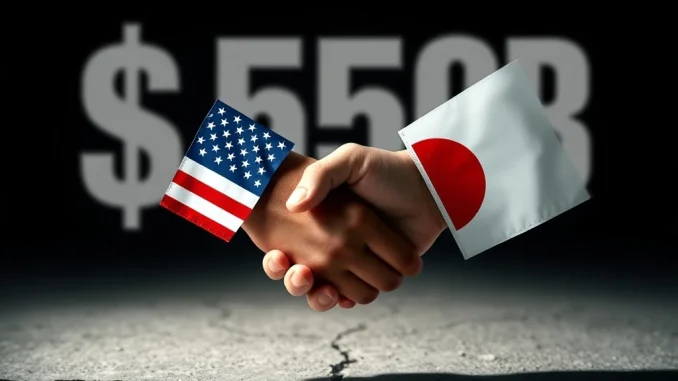
The July 2025 trade deal between the United States and Japan has set a new precedent with its ambitious financial commitment. Japan has pledged an unprecedented $550 billion investment, earmarked for critical U.S. sectors. This massive capital injection is contingent on Tokyo directing funds into:
- Energy infrastructure
- Semiconductors
- Critical minerals
- Pharmaceuticals
- Shipbuilding
What makes this pledge particularly noteworthy is the explicit statement from the White House: the investment will be directed “at President Trump’s direction.” This grants President Trump significant influence over the allocation of these funds, aiming to channel foreign capital into American industries vital for national competitiveness. The agreement also includes a reduction in U.S. tariffs on Japanese vehicles, from 25% to 15%, a key incentive for Japan’s commitment.
Why Analysts Doubt the Trade Deal Viability
Despite the grand scale of the investment pledge, skepticism abounds among analysts and industry experts regarding the deal’s long-term trade deal viability. Several factors contribute to this doubt:
- Lack of Enforceable Mechanisms: Critics argue the agreement lacks binding legal commitments, making the investment more aspirational than actionable.
- Unclear Timelines: Key details, such as specific investment timelines and governance structures, remain unresolved, adding to the uncertainty.
- Structural Uncertainties: The framework, described as a “Japanese/USA investment vehicle,” proposes a complex financing model. For instance, a hypothetical U.S. chip plant might receive financing from this vehicle, followed by favorable lease terms, with 90% of rental revenue flowing to the U.S. government. However, Japanese officials emphasize that profit-sharing should reflect “the degree of contribution and risk taken by each party,” directly contrasting the 90% U.S. retention outlined.
Brad Setser, a former U.S. Treasury official, bluntly described the $550 billion figure as “vaporware,” suggesting it’s unlikely to materialize beyond existing projects like the Alaska LNG facility.
The Nuances of Trump Control Over Investment
The concept of direct Trump control over such a substantial foreign investment raises questions about accountability and transparency. While Treasury Secretary Scott Bessent championed the fund as crucial for securing reduced tariffs, the arrangement’s non-binding nature is a significant point of contention. The stark difference in expectations regarding profit-sharing between U.S. and Japanese officials highlights the ambiguities inherent in the deal’s structure.
Furthermore, U.S. labor costs and potential trade policies under a Trump administration could deter Japanese firms from expanding investments in the country, even with the promise of funds. This adds another layer of complexity to the practical implementation of the investment pledge.
Broader Implications for Economic Policy and Future Deals
Analysts at Bank of America suggest this economic policy could serve as a model for other trade partners, especially countries with similar economic profiles to Japan, such as South Korea. These nations often share characteristics like high U.S. exports and existing non-tariff trade barriers, making them potential candidates for similar investment-for-tariff-reduction arrangements.
However, the deal’s ambiguity is compounded by ongoing legal challenges to Trump’s tariffs. A court hearing on the president’s authority under the International Emergency Economic Powers Act to impose wide-ranging duties could further complicate the deal’s implementation. Piper Sandler analysts note that this uncertain legal status may deter foreign companies from making large U.S. investments they might not otherwise pursue.
The U.S. administration’s strategy of redirecting foreign capital to American industries aligns with broader strategic goals of bolstering national competitiveness. Yet, the absence of enforceable terms and concrete metrics for measuring progress raises serious concerns about the investment’s credibility. Past U.S. trade agreements, including those with South Korea, have seen similar investment pledges fall short due to shifting economic conditions and political priorities.
As other nations contemplate similar models, the onus will be on policymakers to strike a balance between ambitious goals and practical execution. The Japan deal underscores the potential risks of relying on unverified investment commitments to offset trade imbalances, especially in an environment rife with legal and political uncertainties. While this agreement marks a significant shift in U.S.-Japan economic relations, its true success will hinge on the development of robust frameworks to ensure accountability and transparency.
Frequently Asked Questions (FAQs)
1. What is the core of the U.S.-Japan trade deal discussed?
The core of the deal is a significant $550 billion investment pledge from Japan into key U.S. sectors like energy, semiconductors, and pharmaceuticals, in exchange for reduced U.S. tariffs on Japanese vehicles. A notable aspect is the stated control President Trump would have over the allocation of these funds.
2. Why are analysts skeptical about the $550B investment pledge?
Skepticism stems from a lack of clear enforceable mechanisms, unresolved timelines, and structural uncertainties within the investment framework. Experts like Brad Setser have even called the figure “vaporware,” suggesting it might not fully materialize as promised.
3. How does the proposed profit-sharing model differ between U.S. and Japanese views?
The agreement outlines a model where 90% of rental revenue from financed projects would flow to the U.S. government. However, Japanese officials emphasize that profit-sharing should reflect “the degree of contribution and risk taken by each party,” suggesting a more equitable distribution.
4. Could this U.S.-Japan trade deal serve as a model for other countries?
Analysts at Bank of America believe this deal could indeed serve as a model for other U.S. trade partners, particularly countries like South Korea, which share similar economic profiles and trade dynamics with Japan.
5. What external factors could complicate the deal’s implementation?
Ongoing legal challenges to President Trump’s authority to impose wide-ranging tariffs under the International Emergency Economic Powers Act could significantly complicate the deal. The uncertain legal status of these tariffs may deter foreign companies from making large U.S. investments.