The ongoing political gridlock in Washington D.C. has once again captured national attention. A proposed Senate budget bill, aimed at resolving the current US government shutdown, recently failed to secure sufficient votes. This development prolongs the fiscal impasse, raising concerns across various sectors. For those invested in digital assets, this political instability often sparks questions about its potential crypto market impact. Indeed, economic uncertainty stemming from government dysfunction can significantly influence investor sentiment within the volatile cryptocurrency space.
Understanding the Political Impasse
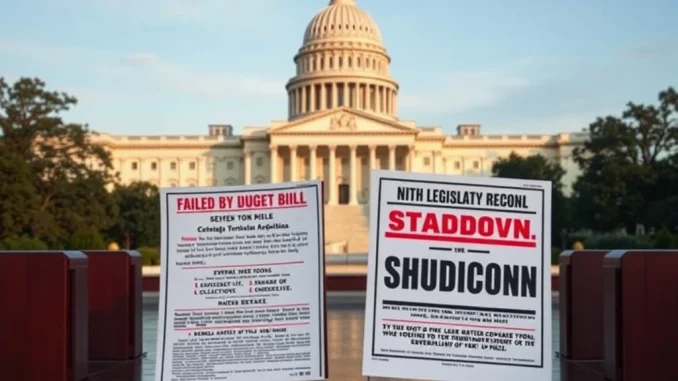
The Democratic Party introduced a budget bill designed to fund federal agencies and reopen the government. However, it required 60 votes to overcome a procedural hurdle in the Senate. Ultimately, the measure did not garner the necessary bipartisan support. This failure means that numerous federal operations remain unfunded. Consequently, hundreds of thousands of federal workers are either furloughed or working without pay. The core disagreement centers on funding for border security, a contentious issue between the two major parties. The inability to pass a basic spending bill highlights deep divisions within Congress. Such political stalemates are not new, but their duration and frequency cause significant disruption.
Economic Uncertainty and its Ripple Effects
A prolonged US government shutdown carries substantial economic costs. Analysts point to several key areas of concern:
- Reduced consumer spending: Federal employees missing paychecks directly impact local economies.
- Disrupted government services: Agencies responsible for economic data may delay crucial reports.
- Strain on businesses: Small businesses relying on federal contracts face payment delays.
This lack of timely information can obscure the true state of the economy. Businesses and investors rely on such data for informed decision-making. Moreover, small businesses depending on federal contracts might experience payment delays. This can strain their operations and cash flow. The cumulative effect of these disruptions contributes to broader economic uncertainty. Investors, both traditional and crypto-focused, closely monitor these macroeconomic indicators.
The Crypto Market Impact
The cryptocurrency market, while distinct, does not exist in a vacuum. It often reacts to broader economic and political shifts. When traditional markets experience volatility due to economic uncertainty, some investors might seek refuge in alternative assets. Cryptocurrencies, particularly Bitcoin, are sometimes viewed as a hedge against inflation or government instability. Conversely, a severe economic downturn could reduce disposable income, potentially leading to sell-offs in speculative assets like crypto. The ongoing US government shutdown introduces an element of unpredictability. This could lead to increased price volatility in digital assets. Traders and investors must therefore remain vigilant. They need to assess how prolonged political gridlock might influence market sentiment.
Regulatory Clarity Stalled Amidst Gridlock
Beyond immediate economic effects, a government shutdown also impacts the regulatory landscape for cryptocurrencies. Key agencies, like the Securities and Exchange Commission (SEC) and the Commodity Futures Trading Commission (CFTC), operate with reduced staff or even face temporary closures. This means progress on new crypto regulations or guidance can slow significantly. For an industry actively seeking regulatory clarity, this gridlock presents a notable challenge. Businesses operating in the crypto space require clear rules to innovate and grow. Delays in regulatory frameworks can hinder institutional adoption. They also create an environment of uncertainty for existing projects. Therefore, the failure of the Senate budget bill indirectly affects the future trajectory of crypto regulation.
Navigating the Uncharted Waters
A prolonged shutdown could lead to a downgrade in the US credit rating. This happened during a previous budget crisis. Such an event would have far-reaching global financial implications. It could weaken the dollar, making some investors consider non-fiat alternatives. However, the crypto market itself faces its own internal dynamics. These include technological advancements and adoption rates. The interplay between traditional political events and digital asset performance is complex. Investors often seek stability. Yet, they also look for opportunities in times of disruption. The current situation demands careful consideration of both macro and micro factors.
The failure of the Democratic Senate budget bill to end the US government shutdown marks a critical juncture. It highlights persistent political divisions. This gridlock generates significant economic uncertainty. This uncertainty inevitably casts a shadow over global financial markets, including the burgeoning cryptocurrency sector. While direct causation is hard to pinpoint, the indirect crypto market impact is undeniable. Investors and enthusiasts must monitor these developments closely. The pursuit of regulatory clarity also faces delays. As the situation evolves, adaptability and informed decision-making will remain paramount for navigating the digital asset landscape.
Frequently Asked Questions (FAQs)
Q1: What is the US government shutdown?
A1: A US government shutdown occurs when Congress fails to pass appropriation bills, or funding, for the next fiscal year or a temporary funding measure. Non-essential government functions cease, and many federal employees are furloughed.
Q2: Why did the Senate budget bill fail?
A2: The Democratic-proposed budget bill failed to secure the necessary 60 votes in the Senate. This was primarily due to disagreements over spending priorities, particularly concerning border security funding, leading to a lack of bipartisan support.
Q3: How does a government shutdown affect the broader economy?
A3: A shutdown can lead to reduced consumer spending from furloughed federal workers, delays in economic data releases, and disruptions for businesses reliant on federal contracts. These factors contribute to overall economic uncertainty and can slow economic growth.
Q4: What is the potential crypto market impact of a shutdown?
A4: A shutdown can increase economic uncertainty in traditional markets. This may cause some investors to seek alternative assets like cryptocurrencies as a hedge, or conversely, lead to increased volatility and potential sell-offs if the economic outlook darkens significantly. The direct crypto market impact is often indirect but notable.
Q5: Does a shutdown affect cryptocurrency regulation?
A5: Yes, a government shutdown can slow progress on cryptocurrency regulation. Agencies like the SEC and CFTC may operate with reduced staff, delaying new guidance or rule-making. This impedes the industry’s pursuit of regulatory clarity and can affect institutional adoption.
Q6: How can investors navigate economic uncertainty during a shutdown?
A6: Investors should monitor macroeconomic developments, diversify their portfolios, and consider the potential for increased market volatility. Staying informed about both traditional financial news and specific crypto market trends is crucial during periods of government-induced economic uncertainty.