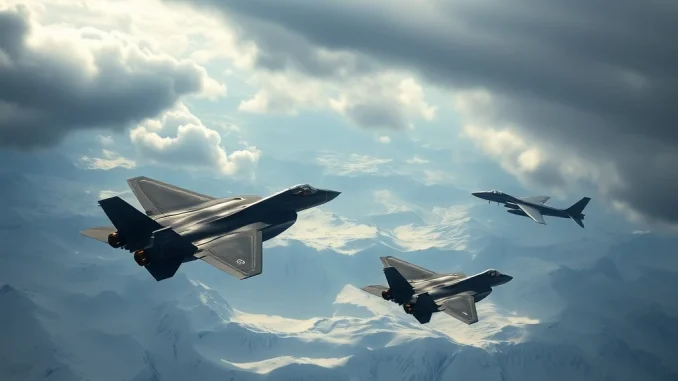
In the dynamic landscape of global affairs, even seemingly distant geopolitical events can send ripples through financial markets. Investors, including those in the volatile cryptocurrency space, often watch for signs of instability. A recent **military incident** involving a **Russian bomber** near **Alaskan airspace** serves as a stark reminder of these ongoing tensions. Such events, while not directly tied to digital assets, can influence overall market sentiment and investor confidence.
US Fighter Jets Respond to Alaskan Airspace Incursion
The United States Northern American Aerospace Defense Command (NORAD) recently confirmed a significant aerial event. They scrambled **US fighter jets** in response to a Russian aircraft. This bomber had entered the Air Defense Identification Zone (ADIZ) off the coast of Alaska. Reports indicate that multiple media outlets covered this developing story. This swift action underscores the continuous vigilance required for national security.
Specifically, two F-22 Raptor stealth fighters intercepted a pair of Russian Tu-95 Bear bombers. These events unfolded on a recent Monday. The Russian aircraft remained in international airspace. However, their proximity to **US airspace** triggered the robust response. NORAD routinely monitors foreign military aircraft operating near the US and Canadian borders. Their mission is clear: to defend North American airspace.
Understanding the Alaskan Airspace Incident and NORAD’s Role
An Air Defense Identification Zone (ADIZ) extends beyond sovereign airspace. It requires aircraft to identify themselves for national security reasons. The Russian bomber did not violate sovereign US airspace. Yet, its presence necessitated a rapid military response. NORAD officials confirmed the bombers were escorted for the duration of their flight. This demonstrates effective air defense protocols.
NORAD employs a layered defense strategy. It includes ground-based radar, satellite surveillance, and airborne interceptors. When an unidentified or potentially hostile aircraft approaches, these systems activate. Therefore, the deployment of **US fighter jets** is a standard procedure. It ensures the integrity and security of the ADIZ. This proactive approach prevents any potential threats from escalating.
A Pattern of Russian Bomber Activity Near US Airspace
This is not an isolated **military incident**. Russian long-range aviation units regularly conduct patrols in international airspace. These flights often occur near the borders of NATO allies and the United States. Historically, such maneuvers are a display of military capability. They also serve as a form of intelligence gathering.
Over the past decade, there have been numerous similar encounters. For instance, Russian bombers have flown near Alaska, the UK, and other strategic areas. Each time, NATO and allied forces respond promptly. They ensure the aircraft do not infringe on sovereign territory. These routine interceptions highlight persistent geopolitical tensions. They also demonstrate the constant need for readiness.
Geopolitical Implications of the Russian Bomber’s Presence
The presence of a **Russian bomber** near **Alaskan airspace** carries significant geopolitical weight. It occurs amidst heightened tensions between Russia and the West. The Arctic region is becoming increasingly strategic. Both the US and Russia have growing interests there. This includes resource extraction and new shipping routes.
Such flights are often seen as a projection of power. They test the response times and capabilities of opposing forces. Consequently, they contribute to a climate of cautious vigilance. While this specific event did not lead to direct conflict, it underscores ongoing competition. Global stability remains a delicate balance. Events like this remind us of that fact.
Ensuring Security and Stability: Beyond the Military Incident
The rapid deployment of **US fighter jets** is a testament to robust defense systems. It reassures allies and signals deterrence. This particular **military incident** ended without escalation. Nevertheless, it underscores the importance of continuous monitoring. Maintaining clear communication channels is also vital. This helps prevent misunderstandings in sensitive regions.
Ultimately, global stability affects all sectors, including financial markets. While cryptocurrencies operate on decentralized networks, they are not immune to macro-economic forces. Geopolitical uncertainties can lead to risk aversion. This may cause investors to move away from volatile assets. Thus, even distant aerial encounters can indirectly influence investment decisions worldwide. Vigilance is paramount, not just in the skies, but in understanding broader global impacts.
Frequently Asked Questions (FAQs)
What is an Air Defense Identification Zone (ADIZ)?
An ADIZ is an area of airspace over land or water. It extends beyond a country’s sovereign airspace. Nations require incoming aircraft to identify themselves. This ensures national security and allows for early warning of potential threats.
Did the Russian bomber violate US airspace?
No, the Russian bomber did not violate sovereign US airspace. It operated within the international ADIZ off the coast of Alaska. This area is monitored for identification purposes, but it is not sovereign territory.
Why did the US scramble fighter jets if no airspace was violated?
The US scrambled **US fighter jets** as a standard procedure. This happens when foreign military aircraft enter the ADIZ. It ensures identification and confirms no hostile intent. It also demonstrates readiness and capability to defend national interests.
How often do such military incidents occur near Alaskan airspace?
Such **military incident**s are not uncommon. Russian military aircraft regularly conduct long-range patrols. These flights often approach the ADIZ off Alaska. NORAD routinely intercepts and escorts these aircraft, documenting each event.
What type of Russian bomber was involved in this incident?
Reports confirmed that the Russian aircraft involved were Tu-95 Bear bombers. These are large, four-engine turboprop-powered strategic bombers. They have been in service since the 1950s.
How do these geopolitical events indirectly affect cryptocurrency markets?
While not directly linked, geopolitical tensions can increase global uncertainty. This often leads to risk aversion among investors. Consequently, some may withdraw from volatile assets like cryptocurrencies. They might seek safer havens, impacting overall market sentiment and prices.