In the dynamic world of finance, major geopolitical shifts often send ripples across various markets, including the often-volatile cryptocurrency space. A significant development like the newly announced US EU Trade Pact, a colossal $1.35 trillion agreement, holds the potential to reshape global economic stability, which in turn can influence investor sentiment and market trends in the digital asset realm. While direct impacts might not be immediately apparent, the stability brought by such a massive deal could foster a more predictable environment, indirectly benefiting the broader financial landscape where crypto operates.
Unpacking the Monumental Trump Trade Deal
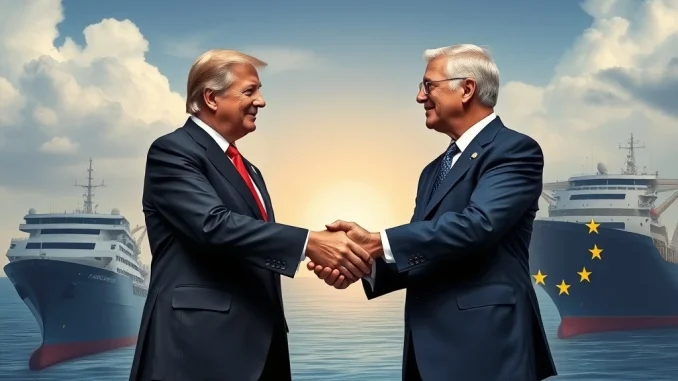
On July 26, 2025, U.S. President Donald Trump unveiled what he termed “the biggest deal ever made” – a landmark trade agreement with the European Union. This comprehensive Trump Trade Deal introduces a 15% tariff on EU exports to the U.S., alongside substantial commitments from the EU. Specifically, the agreement secures a $600 billion investment from the EU into U.S. energy and defense sectors, complemented by a $750 billion purchase of American energy and military equipment.
Finalized just ahead of an August 1 deadline, this pact is designed to avert a potential escalation of trade tensions. It smartly maintains existing tariffs on steel and aluminum while replacing earlier, more aggressive proposals with a framework built on reciprocity. This approach aims to stabilize transatlantic trade relations and bolster U.S. Economic Interests, signaling a strategic recalibration in global commerce.
The 15% Tariff: A New Standard for Global Trade?
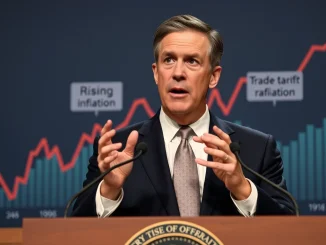
The introduction of a universal 15% Tariff on most EU exports to the U.S. marks a notable shift in U.S. trade policy under the Trump administration. This rate is consistent with recent bilateral agreements the U.S. has forged with other major economies, including Japan, Vietnam, and Indonesia. This consistency suggests a deliberate strategy to establish a benchmark for future trade negotiations.
However, the agreement isn’t a blanket application of the tariff. European Commission President Ursula von der Leyen highlighted crucial flexibility, noting exceptions for “zero for zero tariffs” on strategic goods such as aircraft parts and minerals. U.S. negotiators, on their part, emphasized the EU’s commitment to opening its markets to American goods at 0% rates, creating a truly reciprocal exchange that benefits both sides.
Reshaping Transatlantic Trade Dynamics
This landmark agreement is set to significantly reshape Transatlantic Trade dynamics. By prioritizing reciprocal commitments over unilateral measures, the deal aims to foster a more balanced and predictable trading environment between two of the world’s largest economic blocs. The EU’s substantial investment pledge, projected to strengthen U.S. energy production and defense manufacturing, aligns directly with Trump’s broader focus on domestic industrial growth and self-sufficiency.
Treasury Secretary Scott Bessent articulated the administration’s strategy of “making the best deal first” to establish clear tariff benchmarks. This tactic, evident in the consistent 15% rate across recent agreements, underscores a calculated effort to redefine global trade norms and ensure that U.S. trade relationships are built on equitable terms. The agreement’s structure reflects a deliberate move towards bilateral frameworks, prioritizing specific U.S. economic priorities over broader multilateral negotiations.
How Does This Deal Bolster U.S. Economic Interests and Future Stability?
At its core, the US EU Trade Pact is designed to robustly secure U.S. Economic Interests. The influx of $600 billion in investment and $750 billion in purchases from the EU is poised to invigorate key American sectors, particularly energy and defense. This direct capital injection and demand for U.S. products are expected to create jobs, stimulate manufacturing, and enhance national security capabilities.
The administration views this agreement as a crucial step in reducing business uncertainty for American companies operating internationally. By setting clear rules and reciprocal terms, the deal provides a more stable foundation for long-term planning and investment. While reactions from European leaders have been cautiously optimistic, acknowledging internal debates, U.S. officials remain confident in the deal’s potential to drive sustained economic growth and stability.
Challenges and the Road Ahead
Despite the fanfare, the path forward for this massive trade deal is not without its challenges. European leaders, while expressing cautious optimism, have also acknowledged significant internal debates over the potential impact on sensitive industries within the EU. The nuances of implementation, coupled with the need for market adjustments across various sectors, will determine its true long-term success.
Analysts caution that while the deal reduces immediate uncertainty, its full benefits will unfold only through diligent execution and adaptation by businesses on both sides of the Atlantic. This agreement marks the sixth major trade deal under the Trump administration, following pacts with Vietnam, Japan, and the UK. This trend underscores a clear shift towards bilateral frameworks, prioritizing specific U.S. economic priorities over complex multilateral negotiations, signaling a new era in global trade relations.
Conclusion
The announcement of the $1.35 trillion US EU Trade Pact, featuring a 15% Tariff and significant EU investments, represents a monumental achievement for the Trump administration. Hailed as the “biggest deal ever,” this agreement seeks to stabilize Transatlantic Trade, bolster U.S. Economic Interests, and redefine global trade dynamics. While challenges remain in its implementation and market adjustments, the deal sets a precedent for future bilateral agreements, emphasizing reciprocity and strategic economic alignment. Its long-term implications for global stability and, by extension, various financial markets, including cryptocurrencies, will be keenly observed.
Frequently Asked Questions (FAQs)
1. What are the main components of the US EU Trade Pact?
The core components include a 15% tariff on EU exports to the U.S., a $600 billion investment from the EU into U.S. energy and defense sectors, and a $750 billion purchase of American energy and military equipment.
2. Why was a 15% tariff chosen for EU exports?
The 15% tariff rate is consistent with recent bilateral trade agreements the U.S. has made with other nations like Japan, Vietnam, and Indonesia, signaling a strategic benchmark for U.S. trade policy under the Trump administration.
3. How does this deal avoid a potential trade war?
The agreement maintains existing tariffs on steel and aluminum while replacing earlier, more aggressive proposals with a reciprocal framework, thereby de-escalating potential trade tensions and providing a stable foundation for future relations.
4. What are the projected benefits for U.S. economic interests?
The deal is expected to strengthen U.S. energy production and defense manufacturing through significant EU investments and purchases. It also aims to reduce business uncertainty and open EU markets to American goods at 0% rates for strategic items, aligning with a focus on domestic industrial growth.
5. How might this trade pact indirectly affect cryptocurrency markets?
While not directly linked, major global trade agreements like this can foster greater economic stability and predictability. A more stable global economy often leads to increased investor confidence, which can indirectly influence capital flows and sentiment across all financial markets, including the cryptocurrency space.