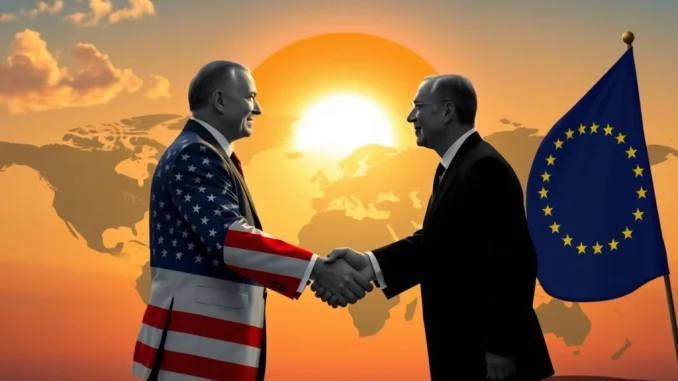
In a move that sent ripples across the financial world, the United States and the European Union have successfully negotiated a landmark US-EU trade pact. This pivotal agreement, announced on July 27, 2025, by President Donald Trump, marks a significant turning point, effectively averting a potential trade war averted that threatened to destabilize the global economy. The deal is poised to reshape the transatlantic economy and set new precedents for international commerce.
Understanding the Landmark Tariffs Agreement
At the heart of this groundbreaking accord is a reciprocal 15% tariff on most EU goods, with the notable exclusion of automobiles. This rate, lower than the 30% tariffs previously threatened by the Trump administration, reflects a strategic compromise aimed at fostering stability rather than escalating tensions. European Commission President Ursula von der Leyen lauded the agreement as “across the board and inclusive,” emphasizing its role in providing “stability and predictability” to trade relations.
Key provisions of the tariffs agreement include:
- Reciprocal 15% Tariffs: Applied to most goods traded between the US and EU, excluding automobiles. This ensures a level playing field for both economic blocs.
- “Zero for Zero” Tariff Framework: Strategic goods such as aircraft components and minerals will face zero tariffs, highlighting areas of mutual strategic importance and flexibility.
- Departure from Higher Threats: The 15% rate is a significant reduction from earlier threats of up to 30% tariffs, signaling a de-escalation of trade hostilities.
This nuanced approach to tariffs demonstrates a shift towards pragmatic negotiation, aiming to secure economic benefits without resorting to destructive protectionist measures. It aligns with Trump’s broader trade strategy, mirroring similar agreements with Japan and other Asian partners, indicating a consistent approach to leveraging tariffs as negotiation tools.
The $600 Billion Investment: Fueling the Transatlantic Economy
Beyond tariffs, a cornerstone of this agreement is the EU’s commitment to a staggering $600 billion investment in U.S. infrastructure and technology. This massive infusion of capital is complemented by increased purchases of American energy and defense equipment, with a specific mention of a $750 billion energy buy. This investment component is crucial for bolstering the transatlantic economy and fostering long-term growth.
Why is this investment so significant?
- Infrastructure Boost: The $600 billion commitment will funnel substantial funds into modernizing U.S. infrastructure, from roads and bridges to broadband networks, creating jobs and stimulating economic activity.
- Technological Advancement: Investment in technology sectors will accelerate innovation, keeping the U.S. competitive in critical emerging industries.
- Energy Security: Increased European purchases of American energy enhance U.S. energy independence and provide a stable market for its growing energy output.
- Defense Cooperation: Expanded defense equipment procurement strengthens strategic alliances and supports the U.S. defense industry.
Treasury Secretary Scott Bessent noted Trump’s strategy of securing “the best deal for the first person who makes a deal,” underscoring his focus on favorable terms for the U.S. This investment pledge is a testament to the strategic dimensions of the deal, moving beyond mere trade balances to encompass broader economic and security objectives.
Averting a Trade War: Global Implications and Market Reactions
The most immediate and profound impact of this agreement is the fact that a trade war averted. Experts universally agree that a full-blown trade conflict between the two largest economic blocs would have had catastrophic consequences for global trade, leading to higher consumer prices, reduced economic growth, and significant job losses worldwide. Jörn Fleck of the Atlantic Council aptly observed that the agreement “avoids a self-destructive trade war in the biggest and deepest commercial and investment relationship the global economy knows.”
While the deal is a diplomatic triumph, its immediate impact on markets has been relatively muted. Analysts caution that the full economic effects will take time to materialize. The complexity of integrating new tariff structures and investment flows into existing supply chains means that tangible benefits will unfold gradually over months and years.
Key market considerations:
- Sectoral Impact: Industries heavily reliant on EU exports, particularly those that had previously enjoyed lower tariffs, may face adjustments. However, the stability provided by the agreement might offset some of these challenges.
- Consumer Prices: The 15% tariff could lead to marginal price increases for certain imported goods, but this is likely to be less severe than under higher tariff scenarios.
- Investor Confidence: The removal of trade war uncertainty is a positive signal for investors, potentially encouraging more cross-border investment and long-term planning.
Barbara C. Matthews of the Atlantic Council highlighted that the deal follows patterns seen in recent U.S. agreements, including higher tariffs, energy procurement, and foreign direct investment (FDI) commitments. This suggests a consistent framework for future negotiations.
What Does This Mean for Future Global Trade Dynamics?
President Trump indicated that additional trade agreements with other nations could follow a similar structure, with standardized tariff rates ranging from 15% to 50%. This suggests that the US-EU trade pact could serve as a blueprint for future U.S. trade policy, reinforcing economic interdependence with key partners while asserting American economic leverage.
However, the path ahead is not without challenges. European leaders have expressed concerns about the long-term implications of higher tariffs on sectors like automotive and agriculture. The success of this agreement will hinge on the ability of both sides to balance strategic investments with market flexibility, ensuring the transatlantic relationship remains resilient amid shifting global dynamics.
This agreement represents a delicate balance between protectionist impulses and the undeniable benefits of open, predictable trade. It underscores the evolving nature of international economic relations, where strategic partnerships and managed trade are increasingly becoming the norm.
A New Chapter for Global Trade
The US-EU trade pact is more than just a deal; it’s a strategic maneuver that has successfully prevented a damaging trade conflict and laid the groundwork for a revitalized transatlantic economy. With 15% tariffs providing a new framework and a massive $600 billion investment commitment, this agreement sets a precedent for future global trade negotiations. While the full economic effects will unfold over time, the immediate relief of a trade war averted is a significant win for stability and predictability in an increasingly complex world. This accord demonstrates that even in an era of heightened economic nationalism, cooperation and compromise can still yield profound benefits for all parties involved.
Frequently Asked Questions (FAQs)
Q1: What are the primary components of the US-EU trade pact?
The pact primarily involves a reciprocal 15% tariff on most goods (excluding automobiles) and a commitment from the EU to invest $600 billion in U.S. infrastructure and technology, alongside increased purchases of American energy and defense equipment.
Q2: How does this agreement avert a trade war?
By establishing agreed-upon tariff rates and significant investment commitments, the pact de-escalates previous threats of much higher tariffs (up to 30%) and provides a stable framework for trade, thus preventing a destructive trade conflict between the two major economic powers.
Q3: What is the significance of the $600 billion EU investment in the U.S.?
This substantial investment is designed to boost U.S. infrastructure and technology sectors, stimulate job creation, and enhance U.S. competitiveness. It also includes large purchases of U.S. energy and defense equipment, strengthening strategic ties.
Q4: How might the 15% tariffs impact consumers and businesses?
While the 15% tariffs are lower than previously threatened, they may lead to slight price increases for certain imported EU goods. For businesses, it provides predictability, allowing them to plan better than under the uncertainty of escalating trade tensions, though some export-reliant industries might need to adjust.
Q5: Will this US-EU trade pact influence future trade agreements?
Yes, President Trump indicated that this agreement could serve as a precedent for future trade deals with other nations, potentially featuring similar standardized tariff rates and investment commitments, shaping the future of global trade dynamics.