In the volatile world of cryptocurrencies, external macroeconomic factors often dictate market sentiment. A recent development shaking the foundations of traditional finance is the preliminary US-EU trade deal, a pact that could significantly influence global economic stability and, by extension, the crypto landscape. While hailed as a step to avert a full-blown tariff war, this agreement comes with a significant caveat: key disputes remain unresolved, casting a shadow of uncertainty over future transatlantic relations.
Understanding the New US-EU Trade Deal: A Tentative Truce?
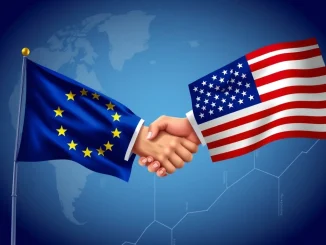
On July 27, 2025, the United States and the European Union announced a preliminary trade agreement, aiming to de-escalate rising tensions. This deal primarily focuses on imposing a 15% tariff on most EU goods entering the U.S., a notable reduction from the initially threatened 30%. In return, the EU has committed to purchasing U.S. energy and military equipment. This agreement was presented as a pathway to stability, yet conflicting statements from U.S. and EU officials immediately highlighted underlying disagreements regarding specific sector terms and enforcement.
Key aspects of the preliminary agreement include:
- Reduced Tariffs: A 15% tariff rate on a broad range of EU goods, including cars and industrial products, entering the U.S.
- Zero-for-Zero Arrangement: The U.S. pledged to maintain zero tariffs on critical sectors such as aircraft, chemicals, generic drugs, semiconductor equipment, and select agricultural products. In exchange, the EU agreed to forgo retaliatory measures.
- EU Commitments: The EU will increase purchases of U.S. energy and military equipment, aiming to address trade imbalances.
Despite these agreements, the devil remains in the details, particularly concerning how both sides interpret the deal’s scope and future implications.
The Shifting Landscape of Trade Tariffs: What’s Included and What’s Not?
While the 15% tariff reduction on many goods is a headline grabber, the agreement’s exclusions and ambiguities are equally, if not more, important. The ‘zero-for-zero’ arrangement aims to protect specific industries from tariffs, yet contentious sectors like pharmaceuticals and steel were deliberately left out, signaling ongoing friction.
Here’s a breakdown of the tariff landscape:
| Sector/Issue | U.S. Stance (President Trump) | EU Stance (President von der Leyen) | Outcome/Status |
|---|---|---|---|
| General Tariffs | EU to open markets at zero tariffs for U.S. goods | 15% rate applies broadly | 15% agreed, but interpretation differs on full scope |
| Pharmaceutical Tariffs | Hinted at higher tariffs beyond 15%; potential Section 232 investigation | 15% rate universally applicable | Unresolved; U.S. could still impose additional measures |
| Steel & Aluminum Tariffs | Existing 50% tariffs will ‘stay the way they are’ | Proposed quota system and reductions | Unresolved; high tariffs remain a point of contention |
| Aircraft, Chemicals, Semiconductor Equipment, Generic Drugs | Zero tariffs maintained | Zero tariffs maintained | Zero-for-zero agreement for these critical industries |
The discrepancy in statements, particularly regarding the universality of the 15% tariff and the future of pharmaceutical tariffs, creates significant uncertainty for businesses and investors alike.
Navigating Global Trade Uncertainties: Pharma, Steel, and Beyond
The core of the unresolved issues lies in sectors deemed critical by both sides. Pharmaceuticals, for instance, are a major point of contention. While the EU emphasizes the 15% rate’s universality, U.S. officials have clarified that a separate Section 232 investigation into pharmaceutical imports could still trigger additional measures, potentially leading to tariffs higher than 15%. This unilateral leverage retained by the U.S. through national security claims remains a point of concern for the EU.
Similarly, the future of steel and aluminum tariffs, currently at a hefty 50%, remains in limbo. President Trump has stated these tariffs would remain, while President von der Leyen has proposed a quota system and reductions. These unresolved tariff disputes could prolong implementation challenges and lead to further political and technical disagreements, as noted by analysts like Carsten Nickel of Teneo.
Beyond these immediate disputes, the agreement also conspicuously excludes aerospace tariffs (which remain at 0%), agricultural subsidies, and digital trade rules. This leaves structural imbalances in the transatlantic trade relationship largely unaddressed, suggesting that this preliminary deal is more of a temporary ceasefire than a comprehensive resolution.
Unpacking the Economic Implications: Winners, Losers, and Market Reactions
The economic fallout from this deal is expected to be mixed. While the 15% tariff framework could offer some predictability, analysts project varying impacts across different economies. For instance, Germany’s exports to the U.S. are projected to rise from $133 billion in 2023 to $149 billion by 2027, indicating a potential boost for some EU nations under the new tariff regime.
However, the broader economic implications are not entirely positive. AP News reported that the deal could ‘raise prices and slow growth,’ underscoring potential inflationary pressures and reduced overall trade volumes due to the remaining tariffs. The U.S. energy and defense industries may benefit from the EU’s purchase commitments, but the lack of detailed implementation mechanisms introduces uncertainty regarding the execution of these agreements.
Market reactions have reflected cautious optimism. The EU’s acceptance of the 15% tariff without immediate retaliation has reduced short-term volatility, providing a semblance of stability. However, the persistent ambiguities and unresolved disputes introduce long-term risks, potentially hindering investment and planning for businesses operating across the Atlantic.
The Future of Tariff Disputes: Will This Agreement Hold?
The durability of this preliminary agreement hinges significantly on its enforcement and interpretation. The U.S. continues to hold considerable leverage through its ability to invoke national security claims for sector-specific tariffs, a power that could be used to impose additional measures on sectors like pharmaceuticals. The EU, by accepting the 15% rate without immediate retaliation, has shown a willingness to de-escalate, but this could strain internal consensus among member states, particularly those heavily impacted by the remaining tariffs or facing potential new ones.
President von der Leyen described the agreement as a ‘significant step forward in transatlantic trade,’ aiming for ‘certainty and stability.’ However, the overlapping investigations and unresolved disputes mean that the pact remains vulnerable to destabilization. For the cryptocurrency market, which often reacts to global economic stability, the ongoing uncertainties in traditional trade relations could translate into continued volatility or a cautious sentiment among investors.
Conclusion: A Precarious Balance
The preliminary US-EU trade deal represents a delicate balance between cooperation and contention. While it successfully averted an immediate, full-scale tariff war and offered some relief to businesses, it also highlighted deep-seated disagreements that continue to plague transatlantic trade relations. The unresolved issues surrounding pharmaceuticals and steel, coupled with conflicting interpretations of the agreement’s terms, mean that the path forward is anything but clear. Businesses and investors must remain vigilant, as the future of these crucial trade relationships will undoubtedly impact global economic stability and, by extension, the broader financial landscape, including the burgeoning crypto markets.
Frequently Asked Questions (FAQs)
Q1: What are the main terms of the US-EU trade deal?
The deal primarily imposes a 15% tariff on most EU goods entering the U.S., down from a threatened 30%. In return, the EU committed to purchasing U.S. energy and military equipment. A ‘zero-for-zero’ arrangement also maintains zero tariffs on specific critical industries like aircraft, chemicals, generic drugs, and semiconductor equipment.
Q2: Why are pharmaceuticals and steel still contentious?
These sectors remain contentious because the agreement did not resolve existing disputes. For pharmaceuticals, the U.S. hinted at potentially higher tariffs through a Section 232 investigation, contradicting the EU’s view of a universal 15% rate. For steel and aluminum, existing 50% tariffs remain, despite the EU proposing a quota system and reductions.
Q3: How might this deal impact the global economy?
The deal aims to reduce immediate trade tensions, potentially boosting EU exports to the U.S. in some sectors. However, analysts warn it could still ‘raise prices and slow growth’ due to remaining tariffs and ambiguities, leading to inflationary pressures and reduced overall trade volumes. The unresolved issues create long-term uncertainty for global trade and investment.
Q4: What does “zero-for-zero” mean in this context?
The ‘zero-for-zero’ arrangement refers to an agreement where both the U.S. and the EU maintain zero tariffs on specific, mutually agreed-upon critical industries. This includes sectors like aircraft, chemicals, generic drugs, and semiconductor equipment, aiming to protect these industries from new tariffs.
Q5: What are the long-term implications for transatlantic trade?
While the deal offers a temporary truce, its long-term implications are uncertain. The unresolved disputes over key sectors, conflicting interpretations, and the U.S.’s ability to impose tariffs based on national security claims could lead to ongoing friction. It suggests that deeper structural imbalances in transatlantic trade remain unaddressed, potentially leading to future trade disputes.