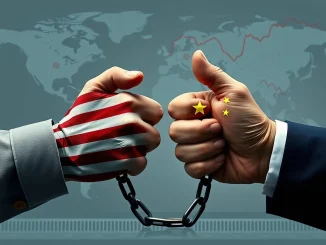
In the dynamic world of global economics, major trade agreements can send ripples far beyond their immediate impact, influencing everything from supply chains to investor confidence. For those navigating the volatile waters of cryptocurrency, understanding these macroeconomic shifts is crucial, as they often dictate the broader market sentiment. A significant development on the horizon is the proposed US-EU trade deal, which aims to de-escalate a protracted dispute and potentially reshape transatlantic trade dynamics. This agreement, if finalized, could avert a costly trade war, offering a glimpse into the future of international economic relations.
What’s at Stake: Averting Steep Trump Tariffs
The core of the recent negotiations between the United States and the European Union revolves around preventing the imposition of severe Trump tariffs. Washington had set an August 1 deadline for a potential 30% tariff on various EU goods, a move that would have significantly escalated trade tensions and impacted European economies. The proposed agreement offers a pathway to avoid this drastic measure, instead settling for a baseline 15% tariff on EU exports to the U.S.
- The Deadline: August 1st was the critical date, pushing both sides to find common ground.
- The Stakes: A 30% tariff threatened widespread economic disruption across Europe, impacting various sectors.
- The Compromise: A 15% tariff rate, while higher than historical averages, is seen as a pragmatic compromise to avert the steeper alternative.
This negotiation highlights a shift in U.S. trade policy, where tariffs have increasingly become a primary bargaining tool. The move from a potential 30% to a 15% tariff reflects a complex interplay of economic pressure and diplomatic maneuvering.
The European Union’s Pragmatic Approach
The European Union has demonstrated a pragmatic willingness to engage in these negotiations, recognizing the economic imperative of avoiding a full-blown trade war. Despite the proposed 15% tariff significantly exceeding the historical average of 4.8% on European goods, the EU’s acceptance of this framework signals a strategic concession to resolve the standoff.
During a meeting at President Trump’s Scottish golf resort with European Commission President Ursula von der Leyen, the framework of the deal was reportedly finalized. This engagement underscores the EU’s commitment to finding a resolution, even if it means accepting terms that are less than ideal from a historical perspective. Key aspects of the EU’s strategy include:
- Avoiding Escalation: The primary goal was to prevent the imposition of the more punitive 30% tariffs.
- Securing Commitments: The EU sought and reportedly secured commitments from member states to support the framework.
- Strategic Concessions: Alongside the tariff agreement, the EU has committed to increasing liquefied natural gas (LNG) imports and investments, demonstrating a broader effort to strengthen economic ties.
However, this pragmatism is not without its limits. Some European officials, notably from France, have indicated readiness to impose counter-tariffs on $109 billion in U.S. goods if a satisfactory deal is not reached, underscoring the delicate balance of these negotiations.
Uncertainty Lingers: The Auto Sector and Global Trade Dynamics
Despite President Trump’s assertion that “We have a deal with the EU,” significant ambiguities persist, particularly concerning the highly sensitive auto sector. While a political framework appears to be in place, unresolved issues, including U.S. tariffs on EU cars, steel, and aluminum, remain critical sticking points. This lingering uncertainty is a key factor in the overall outlook for global trade.
Trump’s statements regarding the likelihood of an agreement have also been inconsistent, adding to the uncertainty. Earlier in July, he described the chances as “50-50, maybe less,” a sentiment echoed by von der Leyen’s caution. Diplomatic sources within the EU acknowledge that critical details, especially auto-related provisions, require further resolution. The implications for the auto sector are substantial, given its vital role in both the U.S. and European economies.
This ongoing saga highlights a broader trend in global trade: the increasing use of tariffs as a bargaining chip. While the immediate focus is on the US-EU relationship, the outcome of this deal will undoubtedly influence Washington’s approach to trade negotiations with other major partners, including China.
Navigating the Path Forward: Challenges and Public Sentiment
The path to a fully realized US-EU trade deal is fraught with challenges. Beyond the unresolved specifics of the auto sector, the deal hinges on President Trump’s final approval, which has historically been subject to shifts in political will and public sentiment. The August 1 deadline has been reiterated as non-negotiable by the Trump administration, with Commerce Secretary Howard Lutnick emphasizing “no extensions.”
Public support for Trump’s tariff-driven approach remains relatively low, with Gallup polling showing his approval rating at 37% in July, a decline from earlier in the year. This domestic political context could influence the final decision-making process, as administrations often weigh public opinion when making significant policy moves. The symbolic significance of the Turnberry summit, held at Trump’s personal residence, serves as a testament to his personalized, trade-focused strategy, yet the administration has only finalized five major agreements despite earlier promises of securing “90 deals in 90 days.”
The potential agreement, with its 15% tariff framework, represents a significant moment for transatlantic trade. While the EU’s acceptance signals a strong desire for resolution, the lingering uncertainties, particularly in the auto sector and regarding Trump’s final approval, mean that the journey to a comprehensive agreement is far from over. The resolution of this dispute will undoubtedly shape future U.S. trade dynamics and have broader implications for the stability of the global economic landscape.
Conclusion: Awaiting the Verdict on Transatlantic Trade
The proposed US-EU trade deal stands as a testament to the complex and often contentious nature of international economic relations. While a framework for averting a full-blown tariff war with a 15% rate has been established, the critical approval from President Trump and the resolution of lingering issues, particularly concerning the auto sector, remain paramount. The outcome of these negotiations will not only define the future of transatlantic trade but also set a precedent for how major economic powers navigate disputes in an increasingly interconnected global trade environment. As the August 1 deadline looms, the world watches to see if this pragmatic compromise will indeed usher in a period of greater stability, or if unresolved details will once again push these vital economic partners to the brink.
Frequently Asked Questions (FAQs)
Q1: What is the main objective of the proposed US-EU trade deal?
The primary objective of the proposed deal is to avert the imposition of steep 30% U.S. tariffs on European goods by establishing a new baseline 15% tariff rate. This aims to de-escalate ongoing trade tensions between the United States and the European Union.
Q2: What is the significance of the 15% tariff rate compared to historical averages?
The proposed 15% tariff rate is significantly higher than the historical average of 4.8% on European goods. While it represents a substantial increase, it is viewed as a pragmatic compromise to avoid the more damaging 30% tariffs that were threatened.
Q3: Which sectors are still facing uncertainty in the trade negotiations?
The auto sector remains a major point of ambiguity and unresolved issues. While some sectors like aircraft and spirits may see exceptions, the details regarding U.S. tariffs on EU cars, steel, and aluminum are still being worked out, posing a challenge to the final agreement.
Q4: What is the European Union’s stance on this proposed deal?
The European Union has adopted a pragmatic approach, accepting the 15% tariff framework to avoid a more severe trade conflict. They have also committed to increasing liquefied natural gas (LNG) imports and investments. However, some EU officials have signaled readiness to impose counter-tariffs if a satisfactory deal isn’t fully reached.
Q5: How does this trade deal relate to President Trump’s trade policy?
This deal aligns with President Trump’s tariff-driven trade strategy, where tariffs are used as a bargaining tool. His final approval is crucial for the deal’s implementation, and the outcome will influence future U.S. trade dynamics with other major partners.
Q6: What is the deadline for this trade agreement?
The deadline for reaching an agreement to avert the higher tariffs was August 1. The Trump administration has emphasized that this deadline is non-negotiable, putting pressure on both sides to finalize the deal promptly.