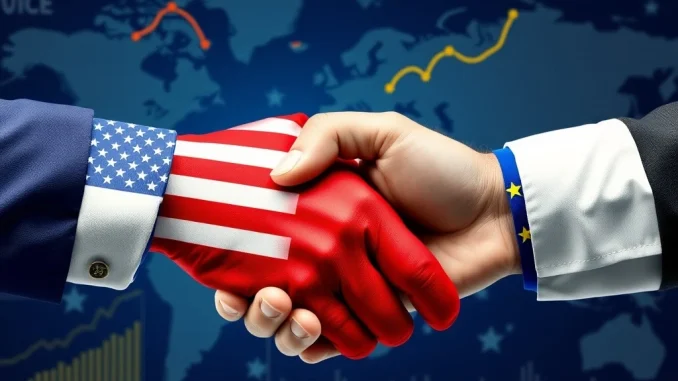
In the intricate web of global finance, major geopolitical shifts often send tangible ripples across all markets, including the dynamic world of cryptocurrencies. A recent pivotal development between two of the world’s largest economic blocs promises to reshape international trade relations and potentially foster greater economic stability. The US-EU trade deal, finalized on July 25, 2025, represents a significant stride towards averting a potentially damaging transatlantic trade war, injecting a substantial $600 billion investment into the American economy from Europe. This agreement isn’t just about tariffs; it’s a comprehensive framework designed to rebalance economic ties and strengthen strategic alliances, with implications that could resonate from Wall Street to decentralized finance protocols.
Understanding the Landmark Tariff Agreement
The core of this tariff agreement is a carefully negotiated balance. At its heart lies a 15% baseline tariff on most European goods entering the U.S., particularly industrial and manufacturing products. This measure, a central demand from the Trump administration, aims to address long-standing trade imbalances. However, unlike previous unilateral tariffs, this deal incorporates significant reciprocal measures designed to offset the financial impact on European industries and ensure a “give-and-take” dynamic.
Key components of the deal include:
- 15% Tariff: Applied to a broad range of European imports into the U.S., primarily industrial and manufacturing goods. The U.S. side views this as a moderate rate, balancing protection for domestic sectors with the need to maintain robust trade flows.
- $600 Billion EU Investment: A cornerstone commitment from the European Union, this massive investment is earmarked for U.S. infrastructure, technology, and energy sectors. European firms are expected to expand their manufacturing and research & development (R&D) operations across America, potentially creating jobs and enhancing supply chain resilience.
- $750 Billion EU Energy & Military Procurement: The EU has also committed to purchasing substantial U.S. energy exports, including liquefied natural gas (LNG) and refined fuels, alongside additional military equipment over the coming years. This aligns with broader geopolitical goals, such as reducing Europe’s reliance on Russian energy sources and bolstering NATO cohesion.
This structured framework replaces earlier threats of retaliatory tariffs, marking a significant shift from a confrontational approach to one of structured collaboration.
How Does This Transatlantic Trade Deal Reshape Global Markets?
The implications of this transatlantic trade agreement extend far beyond the immediate economic figures. Its potential to reshape global markets is substantial, influencing everything from supply chains to consumer prices and geopolitical alliances.
On one hand, the influx of European capital is poised to stimulate innovation and infrastructure modernization in the U.S., bolstering American competitiveness on the world stage. Analysts suggest this investment could provide a significant boost to key sectors, fostering economic growth and creating new opportunities. The commitment to U.S. energy and military exports also reinforces strategic partnerships, aligning economic interests with shared security objectives.
However, the deal has not been without its critics. Some experts warn that the 15% tariffs could introduce distortions into global supply chains. For consumers, there’s a concern that prices for certain European imports, particularly luxury goods and automobiles, could see an increase. Within the EU, industries heavily reliant on U.S. imports, such as automotive and machinery, have voiced concerns about the tariff’s impact on their costs and overall competitiveness. The delicate balance between protecting domestic sectors and maintaining fluid trade flows will be a key challenge in the implementation phase.
The Promise of Economic Stability and Future Cooperation
One of the primary goals of this agreement is to foster greater economic stability across the transatlantic corridor. By establishing a clear framework for trade and investment, both sides aim to reduce uncertainty and create a predictable environment for businesses. European Commission President Ursula von der Leyen hailed the deal as a “bridge to a more balanced future,” acknowledging the EU’s strategic shift to align with U.S. energy and defense priorities.
From the U.S. perspective, the agreement secures a key victory for the administration, demonstrating its ability to negotiate favorable terms while averting a costly trade war. The anticipated job creation and enhanced supply chain resilience resulting from European investments are significant economic benefits. For the EU, the deal mitigates immediate economic risks for European businesses that would have faced more severe unilateral tariffs, while also strengthening strategic ties with the U.S. in critical areas like energy security and defense.
The success of this ambitious pact will, however, hinge on its meticulous implementation. Both the U.S. and the EU will need to navigate complex regulatory challenges and potential domestic political resistance to ensure the deal’s intended benefits materialize. The effectiveness of the EU’s investment deployment and the fulfillment of energy export targets will be closely watched.
Navigating the Complexities: What Are the Criticisms of the US-EU Trade Deal?
While hailed as a success in averting a trade war, the US-EU trade deal has not escaped scrutiny. Critics from both sides of the Atlantic have raised valid concerns about its long-term implications and practical execution.
One major point of contention revolves around the enforceability of the EU’s commitments. On the U.S. side, some argue that the agreement lacks robust mechanisms to ensure the $600 billion investment is deployed effectively or that the ambitious energy export targets are consistently met. This raises questions about accountability and whether the reciprocal measures will truly deliver the promised economic offsets.
Furthermore, the 15% tariff, while moderate compared to potential escalations, could still have unintended consequences. Economists have pointed out the risk of distorting established global supply chains, potentially forcing companies to re-evaluate their production and sourcing strategies. This could lead to higher operational costs, which might eventually be passed on to consumers in the form of increased prices for imported goods. The automotive and luxury goods sectors, in particular, are bracing for potential impacts.
For European industries, the tariff represents an additional cost burden that could affect their competitiveness in the U.S. market. While the investment and procurement commitments are designed to balance this, the immediate impact on profit margins and market share remains a concern for many businesses. The true test of this agreement will be its ability to adapt to unforeseen economic shifts and maintain its intended balance amidst these ongoing challenges.
The US-EU trade deal marks a significant turning point in transatlantic economic relations. By balancing tariffs with substantial investment and procurement commitments, it provides a structured pathway for cooperation, moving away from past confrontational approaches. While the agreement promises enhanced economic stability, job creation, and strengthened geopolitical alliances, its long-term success will depend on diligent implementation and the ability of both parties to navigate inevitable challenges. This pact offers a compelling model for international collaboration in an era of global economic uncertainties, demonstrating that even amidst differing priorities, strategic partnerships can be forged to foster mutual prosperity and avert conflict.
Frequently Asked Questions (FAQs)
Q1: What is the primary objective of the new US-EU trade deal?
A1: The primary objective of the new US-EU trade deal is to avert a potential transatlantic trade war by restructuring economic ties. It aims to address trade imbalances through a 15% tariff on European goods entering the U.S., balanced by substantial EU investments and procurement commitments in the American economy.
Q2: What are the key financial commitments made by the European Union in this agreement?
A2: The European Union has committed to two major financial initiatives: a $600 billion investment pledge into the U.S. economy, targeting infrastructure, technology, and energy sectors, and an additional commitment to purchase $750 billion in U.S. energy exports (like LNG and refined fuels) and military equipment over the coming years.
Q3: How does the 15% tariff impact European imports into the U.S.?
A3: The 15% baseline tariff applies to most European imports into the U.S., particularly industrial and manufacturing goods. While it aims to protect domestic sectors, critics suggest it could lead to higher consumer prices for certain imported items and affect the competitiveness of European industries.
Q4: What are the main benefits expected from this transatlantic trade agreement?
A4: Expected benefits include enhanced economic stability, stimulation of innovation and infrastructure modernization in the U.S., potential job creation through European investments, strengthened supply chain resilience, and alignment of geopolitical goals, such as reducing Europe’s reliance on Russian energy and bolstering NATO cohesion.
Q5: What criticisms have been raised regarding the US-EU trade deal?
A5: Criticisms include concerns that the 15% tariffs could distort global supply chains and raise consumer prices, especially for luxury goods and automobiles. Additionally, some experts argue the agreement lacks sufficiently enforceable mechanisms to ensure the effective deployment of EU investments or the consistent fulfillment of energy export targets.
Q6: How might this deal influence broader global markets and international relations?
A6: This deal sets a precedent for structured transatlantic collaboration, potentially influencing other international trade negotiations. By fostering greater economic stability between two major blocs, it could reduce global economic uncertainties, strengthen strategic alliances, and reshape international trade flows, impacting various global markets.