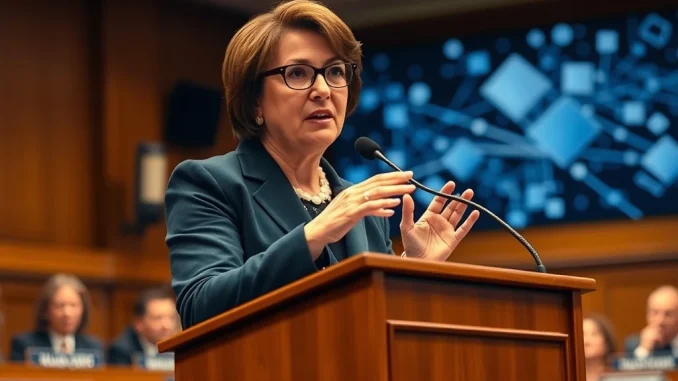
The landscape of US Crypto Regulation is constantly evolving, and a recent development has sent ripples through the digital asset community. A powerful voice from Capitol Hill, Democrat Senator Amy Klobuchar, has called for significant changes to the proposed crypto market structure bill. Her demands highlight a critical ongoing debate: how can the United States effectively regulate the burgeoning cryptocurrency industry while safeguarding consumers and fostering innovation?
The Crucial Debate Over US Crypto Regulation Heats Up
On July 15, during a Senate Agriculture Committee hearing, Senator Amy Klobuchar made headlines by emphasizing the urgent need for major revisions to the proposed Crypto Market Structure Bill. Her remarks, reported by CoinDesk, underscore a growing concern among lawmakers regarding the current state of digital asset oversight. This isn’t just about minor tweaks; Senator Klobuchar is pushing for fundamental changes that could redefine how cryptocurrencies are regulated in the U.S.
The core of her argument revolves around several key pillars:
- Stronger Consumer Protections: Ensuring that everyday investors are shielded from fraud, manipulation, and irresponsible practices within the crypto space.
- Increased Funding for Regulators: Equipping agencies like the Commodity Futures Trading Commission (CFTC) and the Securities and Exchange Commission (SEC) with the necessary resources to effectively police the market.
- Tighter Rules to Close Loopholes: Addressing ambiguities and gaps in existing securities laws that could be exploited by bad actors, potentially weakening the regulatory framework.
This intervention comes at a pivotal time, as both chambers of Congress grapple with the complexities of establishing a clear and comprehensive regulatory framework for digital assets. The stakes are incredibly high, not just for the industry, but for millions of Americans who participate in the crypto economy.
Senator Klobuchar’s Call for Robust Consumer Protection in Digital Assets
Why is Consumer Protection such a central theme in Senator Klobuchar’s demands? The cryptocurrency market, while offering immense potential, has also been a breeding ground for significant financial losses due to scams, exchange collapses, and opaque practices. High-profile incidents like the FTX collapse, Celsius Network bankruptcy, and Terra/Luna implosion have vividly illustrated the devastating consequences of inadequate oversight and lax regulations.
Senator Klobuchar’s focus on consumer protection aims to prevent future catastrophes by:
- Mandating Disclosure: Requiring crypto platforms to provide clear, transparent information about their operations, risks, and financial health to users.
- Establishing Fiduciary Duties: Holding platforms to higher standards, ensuring they act in the best interest of their customers, similar to traditional financial advisors.
- Enhancing Cybersecurity Measures: Protecting user funds and data from hacks and breaches, which have plagued the industry.
- Preventing Market Manipulation: Implementing rules to curb practices like wash trading and pump-and-dump schemes that harm retail investors.
For many, the crypto market represents a new frontier of finance, but without proper safeguards, it can become a Wild West. Klobuchar’s push is a clear signal that lawmakers are no longer willing to tolerate a ‘move fast and break things’ mentality when it comes to people’s hard-earned money.
Understanding the Senate’s Crypto Market Structure Bill
The specific legislation Senator Klobuchar addressed is the Crypto Market Structure Bill, primarily spearheaded by the Senate Agriculture Committee. This bill, often referred to as the Digital Commodities Consumer Protection Act (DCCPA) or similar iterations, aims to grant the Commodity Futures Trading Commission (CFTC) significant new authority over the digital asset spot market, particularly for commodities like Bitcoin and Ethereum.
Key aspects of the Senate bill often include:
- CFTC as Primary Regulator: Shifting much of the oversight of non-security digital assets to the CFTC, which traditionally regulates derivatives and commodities.
- Registration Requirements: Mandating that digital commodity platforms, brokers, and dealers register with the CFTC.
- Market Conduct Rules: Implementing rules around trading practices, customer asset segregation, and risk management.
While the bill is seen by some as a step towards regulatory clarity, critics, including Senator Klobuchar, argue that it might not go far enough in protecting consumers or could inadvertently create loopholes that undermine the SEC’s existing authority over digital assets deemed securities. The delicate balance lies in defining what constitutes a security versus a commodity in the crypto space, a debate that has long vexed regulators and industry players alike.
Navigating the Landscape of Digital Asset Legislation: House vs. Senate
Senator Klobuchar’s remarks gain additional significance when viewed in the context of broader Digital Asset Legislation efforts across Congress. While the Senate Agriculture Committee is advancing its bill, the House of Representatives is also making strides with its own version of crypto legislation, notably the Financial Innovation and Technology for the 21st Century Act (FIT21), also known as the Digital Asset Markets Clarity Act.
Here’s a brief comparison of the two legislative efforts:
| Feature | Senate (e.g., DCCPA/Crypto Market Structure Bill) | House (FIT21/Digital Asset Markets Clarity Act) |
|---|---|---|
| Primary Regulator Focus | CFTC for digital commodities | Defines roles for both CFTC (digital commodities) and SEC (digital assets as securities) |
| Scope | Primarily commodity-focused, aims to fill gaps for non-securities | Broader, attempts to provide comprehensive definitions for digital assets as securities or commodities |
| Key Objective | Grant CFTC clear authority over spot digital commodity markets | Create a clear framework for digital asset classification and regulation, reduce regulatory ambiguity |
The existence of two distinct, albeit sometimes overlapping, legislative initiatives highlights the complexity and fragmentation of crypto policy in the U.S. While both aim for clarity, their differing approaches could lead to legislative gridlock or, if passed separately, a disjointed regulatory environment. Senator Klobuchar’s call for revisions in the Senate bill could influence how these two legislative paths eventually converge or diverge.
Why Enhanced Crypto Regulatory Oversight is Non-Negotiable
The need for robust Crypto Regulatory Oversight extends beyond just consumer protection. It’s about ensuring market integrity, preventing illicit finance, and fostering legitimate innovation. Currently, the lack of a clear, unified framework allows for regulatory arbitrage, where companies operate in grey areas to avoid stringent rules.
Increased funding for regulators, as advocated by Senator Klobuchar, is crucial for several reasons:
- Expertise Development: Regulators need to hire and train experts in blockchain technology, smart contracts, and decentralized finance (DeFi) to effectively understand and oversee the market.
- Enforcement Capabilities: More resources mean better surveillance, faster investigations, and the ability to pursue enforcement actions against bad actors more efficiently.
- Technological Infrastructure: Regulators require advanced tools and systems to monitor complex blockchain transactions and identify suspicious activities.
- International Cooperation: As crypto is a global phenomenon, well-resourced regulators can better collaborate with international counterparts to combat cross-border illicit activities.
Closing loopholes that could weaken current securities laws is equally vital. The ‘Howey Test,’ established by the Supreme Court decades ago, is the primary legal standard for determining if an asset is a security. Applying this test to novel digital assets has proven challenging, leading to ongoing debates and enforcement actions. Lawmakers are attempting to codify a clearer path, but any new legislation must be carefully crafted to avoid inadvertently creating new avenues for evasion or undermining the SEC’s long-standing authority in investor protection.
What’s Next for US Crypto Regulation?
Senator Klobuchar’s intervention underscores the ongoing tension between fostering innovation and ensuring investor safety within US Crypto Regulation. Her demands for stronger consumer protections, increased regulatory funding, and tighter rules will undoubtedly shape the future trajectory of the Senate’s market structure bill. While the House continues to advance its own version, the legislative journey for comprehensive crypto regulation is far from over.
The path forward will likely involve:
- Intense Debates: Lawmakers will continue to debate the scope of regulatory authority, the definition of digital assets, and the appropriate balance between innovation and protection.
- Industry Lobbying: Crypto industry participants will actively engage with policymakers, advocating for frameworks that support their business models while addressing concerns.
- Potential Compromises: Given the bipartisan nature of some crypto legislative efforts, there’s a possibility of finding common ground, but significant hurdles remain.
- Continued Regulatory Actions: Even without new legislation, existing agencies like the SEC and CFTC will continue to take enforcement actions based on their current interpretations of the law.
Ultimately, the goal is to create a predictable and robust regulatory environment that allows the legitimate crypto industry to flourish while effectively weeding out fraudulent schemes and protecting the public. Senator Klobuchar’s strong stance serves as a potent reminder that the details of this legislation matter immensely for the future of digital finance.
Summary: A Pivotal Moment for Crypto Policy
Senator Amy Klobuchar’s call for major revisions to the U.S. Crypto Market Structure Bill marks a crucial moment in the ongoing efforts to establish clear and effective US Crypto Regulation. Her emphasis on robust Consumer Protection, adequate Crypto Regulatory Oversight, and the closure of legal loopholes highlights the deep-seated concerns many lawmakers have regarding the current state of the digital asset industry. As both the Senate and the House advance their respective versions of Digital Asset Legislation, the coming months will be critical in determining the framework that will govern cryptocurrencies for years to come. The outcome will not only impact the future of financial innovation but also the safety and confidence of millions of investors in the digital economy.
Frequently Asked Questions (FAQs)
Q1: What is the main purpose of the US Crypto Market Structure Bill?
A1: The primary purpose of the US Crypto Market Structure Bill (like the Senate’s DCCPA or the House’s FIT21) is to establish a clear regulatory framework for digital assets. This involves defining which assets are considered commodities versus securities, assigning regulatory authority to agencies like the CFTC and SEC, and setting rules for crypto exchanges, brokers, and other market participants to ensure market integrity and consumer protection.
Q2: Why is Senator Amy Klobuchar calling for revisions to the bill?
A2: Senator Klobuchar is calling for revisions primarily to strengthen consumer protections, ensure regulators have sufficient funding and authority, and close potential loopholes that could weaken existing securities laws. She believes the current drafts may not adequately shield investors from risks or provide agencies with the necessary tools to oversee the complex and rapidly evolving crypto market effectively.
Q3: How does the Senate’s Crypto Market Structure Bill differ from the House’s Digital Asset Markets Clarity Act (FIT21)?
A3: While both aim for regulatory clarity, the Senate’s bill (e.g., DCCPA) often focuses on expanding the CFTC’s authority over digital commodity spot markets. The House’s FIT21 bill is generally more comprehensive, attempting to define clear lines between digital assets as commodities (CFTC oversight) and securities (SEC oversight), and aims to provide a broader framework for the entire digital asset ecosystem. The key difference lies in their approach to defining and allocating regulatory jurisdiction.
Q4: What are the main concerns regarding consumer protection in the crypto space?
A4: Main concerns include the lack of transparent disclosures from crypto platforms, susceptibility to scams and fraudulent schemes, inadequate safeguards for customer assets (leading to losses during exchange bankruptcies), market manipulation, and the general complexity of digital assets that can be difficult for average investors to understand. Stronger consumer protection aims to mitigate these risks.
Q5: Why is increased funding for crypto regulatory oversight important?
A5: Increased funding is crucial because it allows regulatory bodies like the SEC and CFTC to hire specialized talent (blockchain experts, data scientists), invest in advanced monitoring technologies, and expand their enforcement capabilities. Without adequate resources, regulators struggle to keep pace with rapid technological advancements and the scale of the crypto market, making it harder to identify and prosecute illicit activities and ensure compliance.
Q6: What does the call to ‘close loopholes’ in securities laws mean for crypto?
A6: Closing loopholes refers to addressing ambiguities or gaps in existing laws, particularly how the Howey Test (which defines a security) applies to novel digital assets. Lawmakers want to ensure that new crypto legislation doesn’t inadvertently create pathways for digital assets that should be regulated as securities to escape proper oversight, thereby protecting investors from potentially unregistered and unregulated offerings.