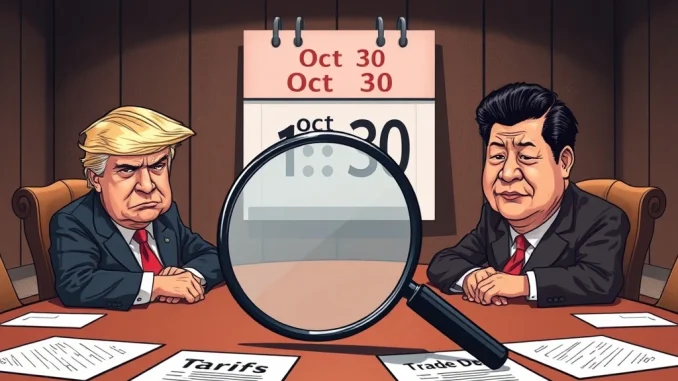
The financial world watches closely as the upcoming US-China Trade Talks prepare for a pivotal moment. President Donald Trump and Chinese President Xi Jinping are scheduled to meet on October 30. This high-stakes encounter, confirmed by The Kobeissi Letter, occurs just 48 hours before a significant 100 percentage point increase in tariffs on Chinese goods. This looming deadline creates considerable Market Uncertainty across global economies and financial sectors, including cryptocurrencies.
Anticipating the Trump Xi Meeting
The highly anticipated Trump Xi Meeting on October 30 holds immense significance. This discussion could shape the future of global commerce. Previously, President Trump indicated a willingness to impose 155% tariffs on China if no agreement is reached by November 1. Such a move would escalate the ongoing trade dispute dramatically. Therefore, the outcome of this meeting carries substantial weight for international trade relations.
Investors and analysts are scrutinizing every detail. Many fear a failure to reach a deal could trigger a broader economic downturn. The potential for a Tariff Increase adds pressure to an already strained global supply chain. Businesses worldwide are already navigating the complexities of existing trade barriers. Consequently, a further escalation could force them to re-evaluate their strategies and sourcing.
The Looming Tariff Increase Deadline
A significant Tariff Increase looms large over the upcoming discussions. The current threat involves a 100 percentage point hike on Chinese goods, set for November 1. This date serves as a critical deadline for both nations. Failure to reach a consensus could see the United States implement even higher tariffs, potentially reaching 155%. Such a measure would directly impact a vast array of imported goods from China.
Furthermore, these tariffs directly affect consumer prices in the US. They also strain American businesses relying on Chinese components. Many companies have already absorbed some costs. Others have passed them onto consumers. Therefore, a further increase would undoubtedly exacerbate these challenges. The economic ramifications extend beyond direct trade. They influence investor confidence and future investment decisions globally. Market participants remain vigilant, awaiting any signals from the talks.
Broader Global Economic Impact of Trade Tensions
The prolonged trade dispute between the US and China has already demonstrated a considerable Global Economic Impact. Analysts warn that a further escalation could severely disrupt international trade flows. This disruption would extend to global supply chains and economic growth projections. Major industries, from manufacturing to technology, face significant headwinds due to tariffs. Moreover, agricultural sectors in both countries have suffered.
Key economic indicators often reflect this tension. Global manufacturing output has slowed. Business investment has become more cautious. Furthermore, consumer sentiment fluctuates with trade headlines. An unresolved trade war creates an environment of uncertainty. This environment deters long-term planning and investment. Many international organizations, including the IMF, have repeatedly cautioned against protectionist policies. They highlight the risks these policies pose to a fragile global economy.
Understanding Market Uncertainty and Cryptocurrencies
The specter of a trade war significantly contributes to widespread Market Uncertainty. Traditional financial markets, including stocks, bonds, and commodities, react sharply to developments. Geopolitical tensions often lead to increased volatility. Investors frequently seek safe-haven assets during such periods. Gold, for example, often sees increased demand. However, the cryptocurrency market also experiences unique reactions to global economic shifts.
For instance, Bitcoin, often dubbed ‘digital gold,’ sometimes acts as a hedge against traditional market instability. Conversely, increased global uncertainty can also trigger broader sell-offs across all asset classes, including cryptocurrencies. Therefore, the outcome of the Trump-Xi meeting could directly influence crypto market sentiment. Traders and investors will monitor the news closely for any potential ripple effects on digital asset prices and adoption rates. The interconnectedness of global finance means few markets remain untouched.
Historical Context and Future Prospects
The upcoming meeting is not an isolated event. It represents another chapter in a long-standing trade disagreement. Past negotiations have seen periods of progress followed by setbacks. Both nations have previously imposed and threatened tariffs. This historical context underscores the difficulty of reaching a comprehensive deal. The core issues often involve intellectual property rights, forced technology transfers, and market access.
Looking ahead, a successful outcome could alleviate some immediate economic pressures. It might foster a more stable environment for global trade. However, a failure to agree could intensify the trade war. This would lead to further economic fragmentation. The long-term implications could include a reordering of global supply chains. It might also accelerate decoupling efforts between the two largest economies. Consequently, the world watches with bated breath.
In conclusion, the October 30 US-China Trade Talks are critically important. They carry the potential to either de-escalate or intensify a significant global economic challenge. The decisions made during the Trump Xi Meeting will have far-reaching consequences. These impacts will extend beyond national borders. They will touch upon international trade, global economic stability, and financial markets, including the dynamic cryptocurrency space. All eyes remain fixed on Beijing and Washington.
Frequently Asked Questions (FAQs)
Q1: What are the main points of contention in the US-China trade talks?
A1: The primary issues include intellectual property theft, forced technology transfers, market access for foreign companies in China, and China’s industrial subsidies. These long-standing grievances form the core of the dispute.
Q2: How could a tariff increase impact consumers?
A2: A tariff increase typically raises the cost of imported goods. This cost can be passed on to consumers through higher retail prices. It can also reduce the availability of certain products or force companies to find more expensive alternative suppliers.
Q3: What does ‘Market Uncertainty’ mean for investors?
A3: Market uncertainty refers to a period where future market direction is unclear. This often leads to increased volatility, as investors become more cautious. They may sell off riskier assets or move funds into perceived safe havens, waiting for clarity.
Q4: How might cryptocurrencies react to the outcome of the meeting?
A4: The reaction of cryptocurrencies can be mixed. If the meeting leads to a positive trade deal, it could boost overall market confidence, potentially lifting crypto prices. Conversely, increased trade tensions might cause a broader market sell-off, including crypto. Some view Bitcoin as a hedge against economic instability, potentially seeing inflows during times of global economic impact.
Q5: What is the significance of the November 1 deadline?
A5: The November 1 deadline marks the point at which new, significantly higher tariffs (potentially 100% or 155%) on Chinese goods could be imposed. This date acts as a critical pressure point for both sides to reach an agreement before further economic penalties are enacted.