Global financial markets often react sharply to geopolitical shifts. Specifically, the intricate dance of international diplomacy between major economic powers can send ripples across various asset classes, including cryptocurrencies. Therefore, understanding developments around the **US-China trade deal** becomes essential for investors seeking clarity in volatile times.
The Shifting Sands of the US-China Trade Deal
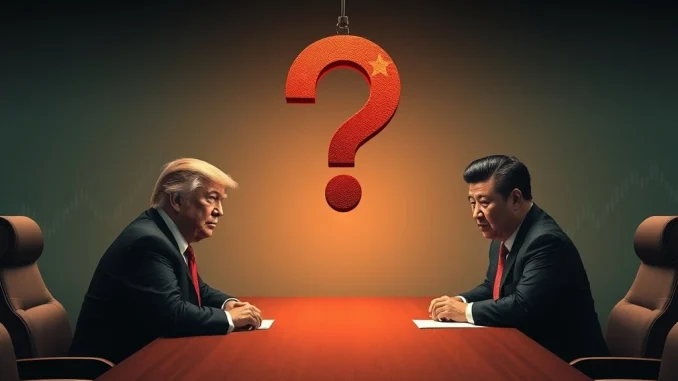
President Donald Trump recently indicated his expectation for a favorable **US-China trade deal**. However, he also introduced a note of caution. Trump suggested that a direct meeting with Chinese President Xi Jinping might not occur as anticipated. This statement introduces significant **economic uncertainty** into global financial forecasts.
For context, trade relations between the United States and China have been a focal point for years. Both nations have imposed tariffs on billions of dollars worth of goods. These actions have impacted global supply chains and corporate earnings. Consequently, market participants closely monitor any signals regarding a potential resolution or escalation.
A comprehensive trade agreement could alleviate some of these pressures. It might boost global economic growth. Conversely, a prolonged stalemate or further escalation could deepen existing concerns. Investors watch for definitive steps rather than mere pronouncements. This ongoing situation keeps markets on edge.
Trump Xi Meeting: A Pivotal Point for Global Stability
The prospect of a direct **Trump Xi meeting** holds immense symbolic and practical weight. Such high-level engagements often signal serious intent towards resolution. When leaders meet, they can bypass bureaucratic hurdles. They can also forge personal understandings that facilitate agreements.
A successful meeting could lead to breakthroughs. It might establish a clear roadmap for resolving outstanding trade issues. However, if a meeting does not materialize, or if it concludes without progress, the implications could be negative. This scenario would signal a lack of immediate common ground. It would also prolong the period of **economic uncertainty** that has characterized global trade for some time.
The global community watches these developments closely. Major economies rely on stability between these two powerhouses. Therefore, any perceived shift in the likelihood or outcome of a **Trump Xi meeting** directly influences investor sentiment worldwide.
Understanding the Global Market Impact
The fluctuating prospects of a **US-China trade deal** have a direct **global market impact**. Stock markets, for instance, often react instantly to news about trade negotiations. Positive news can trigger rallies. Conversely, negative updates or increased tensions can lead to sell-offs. This volatility extends beyond equities.
Consider these key areas:
Commodity Prices: Trade disputes affect demand for raw materials. For example, tariffs on agricultural products impact prices for commodities like soybeans.
Currency Valuations: The U.S. dollar and Chinese yuan often see shifts. These changes reflect market expectations about trade flows and economic health.
Corporate Earnings: Many multinational corporations have significant exposure to both the U.S. and Chinese markets. Tariffs increase costs and reduce profits.
Furthermore, businesses face challenges in long-term planning. They delay investment decisions. This caution slows economic expansion. The interconnectedness of modern supply chains means disruptions in one region quickly spread globally.
Navigating Economic Uncertainty in a Connected World
**Economic uncertainty** describes a state where the future economic direction is unclear. This ambiguity makes it difficult for businesses and consumers to make informed decisions. When there is high uncertainty, spending and investment often decrease. This slowdown can impede economic growth.
Geopolitical tensions, like those surrounding the **US-China trade deal**, are major drivers of this uncertainty. Investors tend to become more risk-averse. They may shift assets into perceived safe havens. Historically, assets like gold, government bonds, and sometimes the U.S. dollar have served this purpose. However, in recent years, digital assets have also entered this conversation.
The global economy is deeply interconnected. Therefore, issues between the U.S. and China resonate far beyond their borders. Small and large businesses worldwide feel the effects. This environment requires careful strategic planning and adaptability from all market participants.
Cryptocurrency Outlook Amidst Geopolitical Volatility
The **cryptocurrency outlook** is increasingly intertwined with broader macroeconomic and geopolitical events. While initially seen as uncorrelated assets, digital currencies, especially Bitcoin, now often react to global market sentiment. When traditional markets face **economic uncertainty**, some investors consider Bitcoin as a potential hedge or ‘digital gold.’
For instance, if the **Trump Xi meeting** fails to materialize or yields disappointing results, traditional markets might experience a downturn. This situation could prompt some investors to explore alternative asset classes. Bitcoin’s decentralized nature and limited supply make it attractive to some. They see it as protection against inflation or currency devaluation. This perception can drive demand for cryptocurrencies.
However, cryptocurrencies also remain highly volatile. They can experience significant price swings in response to both positive and negative news. The growing institutional adoption of crypto means its correlation with traditional finance is increasing. Therefore, understanding global events like the **US-China trade deal** becomes vital for crypto investors. They must anticipate potential market reactions.
In summary, the interplay between geopolitical events, traditional market movements, and the **cryptocurrency outlook** is complex. Investors must remain vigilant. They need to monitor developments in global trade and diplomacy. This approach helps them make informed decisions in a dynamic financial landscape.
FAQs
Q1: How does the US-China trade deal uncertainty affect cryptocurrency prices?
A1: Uncertainty surrounding the US-China trade deal can increase volatility in traditional markets. This may lead some investors to seek alternative assets like Bitcoin, potentially driving up its price. Conversely, extreme market fear can cause a sell-off across all asset classes, including crypto.
Q2: Why is a Trump Xi meeting considered so important for global markets?
A2: A direct Trump Xi meeting signifies high-level commitment to resolving trade disputes. Such meetings can lead to breakthroughs, stabilize economic relations, and reduce global economic uncertainty. A lack of meeting or unproductive talks can signal ongoing tensions, negatively impacting market confidence.
Q3: What are the main drivers of global market impact from trade tensions?
A3: Key drivers include tariffs, which increase costs for businesses and consumers; supply chain disruptions; reduced corporate earnings for multinational companies; and a general decrease in investor confidence, leading to delayed investments and slower economic growth.
Q4: Is Bitcoin truly a ‘safe haven’ during economic uncertainty?
A4: The debate continues. Some view Bitcoin as ‘digital gold’ due to its decentralized nature and limited supply, seeing it as a hedge against inflation and traditional market instability. However, its high volatility means it also carries significant risk, and its safe-haven status is not universally accepted, especially during severe market downturns.
Q5: How can crypto investors stay informed about geopolitical events?
A5: Crypto investors should follow reputable financial news outlets, geopolitical analysis, and macroeconomic reports. Understanding global events, particularly those involving major economies like the US and China, provides context for potential market movements in both traditional and cryptocurrency markets.