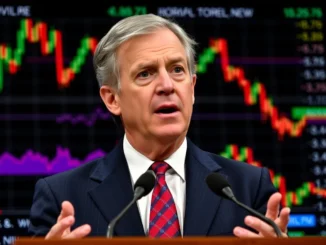
In a development poised to ripple through global markets, including the often-volatile cryptocurrency space, U.S. Treasury Secretary Scott Besent has indicated a strong likelihood of extending the US China tariff truce. This news, initially reported by Walter Bloomberg on X, suggests a significant easing of trade tensions between the world’s two largest economies, a factor that invariably influences broader market sentiment.
Understanding the Looming Tariff Deadline and Its Significance
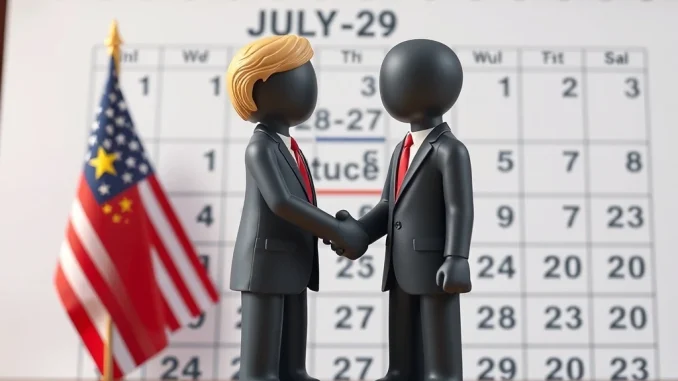
The announcement centers around an upcoming tariff deadline set for August 12. This date has been a point of anticipation for businesses and investors alike, as it could have triggered a renewal of tariffs, potentially escalating trade friction. Secretary Besent’s statement, however, provides a much-needed breath of fresh air, suggesting that a continuation of the current pause on tariffs is probable. The scheduled trade talks between the U.S. and China on July 28 and July 29 are crucial to formalizing this extension.
For those in the crypto community, while not directly tied to digital assets, global economic stability often correlates with investor confidence. A stable macroeconomic environment can encourage broader investment across asset classes, including cryptocurrencies, by reducing systemic risks.
The Role of the Treasury Secretary in Global Diplomacy
The U.S. Treasury Secretary plays a pivotal role not just in domestic fiscal policy but also in international economic relations. Scott Besent’s comments carry significant weight, signaling the U.S. administration’s intent to pursue a path of de-escalation rather than confrontation in its trade relationship with China. This approach can have far-reaching implications, fostering a more predictable environment for international trade and investment. The proactive communication about the likelihood of an extension aims to reduce market uncertainty ahead of the crucial talks.
Historically, periods of heightened trade tensions have often led to market volatility. Conversely, signs of diplomatic progress, such as a prolonged US China tariff truce, tend to be met with positive market reactions, contributing to a sense of relief and optimism among investors.
What Does This Mean for Economic Stability?
The potential extension of the tariff truce is a strong indicator of a commitment to fostering economic stability. Here’s why this is significant:
- Reduced Uncertainty: Businesses can plan more effectively without the immediate threat of new tariffs impacting supply chains and costs.
- Boost to Global Trade: A continued truce encourages smoother international trade flows, benefiting economies reliant on exports and imports.
- Investor Confidence: Predictability in trade relations can lead to increased investor confidence, potentially driving capital into various markets, including emerging technologies and assets.
- Inflationary Pressure: Avoiding new tariffs can help mitigate inflationary pressures on consumer goods, as import costs remain stable.
While the immediate impact on cryptocurrency markets might be indirect, a stronger global economy generally creates a more favorable environment for all risk assets. The absence of escalating trade wars removes a major headwind that could otherwise stifle growth and innovation.
Key Details of the Upcoming Trade Talks
The upcoming discussions, scheduled for July 28 and July 29, will be critical. While the specifics of the agenda are not fully public, the primary objective, as hinted by Secretary Besent, appears to be the formalization of the tariff truce extension. These talks represent an ongoing dialogue aimed at managing the complex economic relationship between the two superpowers. Success in these negotiations could pave the way for broader discussions on other contentious issues, moving beyond just tariffs to address intellectual property, market access, and industrial subsidies.
It’s important to remember that a truce is not a resolution. While it offers a reprieve, the underlying structural issues in US-China trade relations will still need to be addressed in the long term. However, this likely extension buys time and demonstrates a willingness from both sides to engage diplomatically.
The Road Ahead: Challenges and Opportunities
While the news is largely positive, challenges remain. Future negotiations will need to tackle more deeply rooted issues. However, the opportunity for sustained dialogue and a more stable global economic environment is clear. For businesses, this means continued monitoring of trade policies and adapting strategies to leverage the period of reduced tension.
In conclusion, the signal from U.S. Treasury Secretary Scott Besent regarding a likely extension of the US China tariff truce is a significant development. It underscores a shared interest in maintaining economic stability and managing the critical bilateral relationship. As the July trade talks approach, the world will be watching closely for the official confirmation that could bring a prolonged period of calm to global trade, benefiting markets far and wide.
Frequently Asked Questions (FAQs)
Q1: What is the US China tariff truce?
The US China tariff truce refers to a temporary agreement between the United States and China to halt the imposition of new tariffs or to reduce existing ones, aiming to de-escalate trade tensions and facilitate negotiations on broader trade issues.
Q2: Why is the extension of the tariff truce important?
An extension of the tariff truce is crucial because it reduces uncertainty for businesses, promotes smoother global trade, and contributes to overall economic stability. It signals a willingness from both nations to resolve differences through dialogue rather than escalating trade wars, which can negatively impact global markets and supply chains.
Q3: How does this news impact cryptocurrency markets?
While not a direct driver, a stable global economic environment generally fosters investor confidence. Reduced trade tensions and increased economic predictability can encourage broader investment across asset classes, including cryptocurrencies, by mitigating systemic risks and creating a more favorable climate for growth.
Q4: Who is Scott Besent and what is his role in these talks?
Scott Besent is the U.S. Treasury Secretary. In this role, he is a key figure in shaping and executing U.S. economic policy, including international trade relations. His statements carry significant weight, indicating the administration’s stance and intentions regarding the ongoing trade discussions with China.
Q5: What is the significance of the July 28-29 trade talks?
The trade talks scheduled for July 28 and 29 are critical as they are expected to formalize the extension of the tariff truce. These discussions will set the immediate tone for US-China economic relations and could lay the groundwork for addressing more complex, long-term trade issues.