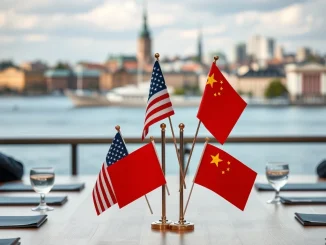
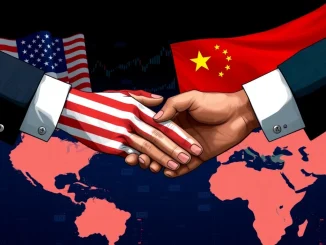
In an increasingly interconnected world, the stability of **US-China relations** holds immense significance. Even for those deeply invested in the dynamic cryptocurrency market, understanding global geopolitical currents is vital. These high-level discussions between the world’s two largest economies often ripple through international trade, technology, and financial markets. Therefore, tracking their progress, especially amidst challenges, becomes paramount for anticipating broader economic shifts.
Xi Jinping Calls for Stability in US-China Relations
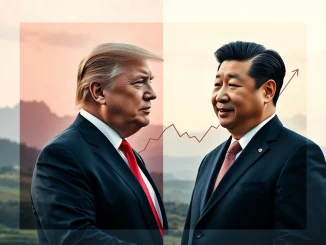
Chinese President Xi Jinping recently underscored the imperative for **US-China relations** to advance constructively. He made these remarks on Thursday during a pivotal summit. Despite acknowledged headwinds and inherent challenges, President Xi stressed the need to move forward. This sentiment, reported by Yonhap News, highlights a desire for continuity and predictability in one of the world’s most critical bilateral relationships. His comments came during his opening remarks at a summit with U.S. President Donald Trump.
The meeting took place at the Naraemaru reception hall on Gimhae Air Base in Busan. Xi noted that the relationship has largely maintained significant stability. He also acknowledged that disagreements are normal. This is due to the differing national situations of the two countries. Such a pragmatic view suggests a recognition of underlying complexities. However, it also points to a commitment to managing these differences. Ultimately, this aims to prevent broader destabilization.
Navigating Global Challenges and Bilateral Ties
The relationship between the United States and China is multifaceted. It spans trade, technology, security, and human rights. Consequently, managing this intricate balance is a constant diplomatic endeavor. Both nations face various **global challenges**, from climate change to economic uncertainties. These issues often require coordinated international responses. Therefore, effective communication between Washington and Beijing is essential.
President Xi’s emphasis on a “right path” signifies a strategic approach. It seeks to avoid confrontational trajectories. Instead, it promotes a framework for dialogue and cooperation. This is especially true where common interests align. For instance, global economic recovery benefits from stable trade flows between the two giants. Furthermore, advancements in critical technologies often involve both countries. This dynamic underscores the interwoven nature of their economies. The ongoing dialogue, despite its difficulties, is a testament to the importance both sides place on these **bilateral ties**.
Key areas of focus often include:
- Trade Policy: Addressing tariffs, intellectual property, and market access.
- Technological Competition: Navigating advancements in AI, semiconductors, and 5G.
- Regional Security: Managing tensions in areas like the South China Sea and Taiwan.
- Climate Change: Collaborating on environmental initiatives and emissions reduction.
The Importance of Diplomatic Efforts Amidst Headwinds
Even with substantial disagreements, **diplomatic efforts** remain crucial. President Xi’s statements confirm this commitment. He acknowledged the existence of “headwinds.” These refer to the various obstacles and points of contention. These include economic competition and geopolitical rivalries. Yet, the call for moving forward “in the same direction” indicates a desire for shared goals. This might involve areas like global health or nuclear non-proliferation. Ultimately, a stable relationship benefits the entire international community. It provides a degree of predictability in an unpredictable world.
The summit in Busan served as a vital platform. It allowed leaders to engage directly. Such direct communication can often de-escalate tensions. It can also clarify intentions. This is particularly important given the potential for misunderstandings. Both nations play significant roles on the global stage. Therefore, their interactions have far-reaching implications. Maintaining open channels for dialogue is not merely an option. It is a necessity for global stability and economic prosperity.
Understanding the Dynamics of US-China Global Challenges
The relationship between the U.S. and China is not static. It evolves constantly, influenced by domestic politics and international events. Therefore, understanding its dynamics is key. The current phase is characterized by both competition and interdependence. While strategic rivalry exists, economic integration remains deep. Many companies, for example, have supply chains spanning both countries. This creates a powerful incentive for stability. Neither nation can afford a complete decoupling without significant economic consequences.
President Xi’s remarks underscore a long-term perspective. He recognizes that short-term issues should not derail the overall trajectory. Instead, they should be managed within a broader framework. This framework prioritizes peace and mutual benefit. For instance, cooperation on global financial stability is a shared interest. Similarly, addressing pandemics requires coordinated responses. These are areas where the two powers can, and often do, find common ground. Their ability to manage their differences sets a precedent for international relations worldwide.
In conclusion, President Xi Jinping’s recent statements offer a clear signal. He aims for a stable and forward-moving relationship with the United States. Despite significant **global challenges** and differing national situations, the emphasis remains on cooperation. This ongoing diplomatic engagement is fundamental. It impacts not only the two nations but also the broader international landscape, including global markets and technological advancements.
Frequently Asked Questions (FAQs)
Q1: What was the main message from Chinese President Xi Jinping regarding US-China relations?
President Xi Jinping emphasized that US-China relations must move forward on the right path and in the same direction, despite existing headwinds and challenges. He called for stability and acknowledged that disagreements are normal given their differing national situations.
Q2: Where did the summit between President Xi and President Trump take place?
The summit took place at the Naraemaru reception hall on Gimhae Air Base in Busan.
Q3: What are some key areas of contention or cooperation in US-China bilateral ties?
Key areas include trade policy (tariffs, intellectual property), technological competition (AI, 5G), regional security (South China Sea, Taiwan), and global issues like climate change and pandemics.
Q4: Why are stable US-China relations considered crucial for the global community?
Stable US-China relations are crucial because both nations are the world’s largest economies and play significant roles in global trade, technology, security, and climate initiatives. Their interactions profoundly impact international stability and economic prosperity worldwide.
Q5: What does President Xi mean by “headwinds and challenges” in the context of US-China relations?
“Headwinds and challenges” refer to various obstacles and points of contention, such as economic competition, geopolitical rivalries, differences in human rights approaches, and strategic disagreements that can hinder smooth diplomatic progress.
Q6: How do these diplomatic discussions impact global markets, including cryptocurrency?
While not directly tied to cryptocurrency, stable US-China relations foster global economic predictability and reduce geopolitical risks. This can positively influence investor sentiment across all markets, including traditional finance and the volatile cryptocurrency space, by creating a more stable macroeconomic environment.