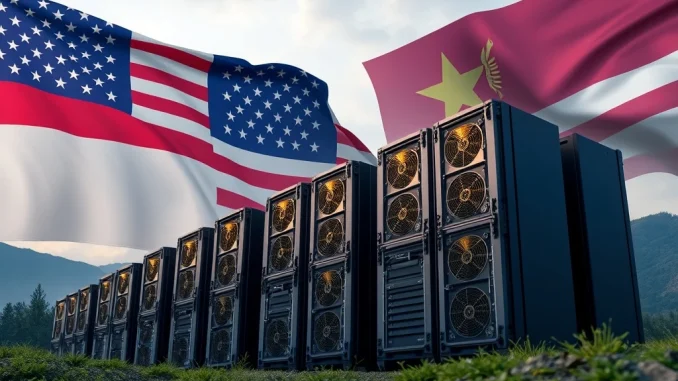
The landscape of US Bitcoin mining is undergoing a significant shift. Miners across the United States now confront a substantial increase in equipment costs. The White House recently finalized new reciprocal tariffs, directly impacting the import of vital Application-Specific Integrated Circuit (ASIC) mining rigs. This development creates a challenging environment for domestic operations.
Unpacking the New ASIC Tariffs on US Bitcoin Mining
The U.S. government has imposed an additional 19% tariff on ASIC tariffs originating from Indonesia, Malaysia, and Thailand. This new duty adds to existing import charges. Consequently, the total import duties on these essential machines now reach a considerable 21.6%. Luxor Technology, a prominent Bitcoin mining software and services company, recently confirmed these figures in an interview with The Block. This measure aims to balance trade relations. Furthermore, it reflects broader economic strategies. However, it places an immediate financial burden on U.S. based miners.
These tariffs target specific countries. Indonesia, Malaysia, and Thailand are key manufacturing hubs for various electronic components, including ASICs. Therefore, this policy directly impacts the global supply chain for mining hardware. American companies importing these rigs will now pay significantly more. This affects both established large-scale operations and smaller, emerging mining firms. The increased cost of entry could deter new participants. Moreover, it might slow the expansion plans of existing ones. The tariffs became effective immediately, requiring miners to adjust their procurement strategies swiftly.
Immediate Impact on Bitcoin Mining Rigs
The immediate consequence of these tariffs is clear: higher acquisition costs for Bitcoin mining rigs. For miners, these machines represent the primary capital expenditure. A 21.6% increase translates into millions of dollars for large-scale facilities purchasing hundreds or thousands of units. This directly affects profitability projections. Miners operate on thin margins, often influenced by Bitcoin’s price fluctuations and electricity costs. Adding a significant tariff further squeezes these margins. Consequently, some planned expansions might face delays or cancellations. This situation could also make U.S. mining less competitive globally.
Industry experts are closely monitoring the situation. They suggest that the tariffs could force miners to reassess their business models. Many operations rely on a constant influx of new, more efficient hardware. This allows them to maintain a competitive hash rate. With higher equipment costs, upgrading becomes more expensive. This might slow down the adoption of newer generation rigs. Furthermore, it could prolong the operational life of older, less efficient models. This ultimately impacts the overall efficiency of the U.S. mining fleet. Miners must now carefully weigh the cost benefits of importing versus seeking alternative solutions.
The Ripple Effect on Crypto Mining Costs
The tariffs will inevitably drive up overall crypto mining costs within the United States. Equipment is a major expense, but the impact extends beyond the initial purchase price. Higher equipment costs might necessitate increased financing for new projects. This could lead to higher interest rates for loans. Moreover, it could reduce the return on investment (ROI) for new mining ventures. Existing miners might also find it harder to secure capital for upgrades. The tariffs could also create a ripple effect throughout the supply chain. Suppliers might pass on increased import costs to their distributors and ultimately to the miners. This creates a complex economic challenge.
This situation compels U.S. miners to explore various mitigation strategies. Some might try to absorb the increased costs. Others may pass them on to their clients, if applicable. However, the most likely outcome involves a search for new procurement avenues. Miners could look to manufacturers in countries not subject to these specific tariffs. This might include China, though its own trade relations with the U.S. are complex. Alternatively, they might consider domestic manufacturing options. However, scaling domestic production of advanced ASICs presents its own set of challenges and requires significant investment. The tariffs certainly add another layer of complexity to an already dynamic industry.
Strategic Shifts in Global Bitcoin Mining
These tariffs prompt significant strategic shifts within the global Bitcoin mining landscape. U.S. Bitcoin miners, facing increased domestic costs, are actively considering overseas expansion. Setting up operations in countries with lower equipment costs or more favorable energy prices becomes an attractive alternative. Nations in South America, Africa, or even parts of Europe might see increased interest from U.S. firms. This decentralization of mining operations could impact the global distribution of Bitcoin’s hash rate. A more diversified global mining footprint could emerge. This shift would reflect economic pressures rather than purely geographical advantages.
Furthermore, the tariffs could accelerate the trend of miners seeking diverse supply sources. Relying heavily on a few countries for critical hardware carries inherent risks. Geopolitical tensions or new trade policies can quickly disrupt supply chains. Therefore, miners may prioritize manufacturers in a wider array of nations. This diversification strategy aims to reduce dependency and enhance resilience. The tariffs serve as a stark reminder of the interconnectedness of global trade and its direct impact on specialized industries like cryptocurrency mining. The industry is adapting, seeking new solutions to maintain growth and profitability.
Navigating the Future of US Bitcoin Mining
The future of US Bitcoin mining hinges on how the industry adapts to these new trade policies. Industry associations and major mining companies are likely to engage in lobbying efforts. They will aim to influence future tariff decisions or seek exemptions. Such advocacy is crucial for mitigating the long-term impact on domestic competitiveness. Meanwhile, companies are exploring innovative solutions. This includes optimizing existing hardware efficiency and investing in renewable energy sources. Reducing operational costs can offset some of the increased equipment expenses. The industry remains resilient and continues to seek pathways for sustainable growth.
Moreover, the tariffs could inadvertently stimulate domestic innovation. The increased cost of imported ASICs might make domestic manufacturing more economically viable. While challenging, developing U.S.-based ASIC production capabilities would enhance supply chain security. It would also create new jobs within the country. This long-term vision requires substantial investment and governmental support. The current tariff situation serves as a catalyst for such strategic discussions. The U.S. mining sector is at a crossroads, where strategic decisions made today will shape its trajectory for years to come. The goal remains to maintain a strong, competitive position in the global Bitcoin network.
The imposition of 21.6% tariffs on Southeast Asian ASIC mining rigs presents a formidable challenge for U.S. Bitcoin miners. This move elevates equipment costs, impacting profitability and potentially driving miners to consider overseas expansion. The industry must now navigate these increased financial burdens. It must also explore new supply chains and potentially advocate for policy adjustments. The resilience and adaptability of the U.S. Bitcoin mining sector will be tested. Its response will shape its future role in the global cryptocurrency landscape.
Frequently Asked Questions (FAQs)
Q1: What are the new tariffs imposed on Southeast Asian mining rigs?
The U.S. has finalized reciprocal tariffs of 19% on ASIC mining rigs from Indonesia, Malaysia, and Thailand. This brings the total import duties on these rigs to 21.6%.
Q2: How do these ASIC tariffs impact US Bitcoin mining operations?
These tariffs significantly increase the cost of acquiring new ASIC mining rigs for U.S. miners. This directly impacts their capital expenditure, reduces profitability, and makes it more challenging to expand or upgrade their operations competitively.
Q3: Why were these tariffs specifically imposed on Southeast Asian countries?
The tariffs are described as ‘reciprocal,’ suggesting they are part of broader U.S. trade policies aimed at balancing trade relations or responding to existing trade practices with Indonesia, Malaysia, and Thailand. These countries are significant manufacturers of electronic components, including ASICs.
Q4: Will these tariffs lead to higher crypto mining costs for consumers?
While the tariffs directly affect the operational costs of miners, the impact on consumers is indirect. Higher mining costs could potentially influence the overall supply and demand dynamics of Bitcoin, but typically, the price of Bitcoin is driven by a multitude of global factors rather than solely mining costs.
Q5: Are US Bitcoin miners considering moving operations overseas due to these tariffs?
Yes, some U.S. Bitcoin miners are indeed considering overseas expansion. The increased equipment costs at home make setting up operations in countries with more favorable tariff structures or lower energy costs an attractive alternative to maintain profitability and competitiveness.
Q6: What is the long-term outlook for US Bitcoin mining given these tariffs?
The long-term outlook for US Bitcoin mining will depend on several factors. These include the industry’s ability to find alternative supply chains, potential lobbying efforts to influence future trade policies, and the possibility of stimulating domestic ASIC manufacturing. The sector aims to adapt and maintain its competitive edge despite these challenges.