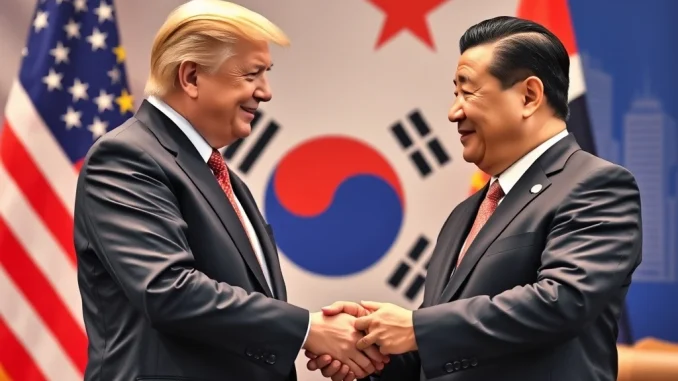
Global financial markets frequently react to major geopolitical developments. Therefore, news of an anticipated **Trump Xi meeting** carries significant weight. Investors, including those in the cryptocurrency space, often watch these high-level discussions closely. Geopolitical stability often underpins market confidence. This upcoming summit could shape the trajectory of the **global economy** for months to come.
Anticipated Trump-Xi Meeting: A Glimmer of Hope for Global Stability
U.S. Treasury Secretary Scott Bessent recently confirmed President Donald Trump’s expectation. He stated that Trump still anticipates a meeting with Xi Jinping in South Korea. Walter Bloomberg reported this significant development. This potential meeting comes at a critical juncture. It offers a crucial opportunity for dialogue amid escalating tensions. Such high-level discussions are vital for international relations.
This anticipated **Trump Xi meeting** underscores ongoing efforts. Both nations seek to navigate complex economic challenges. A successful dialogue could ease market anxieties. It might also pave the way for future cooperation. Conversely, a lack of progress could deepen existing uncertainties. Many observers hope for positive outcomes from these important talks.
The Stakes of US-China Trade Talks
The relationship between the United States and China remains pivotal. It influences global trade patterns and economic stability. Ongoing **US-China trade talks** have been fraught with challenges. Tariffs and retaliatory measures have characterized recent years. These actions have impacted numerous industries worldwide. Consumers have also felt the effects.
Key areas of contention include intellectual property rights and market access. State subsidies for Chinese industries also remain a major point of disagreement. Resolving these issues is paramount. It would foster a more predictable international trade environment. Therefore, the upcoming meeting holds immense importance for both countries. It also impacts their global partners significantly.
Diplomatic Efforts Intensify Ahead of South Korea Summit
Secretary Bessent further indicated a series of meetings. These discussions will occur this week. Their purpose is to address China’s recent **export restrictions**. Such preparatory talks are standard diplomatic practice. They aim to lay groundwork for the leaders’ summit. These meetings allow officials to discuss complex issues. They also seek potential solutions before the principals meet.
The choice of location, **South Korea summit**, adds another layer of significance. South Korea maintains strong economic ties with both the US and China. It often plays a balancing act in regional diplomacy. Hosting such a high-stakes meeting highlights its geopolitical importance. Furthermore, the summit provides a neutral ground. This environment can facilitate more open and productive discussions between the two powers.
Understanding China’s Export Restrictions
China’s **export restrictions** represent a powerful economic tool. These measures can significantly disrupt global supply chains. They affect industries reliant on specific Chinese goods or raw materials. The nature of these restrictions varies. They can range from outright bans to stricter licensing requirements. Such actions often aim to exert diplomatic pressure. They also protect domestic industries or strategic resources.
The global technology sector, for instance, is particularly vulnerable. Many companies depend on components or rare earth minerals from China. Therefore, these restrictions can lead to price volatility. They can also force companies to seek alternative suppliers. This search for new sources is often costly and time-consuming. Understanding the scope and impact of these restrictions is crucial for international businesses.
Broader Economic Implications of the Trump Xi Meeting
A positive outcome from the **Trump Xi meeting** could immediately boost market sentiment. It might signal a de-escalation of trade tensions. This would reduce uncertainty for businesses. Conversely, a stalemate or further escalation could trigger market downturns. Investors often react to such news with caution. They seek stability in volatile times.
Beyond immediate market reactions, long-term implications are substantial. Progress in **US-China trade talks** could stabilize global supply chains. It might also encourage greater international investment. Conversely, continued friction could fragment the **global economy**. This fragmentation would force countries to choose sides. It would also create parallel trade systems. This makes the upcoming discussions exceptionally important for future economic trends.
Ultimately, the anticipated meeting between President Trump and President Xi holds immense importance. It offers a critical opportunity for dialogue. Addressing **export restrictions** and other trade issues is paramount. The outcomes will undoubtedly shape the future of international relations. They will also impact the **global economy** for years to come. All eyes remain on the upcoming **South Korea summit** as these crucial discussions unfold.
Frequently Asked Questions (FAQs)
Q1: What is the primary purpose of the anticipated Trump-Xi meeting?
A1: The primary purpose is to discuss and potentially resolve ongoing trade disputes. This includes addressing China’s export restrictions and other points of contention between the two nations.
Q2: Who is U.S. Treasury Secretary Scott Bessent?
A2: U.S. Treasury Secretary Scott Bessent confirmed President Trump’s expectation to meet Xi Jinping. He plays a key role in economic diplomacy and trade negotiations.
Q3: Why is South Korea chosen as the location for the summit?
A3: South Korea often serves as a neutral ground for high-level international diplomacy. It maintains significant economic ties with both the United States and China, making it a suitable host for such crucial talks.
Q4: How do China’s export restrictions affect the global economy?
A4: China’s export restrictions can disrupt global supply chains, particularly for industries reliant on specific Chinese goods or raw materials. They can also create market volatility and force companies to seek costly alternative sources.
Q5: What are the potential outcomes of the US-China trade talks?
A5: Potential outcomes range from a de-escalation of trade tensions and a boost in market confidence to a deepening of existing disputes, leading to further economic uncertainty and fragmentation of the global economy.