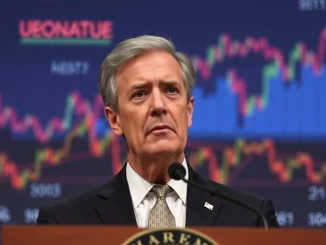
The financial world recently buzzed with significant news. Reports suggest that U.S. President Donald Trump’s inner circle favors Federal Reserve (Fed) Governor Christopher Waller as the next Fed Chair. This development, reported by Walter Bloomberg on X, carries substantial weight. It could signal a notable shift in the direction of the Federal Reserve and its critical monetary policy. Investors, especially those in the dynamic cryptocurrency market, closely watch such appointments. Future economic decisions directly influence asset valuations, including digital currencies. Therefore, understanding these potential changes is crucial for informed investment strategies.
Donald Trump’s Preference: A Closer Look at Christopher Waller
Sources indicate that Donald Trump and his advisors are eyeing Governor Christopher Waller for a top leadership role. Waller currently serves as a member of the Federal Reserve Board of Governors. His appointment to this influential position came in December 2020. Before joining the Fed, Waller held the role of Director of Research at the Federal Reserve Bank of St. Louis. He also served as a professor at the University of Notre Dame. These experiences have significantly shaped his economic views.
A new Fed Chair profoundly impacts the nation’s economic trajectory. The President appoints the Fed Chair, subject to Senate confirmation. This individual leads the central bank. They guide its decisions on interest rates, inflation, and employment. Consequently, a change in leadership can alter the Fed’s strategic approach. This, in turn, affects financial markets worldwide. Presidents often seek a Fed Chair whose economic philosophy aligns with their broader agenda, aiming for policy consistency.
The Federal Reserve’s Critical Role in Shaping Monetary Policy
The Federal Reserve operates as the central bank of the United States. Its primary mandates are clear: achieve maximum employment and maintain price stability. To fulfill these goals, the Fed uses various tools. These actions collectively form the backbone of U.S. monetary policy. The Fed’s decisions ripple through the economy, influencing everything from consumer spending to business investment.
The Fed’s main tools include:
- Adjusting the federal funds rate: This influences short-term interest rates throughout the economy.
- Engaging in open market operations: Buying or selling government securities to inject or withdraw money from the banking system.
- Setting reserve requirements: Dictating how much money banks must hold in reserve.
- Implementing quantitative easing (QE) or tightening (QT): Large-scale asset purchases or sales to influence long-term interest rates and market liquidity.
For instance, when the Fed raises interest rates, borrowing becomes more expensive. This can slow economic growth and help curb inflation. Conversely, lowering rates stimulates borrowing and spending, boosting economic activity. The Fed’s independence is crucial. It allows the institution to make decisions based on economic data, rather than political pressures. This independence helps ensure long-term stability. Understanding the Fed’s functions is key to grasping market movements.
Christopher Waller’s Economic Stance and Outlook
Christopher Waller is known for his clear and often hawkish views on inflation. He consistently emphasizes the importance of bringing inflation down to the Fed’s 2% target. Waller believes that price stability is fundamental for sustained economic growth. He has often advocated for aggressive action to combat rising prices. For example, he supported rapid interest rate hikes in recent years. This stance aligns with a focus on controlling inflation even if it means some short-term economic slowdown.
Waller’s academic background and previous roles inform his perspective. He has published extensive research on monetary theory and central banking. This expertise gives him a deep understanding of economic mechanisms. His public statements often highlight the need for data-driven decisions. He frequently stresses the importance of waiting for clear evidence of sustained inflation reduction before easing policy. Consequently, his leadership as Fed Chair would likely prioritize inflation control. This focus could influence future interest rate paths significantly. His pragmatic approach suggests he would adapt to economic conditions, but with a strong bias towards price stability.
Potential Shifts in Monetary Policy Under a New Fed Chair
A new Fed Chair brings a fresh perspective to the Federal Open Market Committee (FOMC). This committee sets the nation’s interest rates. If Christopher Waller were to assume this role, significant changes in monetary policy could occur. His known hawkish leanings suggest a potential for continued vigilance against inflation. This might mean a readiness to maintain higher interest rates for longer periods. Alternatively, he might advocate for quicker responses to inflation spikes. These actions would aim to anchor inflation expectations firmly.
Historically, different chairs have emphasized different aspects of the Fed’s dual mandate. For example, some prioritize employment, while others focus on price stability. Waller’s appointment could signal a stronger emphasis on the latter. Furthermore, his approach to quantitative tightening (QT) could differ. QT involves reducing the Fed’s balance sheet. These policy shifts can influence everything from mortgage rates to corporate investments. Businesses and consumers alike would feel these effects. A more predictable, inflation-focused Fed could, in the long run, foster greater economic stability, though the path to achieve it might involve tighter conditions initially.
How Federal Reserve Decisions Influence the Cryptocurrency Market
The Federal Reserve‘s monetary policy decisions have a profound impact on risk assets. Cryptocurrencies, while distinct, often behave like risk assets. When interest rates are low, borrowing money is cheap. This encourages investment in higher-risk, higher-reward assets. Consequently, cryptocurrencies often perform well during periods of accommodative monetary policy, such as the era of quantitative easing following the 2008 financial crisis or during the COVID-19 pandemic. Investors seek greater returns when traditional investments yield little.
Conversely, when the Fed raises interest rates, the appeal of safer investments like bonds increases. This can draw capital away from speculative assets such as Bitcoin and Ethereum. Higher rates also increase the cost of capital for businesses. This can reduce overall market liquidity. Therefore, a hawkish Fed, potentially led by Christopher Waller, could create headwinds for the crypto market. A stronger U.S. dollar, often a result of higher rates, can also make dollar-denominated assets like crypto less attractive to international investors. Market participants closely monitor every Fed announcement for clues about future policy. Understanding this correlation is vital for crypto investors to anticipate market shifts.
Navigating the Future: What Donald Trump’s Choice Means for Investors
The prospect of Donald Trump selecting Christopher Waller as the next Fed Chair introduces a layer of anticipation for investors. Waller’s consistent focus on inflation control suggests a potentially firm stance on interest rates. This could lead to a less accommodative monetary environment than some might prefer. For traditional markets, this implies a focus on stability over rapid growth. For cryptocurrencies, it signals a need for caution. The broader economic outlook, shaped by the Fed’s decisions, directly impacts investor sentiment and capital flows into risk assets.
Investors should monitor several key indicators. These include inflation reports, employment figures, and the Fed’s own economic projections. Waller’s public speeches and FOMC minutes will offer further insights into his policy leanings. Additionally, geopolitical events and fiscal policy decisions will interact with monetary policy, creating a complex economic landscape. Ultimately, the Fed’s actions under new leadership will shape the economic backdrop. This backdrop significantly influences the performance of all asset classes, including the volatile crypto sector. Being informed helps investors make strategic decisions and adapt their portfolios accordingly.
Frequently Asked Questions (FAQs)
Q1: What is the primary role of the Federal Reserve Chair?
The Fed Chair leads the Federal Reserve System. This person sets the agenda for the Federal Open Market Committee (FOMC). The FOMC determines the nation’s interest rates and other monetary policies. The Chair acts as the public face of the Fed. They communicate its decisions to Congress and the public. This role is crucial for economic stability and market confidence.
Q2: Who is Christopher Waller, and what are his known economic views?
Christopher Waller is a current Governor on the Federal Reserve Board. He was previously the Director of Research at the Federal Reserve Bank of St. Louis. Waller is generally considered hawkish on inflation. He strongly advocates for maintaining price stability. He believes this is essential for long-term economic health. His views suggest a readiness to use interest rate adjustments to control rising prices, prioritizing inflation control over other economic factors.
Q3: How does a change in Fed Chair typically impact monetary policy?
A new Fed Chair can significantly influence monetary policy. The Chair guides the FOMC. They can shift the emphasis between the Fed’s dual mandates of maximum employment and price stability. Different chairs may favor different tools or approaches. This can lead to changes in interest rate paths, quantitative easing, or quantitative tightening strategies. The overall economic direction can change as a result, affecting inflation, employment, and market liquidity.
Q4: How might Christopher Waller’s potential appointment affect the cryptocurrency market?
If Christopher Waller becomes Fed Chair, his hawkish stance on inflation could lead to a less accommodative monetary environment. This generally means higher interest rates. Higher rates make risk assets, including cryptocurrencies, less attractive. Investors might shift funds to safer, yield-bearing assets. Consequently, this could create downward pressure or slower growth for crypto markets. Conversely, an unexpected dovish turn could have the opposite effect.
Q5: What are the primary mandates of the Federal Reserve?
The Federal Reserve has two primary mandates given by Congress. These are often called the ‘dual mandate’. First, it aims for maximum employment. This means striving for the lowest unemployment rate consistent with price stability. Second, it works to maintain price stability. This involves controlling inflation to prevent erosion of purchasing power. The Fed uses its monetary policy tools to achieve both objectives, balancing them as economic conditions evolve.
Q6: Why is the Fed Chair appointment so important for investors?
The Fed Chair holds immense power over the economy. Their decisions on interest rates and money supply directly impact borrowing costs, corporate profits, and investment returns across all asset classes. For investors, the Fed Chair’s stance provides a crucial signal about the future economic environment. This helps them position their portfolios, whether in stocks, bonds, or cryptocurrencies, to align with anticipated market conditions and mitigate risks.