In the dynamic world of finance, where every geopolitical tremor sends ripples across markets, the ongoing saga of President Donald Trump’s trade negotiations with the European Union is a narrative that demands attention. For cryptocurrency enthusiasts and investors, understanding these macro-economic shifts is crucial, as they directly influence traditional market sentiment, which often spills over into the digital asset space. The potential for a Trump trade deal or the imposition of new tariffs could dramatically alter global economic landscapes, impacting everything from supply chains to investor risk appetite.
Understanding the Trump Trade Deal Strategy
President Donald Trump’s approach to international trade has consistently been characterized by a blend of assertive negotiation and strategic ambiguity. His recent statements indicate a 50% chance of securing a trade agreement with the European Union, a figure that itself underscores the unpredictable nature of his administration’s foreign policy. This dual strategy involves pushing for bilateral deals with key partners while simultaneously applying significant pressure, often in the form of tariff threats, on nations yet to engage or concede. The proposed 15% tariff rate on EU goods, though lower than previous threats of 30%, still marks a significant increase from the current 10% baseline, which Trump has controversially labeled “the new zero.” This recalibration aims to reshape global commerce, aligning with reciprocal investment commitments seen in agreements with countries like Indonesia (19%) and the Philippines (25%). However, the lack of clarity regarding terms with major partners like India and Canada, where tariffs as high as 35% have been reportedly warned, keeps markets on edge. Analysts suggest this leveraging of uncertainty is a deliberate tactic to extract concessions, though it undeniably fuels market volatility and diplomatic friction.
The Looming Specter of EU Tariffs
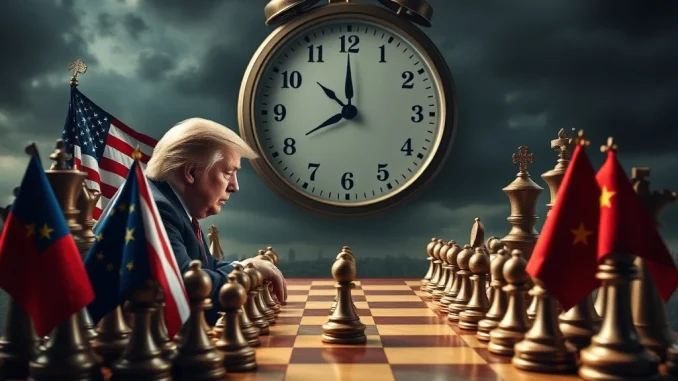
The threat of increased EU tariffs remains a central point of contention in the transatlantic trade dialogue. European leaders have voiced significant concerns, with German Chancellor Friedrich Merz warning that a 30% tariff would inflict “severe damage” on German exporters. In response, the EU has prepared retaliatory measures, reportedly targeting $100 billion in U.S. goods, though the specifics are yet to be disclosed. This prepares the ground for a potential trade war, where both sides could suffer significant economic consequences. The asymmetry in trade relations is notable: the U.S. aims to reduce its goods trade deficit with the EU (where the bloc currently holds a surplus), while the EU maintains a substantial $109 billion services deficit with the U.S. This complex dynamic makes reaching a mutually beneficial agreement particularly challenging. The August 1 deadline looms large, serving as a critical point where negotiations could either yield a breakthrough or escalate into a full-blown tariff confrontation.
Navigating US Trade Policy: A Balancing Act?
The broader context of US trade policy under the Trump administration reveals a pattern of rapid adjustments and aggressive stances. The administration’s stated goal is to establish a “global trade standard” aimed at rebalancing international commerce in favor of the United States. This involves not only direct tariff threats but also the strategic use of deadlines and public statements to influence negotiations. While Treasury Secretary Scott Bessent has hinted at additional deals on the horizon, the persistent absence of concrete details for key partners like India and Canada continues to generate uncertainty. This approach, characterized by unpredictability, has strained transatlantic relations, with European leaders openly expressing frustration. The challenge for the U.S. lies in balancing its assertive demands for fairer trade with the need to maintain stable diplomatic and economic alliances, particularly with long-standing partners in Europe and Asia.
Broader Implications for Global Trade
The outcomes of these negotiations extend far beyond the immediate parties, casting a long shadow over global trade. A potential 15% EU deal might offer short-term relief, but it wouldn’t necessarily resolve the deeper structural issues in U.S.-Europe trade relations. More critically, the specter of 50% tariffs on non-negotiating countries underscores the administration’s aggressive stance and its willingness to disrupt established trade norms. Such measures could lead to significant reconfigurations of global supply chains, forcing companies to reconsider manufacturing locations and distribution networks. This uncertainty deters long-term investment and could slow down global economic growth. The interconnectedness of modern economies means that trade disputes between major players like the U.S. and the EU have ripple effects, impacting developing nations, commodity prices, and overall economic stability worldwide.
Impact on Market Volatility and Investor Confidence
The ambiguity inherent in Trump’s messaging has directly translated into heightened market volatility. Rumors of a potential 15% deal have occasionally boosted risk appetite, signaling a brief reprieve for investors. However, the persistent threat of higher tariffs, particularly the 30% figure, has sustained hedging strategies across various sectors. Industries like aviation, for instance, face potential market-share losses, as ePlaneAI forecasts suggest. This environment of ‘wait and see’ makes strategic planning difficult for businesses and investors alike. For those in the cryptocurrency space, understanding this traditional market sentiment is key. When global trade tensions rise, investors often seek safe havens, which can include traditional assets like gold or, increasingly, decentralized assets like Bitcoin. Conversely, a resolution or de-escalation could free up capital for riskier assets, potentially benefiting the crypto market. The Justice Integrity Project has rightly highlighted how Trump’s tariff rhetoric has strained transatlantic relations, contributing to an overall climate of unpredictability that directly impacts investor confidence globally.
As the August 1 deadline rapidly approaches, the world watches with bated breath to see how President Trump’s trade strategy unfolds. The delicate balance between securing favorable bilateral deals and avoiding a full-blown trade war will define the immediate future of U.S.-EU relations and, by extension, the broader global economic landscape. While a 15% tariff deal with the EU could provide temporary calm, the underlying aggressive stance towards non-negotiating countries suggests that trade tensions are likely to remain a significant factor in international relations. For investors, businesses, and indeed, the cryptocurrency community, staying informed and adapting to this evolving geopolitical and economic climate will be paramount.
Frequently Asked Questions (FAQs)
Q1: What is the primary focus of President Trump’s trade negotiations with the EU?
A1: President Trump’s primary focus is to secure a bilateral trade agreement with the European Union, aiming to reduce the U.S. goods trade deficit and establish new tariff rates, potentially starting at 15%.
Q2: What is the significance of the August 1 deadline?
A2: The August 1 deadline is a crucial point for negotiations between the U.S. and the EU. If a deal is not reached by this date, President Trump has threatened to impose significantly higher tariffs, potentially reaching 30% or more, on European goods.
Q3: How might these trade tensions impact global supply chains?
A3: Increased tariffs and trade uncertainty could force companies to re-evaluate their global supply chains, potentially leading to manufacturing shifts, increased costs, and disruptions in the flow of goods worldwide as businesses seek to mitigate risks.
Q4: What are the potential retaliatory measures from the EU?
A4: The European Union has prepared retaliatory measures targeting approximately $100 billion in U.S. goods if the U.S. imposes higher tariffs. The specific products targeted have not yet been disclosed.
Q5: How does this trade policy affect market volatility?
A5: The unpredictable nature of Trump’s trade rhetoric and the looming threat of tariffs contribute to heightened market volatility. This uncertainty influences investor confidence, prompting hedging strategies and potentially leading to shifts in asset allocation across traditional and digital markets.