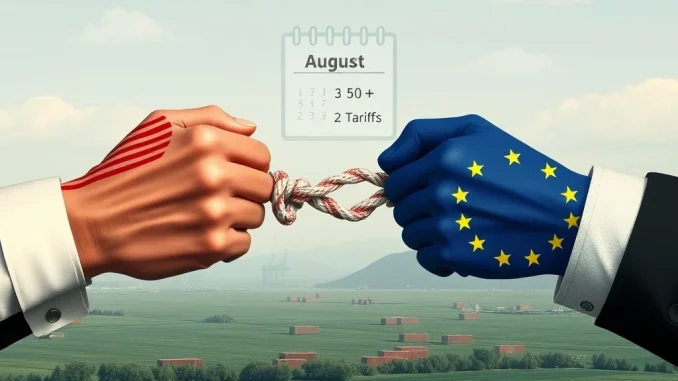
The global economic landscape is bracing for significant shifts as former President Donald Trump’s latest pronouncements on tariffs send ripples across international markets. While the immediate focus might be on traditional finance, these developments have a profound, albeit indirect, impact on the stability and sentiment within the cryptocurrency space. The looming threat of new Trump tariffs and the precarious state of the US-EU trade deal are creating an environment of heightened uncertainty, prompting investors to closely watch the unfolding diplomatic drama.
Understanding the Looming Trump Tariffs
In a recent press conference, Donald Trump laid out his administration’s renewed strategy for international trade, emphasizing tariffs as a powerful bargaining chip. He announced plans to impose new tariffs ranging from 15% to 50% on goods from various countries, with specific threats aimed at the European Union. For the EU, a critical August 1 deadline has been set: failure to finalize a comprehensive trade agreement by this date would trigger a substantial 30% tariff on most EU goods, alongside targeted penalties for specific industries.
This aggressive stance is not new, but the specified rates and timeline add a fresh layer of urgency. Trump described these as “a straight, simple tariff of anywhere between 15% and 50%,” indicating a baseline of 15% from which negotiations might commence, but no willingness to go lower. Over the coming days, nearly 200 tariff letters are expected to be issued, some already specifying rates of 10% or 15%. This move underscores a clear intent to reshape trade relationships through economic leverage.
The US-EU Trade Deal: A High-Stakes Stalemate
The prospect of a new US-EU trade deal hangs by a thread, with Trump himself assessing the likelihood of an agreement to reduce import tariffs as “50-50,” acknowledging it could even be “less.” This declaration intensifies the diplomatic scramble ahead of the August 1 deadline. EU officials have not been passive observers; they previously authorized retaliatory tariffs on U.S. goods, a measure held in abeyance pending the outcome of negotiations.
The dance between Washington and Brussels is a delicate one. While the EU seeks to avoid a full-blown trade conflict, its preparedness for countermeasures signals a firm resolve to protect its economic interests. The ongoing discussions are pivotal, as a partial agreement, as suggested by economist Holger Schmieding, could potentially mitigate the broader risks of a trade war. However, with Trump having previously hinted at rates as high as 30% or 50%, the pressure on EU negotiators is immense.
Navigating Global Trade Dynamics
Trump’s approach prioritizes bilateral negotiations over multilateral frameworks, a strategy that analysts suggest could strain broader international trade partnerships. The implications extend far beyond the US-EU relationship, affecting the intricate web of global trade. Countries like Japan have already voiced concerns over the potential impact on profit margins for their agricultural exports, while India and other major economies face similar uncertainties regarding their trade relations with the U.S.
The unilateral nature of these tariff threats contrasts sharply with established multilateral trade agreements and organizations, such as the World Trade Organization (WTO). This shift in approach raises questions about the future stability and predictability of international commerce, potentially leading to a more fragmented global economic order. Businesses reliant on complex global supply chains are particularly vulnerable to these sudden policy shifts, facing increased costs and logistical challenges.
Is a Full-Blown Trade War Imminent?
The rhetoric from both sides suggests that the possibility of a significant trade war is very real. The EU has already taken preparatory steps, emphasizing its readiness to expand retaliatory actions if the August 1 negotiations fail. This tit-for-tat dynamic could escalate rapidly, creating a cascade of tariffs and counter-tariffs that disrupt international commerce on an unprecedented scale.
A full-blown trade war could have severe repercussions, leading to higher prices for consumers, reduced corporate profits, and slower economic growth globally. Businesses would be forced to re-evaluate their sourcing and distribution strategies, potentially leading to significant job losses and economic instability in affected sectors. The global economy, still navigating various post-pandemic challenges, can ill afford another major shock of this magnitude.
Assessing the Economic Impact and Market Reactions
Analysts are unified in their warnings: such widespread tariff measures could significantly disrupt global supply chains and exacerbate inflationary pressures. The direct economic impact would be felt by consumers through higher prices for imported goods and by businesses through increased input costs. Industries heavily reliant on international trade, from automotive to agriculture, would face immediate challenges.
Market reactions are already showing signs of nervousness. Uncertainty tends to dampen investment and consumer confidence, which can lead to volatility across financial markets, including equities, commodities, and even cryptocurrencies. While crypto markets might seem insulated, they are ultimately tied to broader economic health and investor sentiment. A downturn in traditional markets due to trade tensions could lead to capital flight or, conversely, a flight to perceived safe havens, impacting digital asset valuations.
Conclusion: What’s Next for Global Trade?
The August 1 deadline is not just a date on a calendar; it’s a critical juncture for global trade and economic stability. While the 50% chance of a U.S.-EU deal offers a glimmer of hope for de-escalation, the aggressive tariff rhetoric has already begun to reshape international trade dynamics. Trump’s strategy of prioritizing bilateral talks over multilateral agreements continues to strain broader trade partnerships, creating an environment of unpredictability.
If no resolution is reached, the EU’s readiness to broaden its retaliatory scope could trigger a more widespread trade conflict, impacting economies worldwide. Investors and businesses alike must remain vigilant, monitoring diplomatic efforts and preparing for potential market volatility. The coming weeks will be crucial in determining whether the global economy navigates towards a path of renewed cooperation or deeper trade disputes.
Frequently Asked Questions (FAQs)
1. What are the key tariffs announced by Trump?
Donald Trump has announced plans to impose new tariffs ranging from 15% to 50% on goods from various countries. Specifically for the EU, a 30% tariff on most goods is threatened if a trade deal isn’t finalized by August 1, along with industry-specific penalties.
2. What is the significance of the August 1 deadline?
The August 1 deadline is critical for the U.S. and EU to reach a trade agreement. If no deal is finalized by this date, Trump has stated that a 30% tariff will be triggered on most EU goods, escalating trade tensions significantly.
3. How has the EU responded to the tariff threats?
The EU has previously authorized retaliatory tariffs on U.S. goods. While their full implementation has been delayed pending negotiations, European officials have emphasized their preparedness to expand retaliatory actions if a trade agreement is not reached.
4. What are the potential economic consequences of these tariffs?
Analysts warn that these measures could disrupt global supply chains, exacerbate inflation, and lead to increased costs for consumers and businesses. They could also contribute to market uncertainty and slower economic growth worldwide.
5. How do these trade tensions affect global markets, including crypto?
While not directly impacting crypto, global trade tensions create economic uncertainty that can influence overall market sentiment. Increased inflation, supply chain disruptions, or a downturn in traditional markets due to a trade war could lead to shifts in investment patterns, potentially affecting liquidity and valuations in the cryptocurrency space.