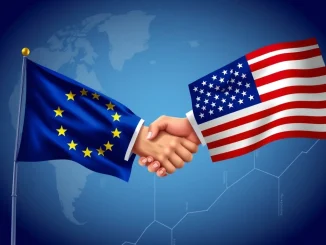
In the ever-evolving landscape of global finance, even non-crypto-specific news can send ripples through digital asset markets. The latest seismic shift comes from former U.S. President Donald Trump, whose ambitious 15-50% Trump tariffs plan is set to redefine international commerce. Understanding these sweeping changes in US trade policy is crucial, as they directly influence economic stability, market confidence, and ultimately, the broader investment climate that impacts cryptocurrency valuations.
Trump Tariffs: Reshaping Global Commerce
U.S. President Donald Trump has unveiled a comprehensive tariff policy, targeting over 150 countries with proposed rates ranging from 15% to 50% on imports. Announced in late July 2025, this framework signals a significant shift toward protectionism, poised to reshape U.S. trade relationships globally. The policy emphasizes simplicity, with most countries receiving baseline tariff notifications of “probably 10 or 15%.” However, Trump has explicitly reserved the option to escalate these rates up to 50% in specific, targeted cases.
This approach blends punitive threats with strategic negotiation, a hallmark of Trump’s previous trade strategies. The underlying goal is to prioritize domestic manufacturing and achieve a more balanced trade sheet for the United States, compelling trading partners to renegotiate terms on American conditions.
Navigating New Global Trade Deals
The announcement of these tariffs has already spurred a flurry of diplomatic activity and the finalization of key global trade deals. Here’s a quick look at how major economies are responding:
- U.S.-Japan Agreement: A significant breakthrough saw the U.S. and Japan finalize a trade deal settling on a 15% tariff for Japanese goods. This rate is notably lower than the initially threatened 30%, showcasing Trump’s strategy of using high tariff threats as leverage to secure more favorable, albeit still tariff-laden, terms.
- U.S.-EU Discussions: Meanwhile, the U.S. and the European Union appear to be nearing a similar 15% tariff agreement. Despite progress, European officials remain cautious, signaling potential retaliatory measures if negotiations falter or if the terms prove too burdensome.
- North American Scrutiny: For neighboring countries, Mexico and Canada, heightened scrutiny is evident. Tariffs of 30% and 35% respectively are slated to take effect on August 1, signaling a tougher stance on cross-border trade within North America.
These varying rates across nations, from the 15% settled with Japan to the higher figures for Mexico and Canada, highlight the complex, multi-tiered system emerging from this policy.
Understanding the Economic Impact
The proposed tariffs have understandably triggered considerable global economic uncertainty. Analysts are closely watching for several potential repercussions:
- Inflationary Pressures: A primary concern is the potential for increased inflationary pressures within the U.S. As tariffs raise the cost of imported goods, American consumers and businesses will likely face higher prices, impacting purchasing power and operational costs.
- Mitigation through Negotiation: However, negotiated deals, like the one with Japan, offer a glimmer of hope. By allowing partners to avoid the upper tariff limits, the broader economic impact may be somewhat mitigated, preventing the most severe disruptions.
- Supply Chain Reorientation: Businesses worldwide are now forced to re-evaluate their sourcing strategies. Prolonged trade tensions could disrupt financial stability, compelling countries and corporations to prioritize cost-efficient sourcing over diversified supply chains, potentially leading to significant shifts in global manufacturing and distribution networks.
While major indices haven’t yet shown significant volatility, the long-term effects of these shifts are a critical watchpoint for investors and economists alike.
The Future of US Trade Policy
This new framework underscores a fundamental reorientation of US trade policy toward bilateral negotiations, moving away from multilateral agreements. Trump’s strategy is clear: use tariffs as a powerful tool of leverage to compel trading partners to renegotiate terms on American conditions. The initial 10-15% baseline announced in July, contrasting with the 15% settled with Japan, suggests a strategic elevation of minimum rates, setting a new floor for trade discussions.
However, significant enforcement complexities remain. Despite Trump’s emphasis on simplicity, the varying rates for specific nations—Japan, Mexico, and Canada—underscore the administrative challenges inherent in managing such a multi-tiered system. Furthermore, the lack of detailed timelines for tariffs beyond August 1 adds a layer of uncertainty for businesses and governments attempting to navigate this new framework.
Forging International Agreements Amidst Uncertainty
The landscape of international agreements is clearly shifting. While the U.S. aims to secure favorable terms, this strategy risks straining relationships with traditional partners if negotiations stall or if perceived non-compliance arises. The world is watching to see how other nations will adapt, whether through similar bilateral deals or through the formation of new trade blocs to counter U.S. protectionism.
The coming months will be critical in determining the full scope and long-term consequences of this bold trade strategy. Businesses, governments, and investors must remain agile and informed to adapt to these rapidly changing dynamics.
Conclusion
Donald Trump’s sweeping tariff plan marks a pivotal moment in global trade, signaling a clear shift towards protectionism and bilateral negotiation. While the strategy has already yielded some significant global trade deals, such as the agreement with Japan, it also introduces considerable uncertainty and potential for inflationary pressures. The ongoing discussions with the EU and the impending tariffs on North American neighbors highlight a complex, evolving landscape. As nations adapt to this new US trade policy, the ultimate economic impact will depend heavily on the success of future international agreements and the resilience of global supply chains. Keeping a close eye on these developments is essential for anyone navigating the interconnected world economy.
Frequently Asked Questions (FAQs)
1. What is the core of Trump’s new tariff plan?
Trump’s plan proposes tariffs ranging from 15% to 50% on imports from over 150 countries. It aims to shift U.S. trade policy towards protectionism and bilateral negotiations, prioritizing domestic manufacturing and trade balance.
2. How have countries like Japan and the EU responded to these Trump tariffs?
Japan has successfully negotiated a 15% tariff rate on its goods, lower than the initially threatened 30%. The U.S. and the European Union are also nearing a 15% tariff agreement, though EU officials remain cautious about potential retaliatory measures.
3. What is the potential economic impact of these new trade policies?
The tariffs could lead to inflationary pressures in the U.S. as import costs rise. However, negotiated deals may mitigate broader impacts. Globally, businesses might reorient supply chains, prioritizing cost-efficiency over diversification due to prolonged trade tensions.
4. How does this US trade policy affect North American trade partners?
Mexico and Canada are set to face higher tariffs, with rates of 30% and 35% respectively, taking effect on August 1. This signals increased scrutiny and potential challenges for cross-border trade within North America.
5. What are the main challenges in implementing these international agreements?
Challenges include the administrative complexities of managing varying tariff rates for different nations, and the lack of detailed timelines beyond initial announcements, which creates uncertainty for businesses and governments.
6. How might these trade policies indirectly affect cryptocurrency markets?
While not directly related, major shifts in global trade policy and their economic impact can influence overall market confidence and stability. Economic uncertainty or inflation could lead investors to re-evaluate traditional assets, potentially increasing volatility or interest in alternative investments like cryptocurrencies, as market sentiment often impacts digital asset valuations.