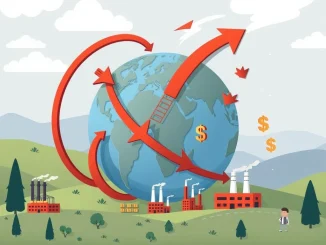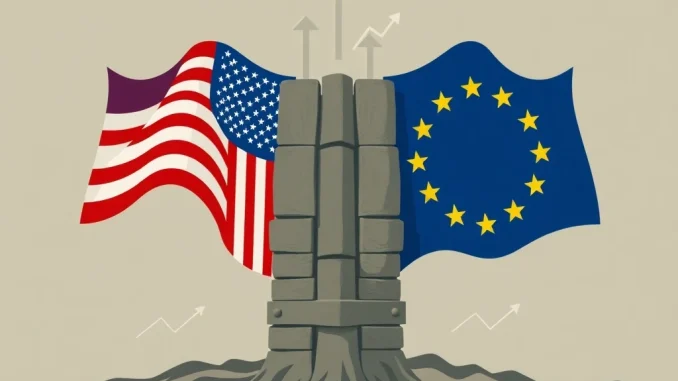
The global economic landscape is a delicate balance, and any tremor can send ripples across markets, including the often-volatile world of cryptocurrencies. Recent reports suggest a significant tremor might be on the horizon: former U.S. President Donald Trump is reportedly considering imposing a hefty 15-20% minimum tariff on all goods imported from the European Union if he returns to office. This potential move, initially reported by Walter Bloomberg citing the Financial Times, could dramatically reshape EU trade relations and trigger widespread trade war fears, with profound global economic impact.
Trump Tariffs: Unpacking the Proposed EU Trade Overhaul
The concept of Trump tariffs is not new, but the proposed scale for European goods marks a potentially aggressive escalation. The suggestion of a 15-20% minimum tariff on all EU imports signals a significant shift from previous, more targeted trade measures. This isn’t just about specific industries; it’s a broad-brush approach that could affect everything from luxury cars and agricultural products to high-tech components and consumer goods.
A ‘minimum tariff’ implies a baseline charge, meaning that even if specific trade deals or agreements exist, this foundational tariff would apply. This could fundamentally alter the economics of importing goods from the EU, making them significantly more expensive for American consumers and businesses. For European exporters, it means a substantial increase in the cost of doing business with one of their largest markets, potentially eroding their competitive edge and profitability.
The Looming Specter of Renewed Trade War Fears
The prospect of such substantial tariffs immediately brings to mind the ‘trade wars’ of Trump’s previous presidency, particularly with China. The term ‘trade war’ isn’t just hyperbole; it describes a cycle of retaliatory tariffs and protectionist measures between countries, where each side imposes duties on the other’s imports, leading to a tit-for-tat escalation. Should the U.S. impose these new Trump tariffs, it’s highly probable that the European Union would respond with its own retaliatory measures on American goods.
Historically, the EU has shown a willingness to defend its economic interests. For instance, during previous trade disputes, the EU has targeted specific U.S. products like Harley-Davidson motorcycles, bourbon, and Levi’s jeans. Such actions are designed to exert political pressure and demonstrate resolve. A full-blown trade war between two of the world’s largest economic blocs would be unprecedented in its potential scope and would cast a long shadow over global commerce.
Assessing the Global Economic Impact: Who Stands to Lose?
The global economic impact of a 15-20% tariff on all EU goods would be multifaceted and largely negative. Here’s a breakdown of potential consequences:
- Higher Consumer Prices: Importers would likely pass on the increased cost of tariffs to consumers, leading to higher prices for a wide range of goods. This could fuel inflation and reduce consumer purchasing power.
- Supply Chain Disruptions: Businesses reliant on European components or finished goods would face increased costs and pressure to find alternative suppliers, leading to complex and expensive supply chain reconfigurations.
- Reduced Trade Volumes: The higher costs associated with tariffs would inevitably lead to a decrease in the volume of goods traded between the U.S. and the EU, shrinking bilateral trade.
- Economic Slowdown: Reduced trade, higher prices, and business uncertainty can collectively dampen economic growth in both the U.S. and the EU, and by extension, globally.
- Job Losses: Industries heavily reliant on imports or exports could face job losses as businesses struggle with increased costs or reduced demand.
- Investor Uncertainty: The unpredictable nature of trade wars often leads to heightened investor uncertainty, making businesses hesitant to invest and potentially causing capital flight from affected regions.
The ripple effect wouldn’t stop at the U.S. and EU borders. Other trading partners, intertwined through complex global supply chains, would also feel the squeeze, contributing to a broader economic slowdown.
Navigating Market Volatility: What This Means for Investors and Crypto
Financial markets notoriously dislike uncertainty, and the prospect of new, sweeping Trump tariffs would undoubtedly inject significant market volatility. Traditional assets like stocks, bonds, and currencies would likely react sharply:
- Equity Markets: Stock markets, particularly those with heavy exposure to international trade or companies that import/export heavily from the EU, could see significant declines.
- Bond Markets: Government bonds, often seen as safe havens during times of uncertainty, might see increased demand, pushing yields down.
- Currency Markets: The U.S. dollar and Euro could experience significant fluctuations as traders react to trade policy shifts and their potential impact on respective economies.
For the cryptocurrency market, the implications are less straightforward. While crypto assets like Bitcoin are often touted as uncorrelated or a hedge against traditional financial systems, they are not immune to macro-economic shifts. In periods of extreme market volatility and uncertainty, crypto can sometimes act as a risk-on asset, experiencing sell-offs alongside equities. However, for some investors, Bitcoin’s decentralized nature and limited supply make it an attractive alternative when traditional financial systems face stress or inflation fears rise due to policies like tariffs.
The key for crypto investors will be to monitor how the broader financial markets react and understand that while crypto may offer a different risk profile, it is still influenced by the overall sentiment around global economic impact and stability.
Beyond the Headlines: What’s Next for US-EU Trade Relations?
While the proposal of these new Trump tariffs is a significant headline, it’s important to remember that such policies are complex to implement and face numerous political and economic hurdles. The U.S. President has considerable power over trade policy, but domestic industries, consumer groups, and international allies would all weigh in. Furthermore, the EU would certainly engage in intense diplomatic efforts to avert or mitigate such tariffs.
The ultimate outcome will depend on various factors, including the political landscape in both the U.S. and the EU, the willingness of both sides to negotiate, and the perceived economic costs of a full-blown trade conflict. Regardless of the immediate implementation, the mere discussion of such substantial tariffs creates an environment of uncertainty that businesses and investors must contend with.
In conclusion, the potential imposition of a 15-20% minimum tariff on all EU trade goods by a future Trump administration represents a significant challenge to global economic stability. It revives trade war fears, threatens to disrupt supply chains, increase consumer costs, and create substantial market volatility across traditional and potentially crypto markets. Understanding these dynamics is crucial for anyone navigating the complex interplay of politics, economics, and finance in today’s interconnected world.
Frequently Asked Questions (FAQs)
1. What exactly are ‘Trump tariffs’ being proposed for EU goods?
The proposed ‘Trump tariffs’ refer to a potential 15-20% minimum tariff that former U.S. President Donald Trump is reportedly considering imposing on all goods imported from the European Union if he returns to office. This is a broad, across-the-board tariff, unlike previous, more targeted duties.
2. How would a 15-20% tariff affect EU trade with the U.S.?
A 15-20% tariff would significantly increase the cost of EU goods entering the U.S., making them less competitive. This would likely lead to reduced trade volumes, higher prices for American consumers, and pressure on European exporters to find new markets or absorb increased costs, potentially impacting their profitability and production.
3. What are the potential global economic impacts of such tariffs?
The potential global economic impact includes higher consumer prices, supply chain disruptions, reduced overall trade volumes, and a general slowdown in economic growth in both the U.S. and the EU. It could also lead to increased investor uncertainty and job losses in affected sectors worldwide.
4. Could this proposal lead to renewed ‘trade war fears’?
Yes, absolutely. The proposal for such significant Trump tariffs on all EU goods strongly suggests a potential escalation into a trade war. The EU would likely retaliate with its own tariffs on U.S. goods, creating a cycle of protectionist measures that could harm both economies and global commerce.
5. How might market volatility stemming from tariffs affect cryptocurrency?
Increased market volatility from trade tensions could lead to unpredictable movements in cryptocurrency markets. While some view crypto as a hedge, it can also act as a risk-on asset, experiencing sell-offs during broader market downturns. However, its decentralized nature might also appeal to some investors seeking alternatives during traditional financial system stress.
6. Has the U.S. imposed significant tariffs on the EU before?
Yes, during his previous term, Donald Trump imposed tariffs on certain EU products, including steel and aluminum, leading to retaliatory tariffs from the EU. However, the current proposal for a 15-20% minimum tariff across all goods would represent a much broader and potentially more impactful measure than previous actions.