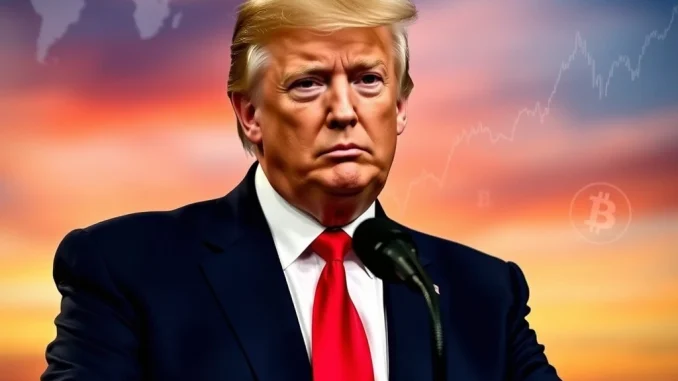
President Donald Trump has announced an urgent meeting regarding tariffs, scheduled for tomorrow. This development immediately captured attention across traditional financial markets. However, for those in the digital asset space, the implications extend directly to the **cryptocurrency market**. Such high-stakes discussions often trigger significant shifts in investor sentiment. Consequently, understanding the potential ripple effects on assets like Bitcoin becomes crucial for savvy investors.
Unpacking the Trump Tariffs Emergency Meeting
President Trump confirmed an emergency meeting on tariffs. This announcement signals a renewed focus on trade policy, a hallmark of his previous administration. Details surrounding the meeting’s agenda remain scarce. Nevertheless, observers anticipate discussions on existing tariffs and potential new trade barriers. Historically, the Trump administration implemented various tariffs on goods from countries like China. These actions aimed to protect domestic industries and rebalance trade deficits. Therefore, this upcoming meeting could significantly influence global economic relations.
The Broader Global Trade Impact
Tariff decisions carry a substantial **global trade impact**. Imposing new tariffs, or adjusting existing ones, can disrupt established supply chains. Manufacturers often face increased costs, which can then be passed on to consumers. Furthermore, retaliatory tariffs from other nations frequently follow. This creates a cycle of trade disputes. Such scenarios often lead to reduced international trade volumes. Moreover, they can hinder economic growth worldwide. Businesses, consequently, must adapt quickly to changing trade landscapes.
Consider these potential effects:
- Supply Chain Disruptions: Companies may need to re-evaluate sourcing.
- Increased Consumer Prices: Tariffs often raise the cost of imported goods.
- Reduced Corporate Profits: Businesses might absorb some tariff costs.
- International Relations Strain: Trade disputes can escalate diplomatic tensions.
These factors collectively contribute to a complex and often unpredictable economic environment. Investors closely monitor these developments for early indicators of market shifts.
Economic Uncertainty Fuels Market Volatility
Major policy announcements, like an emergency tariff meeting, often breed **economic uncertainty**. Investors dislike uncertainty; they seek stability. When traditional markets perceive instability, capital frequently flows into perceived safe-haven assets. Gold has long served this purpose. However, in recent years, Bitcoin has increasingly been viewed as a potential alternative. This perception stems from its decentralized nature and limited supply. Therefore, periods of heightened economic doubt can sometimes correlate with increased interest in digital assets.
Financial analysts are already assessing the potential fallout. Stock markets might react with caution, exhibiting increased volatility. Bond yields could fluctuate as investors seek security. Currency markets also feel the pressure, with major currencies potentially weakening against perceived safer assets. These reactions highlight the interconnectedness of global finance. A significant policy shift in one major economy can send tremors across the entire system. Investors, consequently, must remain vigilant and informed.
Cryptocurrency Market Reacts to Geopolitical Shifts
The **cryptocurrency market** is not immune to global geopolitical and economic events. While often operating independently, it frequently responds to broader financial trends. Bitcoin, as the leading cryptocurrency, often acts as a barometer for the wider digital asset space. When traditional markets show signs of stress, some investors turn to Bitcoin. They view it as a hedge against inflation or a store of value outside government control. This ‘digital gold’ narrative gains traction during times of significant global events.
Past instances demonstrate this correlation. For example, during periods of geopolitical tension or significant economic downturns, Bitcoin has sometimes seen upward price movements. Conversely, if tariff talks lead to a resolution that boosts global confidence, traditional markets might rally. This could potentially draw some capital away from cryptocurrencies in the short term. Analyzing the **Bitcoin price** requires considering both internal crypto dynamics and external macroeconomic factors. Therefore, the outcome of tomorrow’s meeting could certainly influence its trajectory.
Analyzing Bitcoin Price Movements
Monitoring the **Bitcoin price** in response to such events is critical for investors. Analysts will observe immediate price action following the meeting’s outcome. They will also track trading volumes and market sentiment indicators. A sudden surge in buy orders could signal a flight to safety. Conversely, a sharp decline might suggest a broader market sell-off, impacting all asset classes. Traders often use technical analysis alongside fundamental news to make informed decisions. Furthermore, other cryptocurrencies may follow Bitcoin’s lead, exhibiting similar price volatility. Understanding these dynamics is essential for navigating the complex crypto landscape.
Navigating the Future: Potential Scenarios and Investor Strategies
The emergency meeting on **Trump tariffs** presents several potential scenarios. The outcome could range from a reinforcement of existing trade policies to the introduction of new, more aggressive measures. Alternatively, the discussions might lead to de-escalation or new trade agreements. Each scenario carries distinct implications for global markets and, by extension, the **cryptocurrency market**. Investors should prepare for various possibilities rather than relying on a single forecast.
For cryptocurrency investors, a diversified portfolio remains a prudent strategy. While Bitcoin often captures headlines, other digital assets also offer unique value propositions. Staying informed about global economic news is paramount. Understanding how trade policies can create **economic uncertainty** helps in anticipating market shifts. Regularly reviewing investment strategies ensures alignment with current market conditions. Furthermore, avoiding emotional trading decisions is crucial during periods of heightened volatility. Rational analysis, based on factual information, should guide all investment choices.
Key strategies for investors include:
- Market Monitoring: Closely follow news from traditional financial markets and crypto exchanges.
- Risk Assessment: Evaluate the potential impact of various tariff outcomes on your portfolio.
- Portfolio Diversification: Spread investments across different asset classes and cryptocurrencies.
- Long-Term Perspective: Focus on long-term goals rather than short-term price fluctuations.
These steps help in mitigating risks and capitalizing on potential opportunities. The interplay between global politics, economics, and digital assets continues to evolve. Staying ahead of these trends is key to successful investing.
Conclusion
President Trump’s emergency meeting on tariffs marks a significant event on the global economic calendar. Its potential **global trade impact** could reverberate across industries and nations. This, in turn, fuels **economic uncertainty**, influencing investor behavior in both traditional and digital markets. Consequently, the **cryptocurrency market**, particularly the **Bitcoin price**, will be under close scrutiny. Investors must remain vigilant, informed, and strategic in their approach. Understanding the intricate connections between geopolitical decisions and market movements is essential for navigating these turbulent times effectively.
Frequently Asked Questions (FAQs)
Q1: What is the primary purpose of President Trump’s emergency meeting on tariffs?
A1: The primary purpose is to discuss and potentially make decisions regarding trade tariffs. This often involves reviewing existing tariffs, considering new ones, or addressing specific trade imbalances with other countries. The exact agenda is typically revealed closer to the meeting time.
Q2: How do Trump tariffs typically impact global trade?
A2: Trump tariffs, like any trade barriers, generally increase the cost of imported goods. This can lead to higher prices for consumers, reduced profits for businesses, and disruptions in global supply chains. Often, other countries respond with retaliatory tariffs, escalating trade disputes and impacting international economic relations.
Q3: Why is the cryptocurrency market sensitive to economic uncertainty?
A3: The cryptocurrency market, especially Bitcoin, is often sensitive to economic uncertainty because some investors view digital assets as a hedge against traditional financial instability. During periods of economic doubt, capital may flow into assets perceived as safe havens or alternatives to government-controlled currencies.
Q4: How might this meeting affect Bitcoin price specifically?
A4: The meeting could affect Bitcoin price in several ways. If the outcome increases global economic uncertainty, some investors might turn to Bitcoin as a ‘digital gold,’ potentially driving its price up. Conversely, if the meeting leads to a positive resolution that calms traditional markets, some capital might shift away from crypto in the short term. Volatility is generally expected.
Q5: What should cryptocurrency investors do in response to such news?
A5: Cryptocurrency investors should stay informed about the meeting’s outcome and its broader economic implications. Diversifying portfolios, maintaining a long-term investment perspective, and avoiding emotional trading decisions are prudent strategies. Regularly assessing risk and adjusting strategies as new information emerges is also advisable.