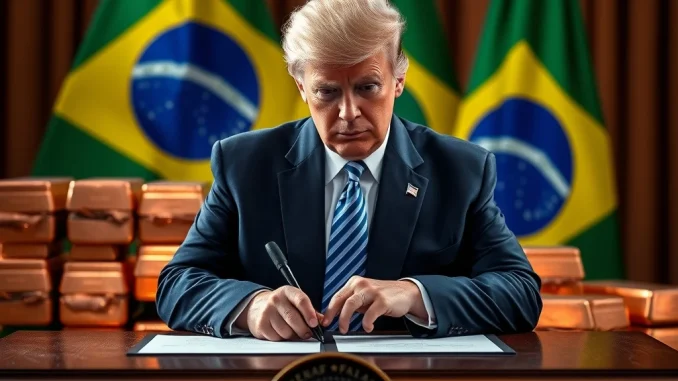
In a bold move to strengthen U.S. economic security, President Trump has announced a 50% tariff on copper and Brazilian imports. This decision, effective August 1, 2025, is set to reshape trade dynamics and supply chains. But what does this mean for the markets and global trade relations? Let’s dive in.
Trump Tariff: A Strategic Move for U.S. Security
The new Trump tariff targets semifinished copper products and Brazilian goods, previously under a 10% duty. The administration cites the International Emergency Economic Powers Act (IEEPA) to justify this escalation. Key impacts include:
- Increased production costs for U.S. manufacturers
- Disrupted supply chains in construction, energy, and agriculture
- Potential inflationary pressures reminiscent of 2018 metal tariffs
Copper Imports: Market Reactions and Fallout
Copper prices plunged following the announcement, with mining giants like Rio Tinto and BHP seeing stock declines. The tariffs, while not as broad as some feared, will significantly raise costs for U.S. importers and end users.
Brazilian Imports: Doubling Down on Trade Barriers
Brazil, a major U.S. trading partner, now faces a steep 50% tariff—double the previous rate. Analysts speculate this timing, just before an August 1 deadline, aims to heighten economic pressure. Retaliatory measures could spark a trade war.
U.S. Trade Policy: A Protectionist Shift
This move reflects Trump’s broader reliance on tariffs for economic leverage. While domestic producers may benefit short-term, long-term risks include higher consumer costs and reduced global competitiveness. The copper industry faces uncertainty as companies reassess supply chains.
Revoking Global De Minimis: A New Complexity
The administration also revoked the global de minimis tariff exemption, affecting small businesses and e-commerce. This adds another layer of complexity to the trade landscape.
Conclusion: A High-Stakes Gamble
Trump’s 50% tariff on copper and Brazilian imports is a high-stakes gamble to reshape global trade in favor of U.S. interests. While it may bolster domestic industries, the risks of inflation, supply chain disruptions, and trade wars loom large.
Frequently Asked Questions (FAQs)
What products are affected by the new Trump tariff?
The tariff targets semifinished copper products and a range of Brazilian goods previously under a 10% duty.
How will the tariff impact U.S. manufacturers?
Manufacturers will face higher production costs and potential supply chain disruptions, particularly in construction, energy, and agriculture.
What was Brazil’s previous tariff rate?
Brazilian imports were previously subject to a 10% duty, making the new 50% tariff a significant escalation.
Could this lead to a trade war?
While Brazil hasn’t announced retaliatory measures, the possibility of a trade war remains a concern among analysts.
How did markets react to the announcement?
Copper prices dropped, and mining stocks like Rio Tinto and BHP declined, reflecting broader economic concerns.
What is the global de minimis exemption?
This exemption allowed low-value imports to enter the U.S. duty-free. Its revocation adds complexity for small businesses and e-commerce.