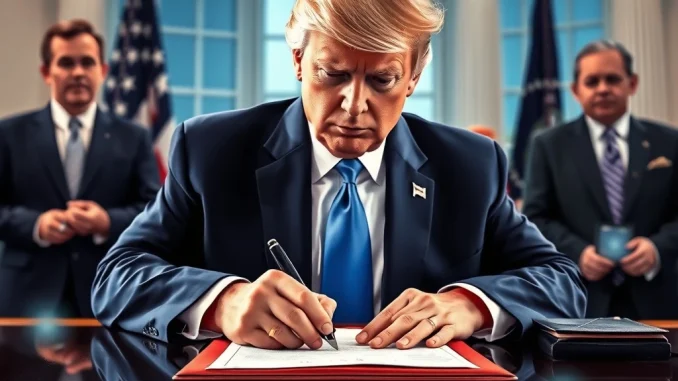
A monumental shift is underway in the world of digital finance. In a move that sent ripples through the cryptocurrency community, U.S. President Trump has officially signed the GENIUS Act into law. This groundbreaking legislation establishes a comprehensive regulatory framework for stablecoins across the United States, as reported by Decrypt. This isn’t just a signature on a piece of paper; it’s a decisive step that could redefine the landscape for stablecoin regulation and digital assets for years to come.
What Does the GENIUS Act Mean for Stablecoins?
The signing of the GENIUS Act marks a pivotal moment, moving stablecoins from a largely unregulated grey area into a defined legal structure. For years, the lack of clear guidelines has been a point of contention for both innovators and traditional financial institutions. This new law aims to provide that much-needed clarity.
While the full details of the act will unfold, typical regulatory frameworks for stablecoins often include provisions for:
- Issuance Standards: Requirements for entities that wish to issue stablecoins, including capital reserves and operational integrity.
- Reserve Requirements: Mandates on what assets must back stablecoins (e.g., cash, short-term government bonds) and how frequently these reserves must be audited and reported.
- Consumer Protection: Measures designed to safeguard users’ funds, ensure transparency, and provide recourse in case of issues.
- Anti-Money Laundering (AML) & Know Your Customer (KYC): Enhanced compliance obligations to prevent illicit financial activities.
This framework is designed to foster stability and trust, potentially paving the way for wider adoption of stablecoins in mainstream finance.
Why is Stablecoin Regulation Crucial Now?
The push for robust stablecoin regulation has been building for some time, driven by several factors. The rapid growth of the stablecoin market, with billions of dollars in circulation, has brought them to the attention of financial regulators worldwide. Previously, these digital assets operated with varying degrees of oversight, leading to concerns about systemic risk and investor confidence.
Regulators have highlighted concerns such as:
- Financial Stability: The potential for a large stablecoin’s collapse to impact broader financial markets, similar to a bank run.
- Consumer Trust: Ensuring that stablecoins are truly backed one-to-one by their underlying assets, preventing scams or insolvencies.
- Illicit Activities: The use of stablecoins in money laundering, terrorist financing, and other illegal transactions due to perceived anonymity.
The GENIUS Act directly addresses these points, aiming to integrate stablecoins safely into the existing financial ecosystem while mitigating potential risks.
Navigating the New US Stablecoin Law: Opportunities and Challenges
The implementation of a clear US stablecoin law presents a dual-edged sword, offering significant opportunities alongside new challenges for the crypto industry.
Opportunities:
- Increased Legitimacy: Regulatory clarity can attract more institutional investors and traditional financial players, viewing stablecoins as a less risky asset class.
- Enhanced Adoption: Businesses and consumers may feel more secure using regulated stablecoins for payments, remittances, and other financial services.
- Innovation with Certainty: Developers and entrepreneurs can build new applications and services on stablecoin rails with a clearer understanding of the legal boundaries.
- Global Leadership: The US setting a precedent for stablecoin regulation could influence global standards, solidifying its position in the digital finance landscape.
Challenges:
- Compliance Burden: Stablecoin issuers and related entities will face increased costs and operational complexities to meet the new regulatory requirements.
- Potential for Over-Regulation: Some fear that overly stringent rules could stifle innovation or make it difficult for smaller players to compete.
- Jurisdictional Arbitrage: Companies might consider relocating to jurisdictions with more lenient or favorable regulatory environments if the US framework is perceived as too restrictive.
The success of this law will depend on a balanced approach that fosters innovation while ensuring financial stability and consumer protection.
President Trump’s Stance on Crypto: A Shifting Landscape?
President Trump’s signing of the GENIUS Act marks a significant policy shift, particularly given his past public skepticism towards cryptocurrencies. While previous administrations and lawmakers have grappled with how to approach digital assets, this move signifies a decisive embrace of a regulatory path for a key segment of the crypto market. It suggests a recognition of stablecoins’ growing importance and their potential role in the broader economy.
This action by Trump crypto policy signals a potential shift towards greater engagement with the digital asset space, moving beyond simply acknowledging its existence to actively shaping its future through legislation. It highlights the bipartisan, and increasingly mainstream, acknowledgment that digital assets require a clear framework to thrive responsibly.
What’s Next for the Digital Asset Framework in the United States?
The GENIUS Act, while focused on stablecoins, is likely just the beginning of a broader evolution in the digital asset framework in the United States. This legislation sets a precedent for how the US government approaches crypto regulation, potentially influencing future laws concerning other types of cryptocurrencies, NFTs, and decentralized finance (DeFi).
Expect ongoing discussions and potential legislative efforts regarding:
- Token Classification: Clarifying whether various digital assets are securities, commodities, or something else entirely.
- Central Bank Digital Currencies (CBDCs): The US’s stance and potential development of a digital dollar.
- DeFi Regulation: How to oversee decentralized protocols without stifling their core principles of decentralization.
The signing of the GENIUS Act firmly positions the US as a key player in shaping the global regulatory landscape for digital assets. It sends a clear message that the era of regulatory ambiguity for stablecoins is drawing to a close, ushering in a new chapter for the entire crypto ecosystem.
A New Dawn for Digital Finance
The signing of the GENIUS Act by President Trump is more than just a legislative event; it’s a transformative moment for stablecoins and the broader digital asset market. By establishing a clear regulatory framework, the US is taking a proactive step towards integrating these innovative financial instruments into the mainstream economy. While challenges remain in navigating the new compliance landscape, the opportunities for increased trust, wider adoption, and accelerated innovation are immense. This act signals a new era where stablecoins can operate with greater certainty, potentially unlocking their full potential as a stable and reliable component of the global financial system. The future of digital finance in the US just got a whole lot clearer.