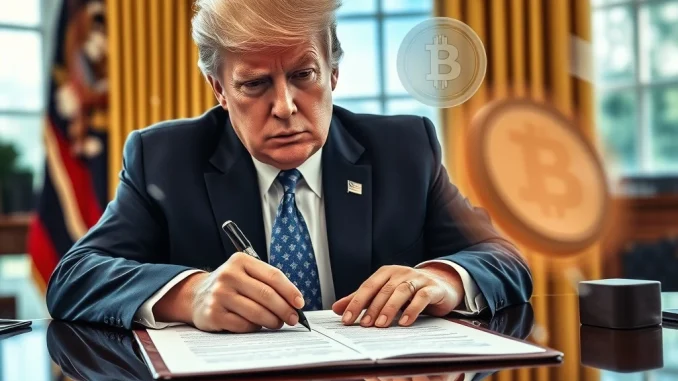
The world of cryptocurrencies just witnessed a pivotal moment. On Thursday, July 24, 2025, President Donald Trump signed the “Guiding and Establishing National Innovation for U.S. Stablecoins Act,” widely known as the GENIUS Act, into law. This groundbreaking legislation is set to fundamentally reshape the landscape for stablecoins and other digital assets in the United States, bringing much-needed clarity and a new era of federal oversight. If you’re invested in crypto, or simply curious about its future, this is a development you can’t afford to ignore.
What Does the GENIUS Act Mean for Stablecoins?
The passage of the GENIUS Act represents a significant stride in addressing the long-standing regulatory uncertainties surrounding stablecoins. Championed by Senator Bill Hagerty, this bipartisan effort aims to establish a robust federal framework, prioritizing consumer protection and enhancing anti-money laundering (AML) measures. Its journey through Congress was marked by intense debate, balancing conservative concerns with Democratic priorities, ultimately incorporating elements from the “Anti-CBDC Surveillance State Act” into a critical defense bill.
Key provisions of this new stablecoin law include:
- Two-Tiered Oversight: Stablecoin issuers can operate under a federal charter or state regulation. State rules must meet federal approval to be recognized.
- State Jurisdiction for Smaller Issuers: Issuers with under $10 billion in circulation may fall under state jurisdiction if their programs receive certification from a new federal committee.
- 100% Cash Backing Mandate: A crucial provision requires stablecoins to be fully backed by cash or short-term U.S. Treasuries. The reuse of reserves is strictly prohibited, directly addressing past controversies involving diversified asset collateral.
- Algorithmic Stablecoin Moratorium: The law imposes a two-year ban on algorithmic stablecoins, like the infamous TerraUSD, which rely on crypto-backed mechanisms rather than traditional reserves.
Unpacking the New Federal Oversight and Backing Mandates
With the Trump stablecoin law now in effect, regulatory authority is centralized, primarily under the Office of the Comptroller of the Currency (OCC) and the Federal Reserve. A newly formed Stablecoin Certification Review Committee will oversee compliance. This committee, comprising officials from the Treasury, Fed, and FDIC, will evaluate state-level regulatory proposals, ensuring they align with stringent federal standards.
Transparency is a cornerstone of the new framework:
- Monthly Reserve Breakdowns: Issuers must publish monthly, certified breakdowns of their reserves.
- CEO/CFO Accountability: Top executives will be held accountable for the accuracy of reserve reports.
- Independent Audits: Regular independent audits will verify compliance, a direct response to prior criticisms of opaque reserve practices in the stablecoin market.
This strict adherence to 100% cash or short-term U.S. Treasuries backing is a game-changer. It aims to instill greater confidence and stability in the stablecoin market, minimizing the risks associated with more volatile or less liquid collateral.
How Will Major Stablecoins Adapt to New Crypto Regulation?
The implications of this sweeping crypto regulation are profound, particularly for the major players in the stablecoin ecosystem. Their operational models will need to adapt significantly to comply with the new mandates.
| Stablecoin | Current Status | Impact of GENIUS Act | Compliance Outlook |
|---|---|---|---|
| Tether (USDT) | Largest stablecoin, diversified reserves (commercial paper, etc.) | Requires significant operational overhaul to transition to cash-and-Treasury-only model. | Pledged compliance; may need to launch a U.S.-specific version of USDT. |
| USD Coin (USDC) | Operated by Circle, already largely aligned with cash/Treasury backing. | Better positioned, but must enhance reporting frequency and audit rigor. | Strong compliance outlook; minor adjustments expected. |
| Dai (DAI) | Decentralized, crypto-backed stablecoin. | Model fundamentally conflicts with the law’s cash-centric mandate. | Significant structural disadvantage; no clear regulatory pathway within U.S. system. |
This highlights a clear divide: stablecoins that can pivot to traditional asset backing will likely thrive under the new regime, while those relying on decentralized or crypto-backed mechanisms face an uncertain future in the U.S. market.
Navigating the Broader Landscape for Digital Assets
Beyond stablecoins, the GENIUS Act has broader implications for the regulatory environment of all digital assets. A notable aspect of the law is its explicit exclusion of the SEC and CFTC from classifying payment stablecoins as securities or commodities. This move is a direct counter to the SEC’s prior enforcement-driven approach and aims to foster private-sector innovation without immediate jurisdictional conflicts.
However, this doesn’t mean a complete hands-off approach for other agencies. The Treasury will continue to study non-payment stablecoins in collaboration with the SEC and CFTC, indicating that unresolved jurisdictional tensions might still exist for other types of digital assets.
How Does the U.S. Approach Compare Globally?
The U.S. is now firmly in the global race to shape digital finance norms. Its new framework contends with the European Union’s comprehensive Markets in Crypto-Assets (MiCA) framework, which offers a unified regulatory license across 27 member states. While MiCA provides a streamlined approach, the U.S. system combines federal and state oversight. Proponents argue this hybrid model promotes flexibility and private-sector growth, potentially fostering innovation. Critics, however, suggest that this patchwork approach might face challenges in competing with MiCA’s unified framework, especially for global enterprises seeking regulatory certainty across multiple jurisdictions.
The CBDC Debate: Private Stablecoins vs. Government Digital Currencies
Interestingly, the new stablecoin law also intertwines with the ongoing debate over Central Bank Digital Currencies (CBDCs). Many proponents argue that a robust private stablecoin market, under strict regulation, could render a U.S. CBDC unnecessary. This stance is reinforced by the attached Anti-CBDC Act, which explicitly blocks the Federal Reserve from offering digital currency accounts directly to the public.
Conversely, some critics view the GENIUS Act as a “stealth” CBDC, expressing concerns that it grants federal agencies excessive control over private digital assets. Legal experts anticipate potential challenges to the law’s authority, particularly regarding the ability to freeze or burn stablecoin assets, raising important questions about constitutional protections against unreasonable seizure. This underlying tension between private innovation and governmental control will undoubtedly continue to shape the discourse around digital currencies.
The implementation of the GENIUS Act heralds a transformative phase in the U.S. crypto regulatory landscape. While it provides much-needed clarity for stablecoin operators, its long-term impact will depend on how industry players navigate compliance hurdles, how it fares in global competition, and how unresolved legal debates unfold. As the market adapts to these new requirements, the fundamental battle for the future of digital finance – balancing private innovation with public oversight, and decentralization with centralization – remains a compelling and evolving narrative.
Frequently Asked Questions (FAQs)
What is the GENIUS Act?
The GENIUS Act, or “Guiding and Establishing National Innovation for U.S. Stablecoins Act,” is a new U.S. law signed by President Trump that establishes a federal regulatory framework for payment stablecoins, mandating 100% cash or short-term U.S. Treasury backing and federal oversight.
How does the GENIUS Act impact existing stablecoins like USDT and USDC?
Tether (USDT) will need a significant operational overhaul to comply with the 100% cash/Treasury backing mandate, potentially requiring a U.S.-specific version. USD Coin (USDC) is better positioned due to its existing backing structure but must enhance reporting and audit rigor. Decentralized stablecoins like Dai (DAI) face significant challenges due to their crypto-backed models.
Will the SEC or CFTC regulate stablecoins under this new law?
No, the GENIUS Act explicitly excludes the SEC and CFTC from classifying payment stablecoins as securities or commodities, effectively sidelining their direct jurisdiction in this specific sector. Regulatory authority is centralized under the OCC and Federal Reserve.
What are the backing requirements for stablecoins under the GENIUS Act?
Under the GENIUS Act, stablecoins must be 100% backed by cash or short-term U.S. Treasuries. The reuse of reserves is prohibited, and issuers must publish monthly, certified reserve breakdowns with CEO/CFO accountability and independent audits.
Does the GENIUS Act affect Central Bank Digital Currencies (CBDCs)?
Yes, the GENIUS Act includes provisions from the Anti-CBDC Act, which blocks the Federal Reserve from offering digital currency accounts directly to the public. This suggests a preference for a robust private stablecoin market over a U.S. CBDC, though some critics view the law as a form of “stealth” CBDC due to increased federal control.