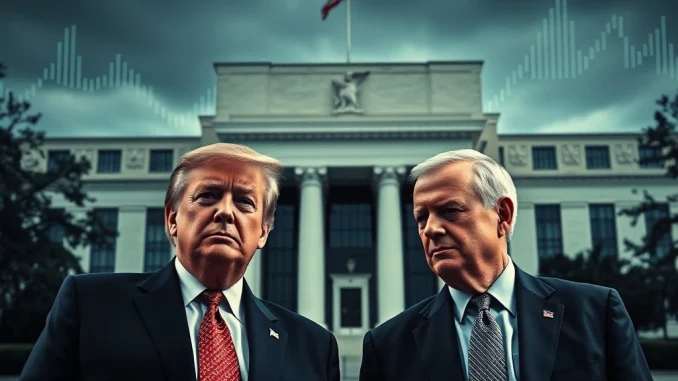
In the dynamic world of finance, few events capture attention quite like a direct confrontation between political power and independent economic authority. For cryptocurrency enthusiasts and traditional investors alike, understanding the nuances of U.S. economic policy, particularly decisions made by the Federal Reserve, is crucial. These decisions often ripple through global markets, influencing everything from stock prices to the volatility of digital assets. Recently, a significant public escalation unfolded involving former U.S. President Donald J. Trump and Federal Reserve Chair Jerome Powell, sparking concerns and discussions across financial sectors. Let’s delve into the details of this high-stakes encounter and what it means for the future of economic stability.
Trump’s Unprecedented Pressure on the Federal Reserve
On July 25, 2025, former President Trump visited the Federal Reserve’s Washington, D.C. headquarters, transforming a routine visit into a public display of mounting tensions. This highly publicized event saw Trump not only criticizing the central bank’s operational decisions but also directly challenging its long-standing independence. His primary target? The ongoing $2.5 billion renovation project at the Fed’s complex. Labeling it wasteful, Trump didn’t shy away from strong language, accusing Chair Jerome Powell of poor judgment and even calling him a “numbskull.”
This public rebuke highlights a recurring theme in recent U.S. politics: the executive branch’s desire to exert influence over the central bank’s actions. While the Federal Reserve is designed to operate independently to ensure its decisions are based purely on economic data rather than political expediency, such direct criticisms from a former president underscore the delicate balance between political pressure and institutional autonomy. For markets, this creates an environment of uncertainty, as the perceived independence of key economic institutions is a cornerstone of investor confidence.
The Urgent Call for Interest Rate Cuts: Why Now?
Beyond the renovation controversy, the core of Trump’s visit centered on his repeated urging for interest rate cuts. Framing these cuts as essential for maintaining economic growth amidst slowing momentum, Trump reiterated his long-held belief that lower rates are the key to unlocking further prosperity. His argument resonates with many who feel that higher borrowing costs stifle business expansion and consumer spending, potentially leading to an economic slowdown.
High interest rates impact various aspects of the economy:
- Borrowing Costs: For businesses, higher rates mean more expensive loans for expansion, equipment, and innovation. For consumers, mortgages, car loans, and credit card interest become more burdensome.
- Investment Climate: Higher rates can make fixed-income investments more attractive compared to riskier assets like stocks or even cryptocurrencies, potentially diverting capital.
- Economic Growth: While designed to curb inflation, sustained high rates can cool down economic activity too much, risking recession.
The former president’s appeals come at a time when inflation pressures persist, and global economic growth shows signs of weakening. This creates a complex dilemma for the Federal Reserve: how to manage inflation without triggering a recession, all while facing intense political scrutiny over its monetary policy decisions.
Jerome Powell’s Steadfast Defense of Monetary Policy
In response to Trump’s critiques, Federal Reserve Chair Jerome Powell stood firm, defending both the renovation project and the Fed’s broader policy stance. Powell emphasized that the renovations are critical for modernizing the Fed’s infrastructure, addressing security needs, and supporting its evolving functions and operational resilience. He argued that these upgrades are necessary for the long-term operational needs of an institution vital to the nation’s financial stability.
More significantly, Powell reinforced the Fed’s commitment to its dual mandate: achieving price stability and maximum employment. He stressed that the central bank’s decisions on monetary policy are data-driven and independent of political influence. This commitment to institutional autonomy is paramount, as any perceived capitulation to political pressure could undermine the Fed’s credibility and its ability to effectively manage the economy.
Powell’s defense during the visit underscored the Fed’s resolve to resist external pressures, maintaining that its mandate requires a careful, data-informed approach rather than one swayed by political agendas. This ongoing tension between political will and central bank independence is a defining feature of modern economic governance.
Beyond the Headlines: The Renovation Controversy and Economic Implications
The $2.5 billion renovation project at the Federal Reserve headquarters became an unexpected focal point of Trump‘s critique. While Trump framed the project as excessive and wasteful, suggesting funds could be reallocated to other priorities, Powell reiterated its necessity for supporting the Fed’s long-term operational needs and evolving functions. The project, which has reportedly faced delays and cost overruns, provides a tangible symbol for the broader debate on fiscal priorities and transparency within government institutions.
Analysts note that such public clashes are not uncommon during periods of economic uncertainty, especially when growth slows and inflation remains a concern. However, they caution against actions that could undermine the Fed’s credibility through public posturing. The administration’s vocal criticism of the Fed’s decisions reflects a broader push to assert executive influence over economic management, even as the central bank reiterates its commitment to institutional autonomy.
What Does This Mean for Markets and Your Portfolio?
While the immediate impact of this specific confrontation on cryptocurrency markets might not be direct, the underlying themes are highly relevant. The stability and independence of institutions like the Federal Reserve are crucial for overall market confidence. Any perceived politicization of monetary policy can lead to increased volatility and uncertainty across all asset classes, including digital assets.
Investors should continue to monitor:
- Fed’s Stance: Will the Fed maintain its independent, data-driven approach, or will political pressure eventually sway its decisions on interest rates?
- Economic Data: Key economic indicators, such as inflation rates, employment figures, and GDP growth, will continue to guide the Fed’s actions.
- Political Discourse: The ongoing dialogue between politicians and the central bank will remain a factor influencing market sentiment.
Conclusion: A Delicate Balance in Economic Governance
The public exchange between former President Trump and Chair Jerome Powell at the Federal Reserve headquarters on July 25, 2025, served as a stark reminder of the challenges in maintaining central bank independence amidst heightened political scrutiny. Trump’s dual critique of renovation costs and his persistent demands for interest rate cuts highlight a fundamental disagreement over economic priorities and the role of the central bank. Powell’s firm defense of the Fed’s operations and its commitment to a data-driven monetary policy reinforces its resolve to resist external pressures.
As global economies navigate complex inflationary environments and growth concerns, the delicate balance between political influence and the Fed’s role as an independent arbiter of monetary policy will continue to be a critical factor. For market participants, understanding this dynamic is essential for anticipating future economic shifts and making informed decisions in an ever-evolving financial landscape.
Frequently Asked Questions (FAQs)
Q1: Why is the Federal Reserve’s independence so important?
The Federal Reserve’s independence is crucial because it allows the central bank to make monetary policy decisions based on economic data and its dual mandate (price stability and maximum employment), rather than being influenced by short-term political cycles or partisan agendas. This helps maintain market confidence and long-term economic stability.
Q2: What is the $2.5 billion renovation project at the Fed headquarters about?
The $2.5 billion renovation project is aimed at modernizing the Federal Reserve’s infrastructure, addressing critical security needs, and supporting its evolving operational functions. Chair Jerome Powell defended it as necessary for the long-term resilience and efficiency of the institution.
Q3: How do interest rate cuts impact the economy?
Interest rate cuts typically make borrowing cheaper for businesses and consumers, encouraging spending and investment, which can stimulate economic growth. However, if cut too aggressively or at the wrong time, they can also fuel inflation.
Q4: What is the Fed’s dual mandate?
The Federal Reserve’s dual mandate is to achieve maximum sustainable employment and maintain price stability (control inflation). These two goals are often balanced against each other when making monetary policy decisions.
Q5: How does this political tension affect cryptocurrency markets?
While not directly impacting crypto, political pressure on the Federal Reserve can create broader market uncertainty and volatility. Changes in interest rates or perceived shifts in monetary policy can influence investor sentiment towards riskier assets, including cryptocurrencies, as capital flows seek more stable or higher-yield environments.