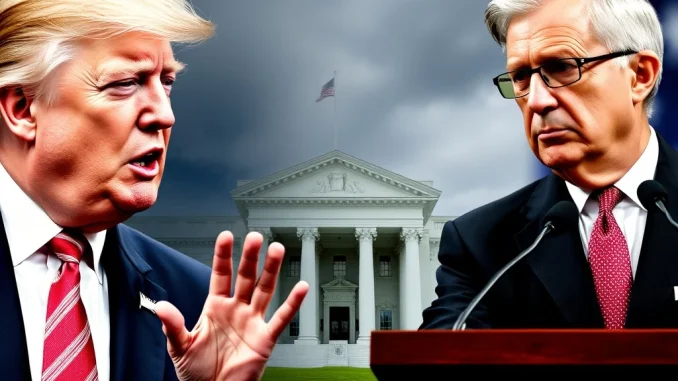
The financial world often sees political figures weigh in on economic decisions. Recently, Donald Trump ignited a significant discussion. He publicly stated that Federal Reserve Chairman Jerome Powell should have implemented an Interest Rate Cut a full year ago. This commentary comes at a critical time. It adds pressure to the ongoing debate about the Federal Reserve’s role in guiding the nation’s economy. For cryptocurrency enthusiasts, understanding these macroeconomic shifts is vital. Federal Reserve policies directly influence market liquidity, investor sentiment, and the broader economic landscape, which in turn impacts digital asset valuations. Therefore, Trump’s remarks are more than just political; they reflect a fundamental disagreement on economic strategy.
Understanding the Federal Reserve Policy and Trump’s Stance
The Federal Reserve, often called the Fed, acts as the central banking system of the United States. Its primary goals include maximizing employment, stabilizing prices, and moderating long-term interest rates. The Fed achieves these objectives through various tools. One of the most powerful tools is setting the federal funds rate. This benchmark rate influences borrowing costs across the economy. Consequently, it impacts everything from mortgages to business loans. President Donald Trump has consistently advocated for lower interest rates. He believes this stimulates economic growth. His recent statement, conveyed via the Walter Bloomberg economic news account on X, underscores this long-held position. He argued that the window for an effective Interest Rate Cut may have passed. According to Trump, waiting too long diminishes the positive impact such a move could have had on the economy.
Trump’s criticism of Jerome Powell is not new. During his presidency, Trump frequently expressed dissatisfaction with the Fed’s decisions. He often pushed for more accommodative monetary policies. His argument centers on the idea that lower rates would have further boosted economic activity. This would have provided more robust support for businesses and consumers. He suggested that the Fed missed a crucial opportunity. A rate cut a year ago, in his view, would have preemptively addressed potential economic slowdowns. Such a proactive measure, he contends, could have sustained stronger growth. Furthermore, this stance highlights the inherent tension between political leadership and the independent role of the central bank. Presidents often desire economic stimulus, while the Fed prioritizes long-term stability and inflation control.
Jerome Powell’s Recent Signals and the Economic Outlook
In contrast to Trump’s retrospective criticism, Jerome Powell recently hinted at potential future actions. Speaking in Jackson Hole, Wyoming, at the annual economic symposium, Powell suggested that current economic conditions might indeed warrant interest rate cuts. This signal marks a potential shift in the Fed’s immediate strategy. Historically, the Jackson Hole symposium serves as a crucial platform. Fed officials use it to communicate future policy directions. Powell’s comments reflect a careful assessment of various economic indicators. These include inflation data, employment figures, and global economic trends. The Fed’s approach involves balancing the risks of inflation against the need for economic support.
Powell’s remarks acknowledge evolving economic pressures. Global trade tensions, for instance, can impact domestic growth. Similarly, a slowdown in manufacturing or consumer spending might necessitate a policy adjustment. The Federal Reserve operates with a dual mandate. It aims for maximum employment and stable prices. Therefore, any decision on an Interest Rate Cut considers both factors. A cut typically makes borrowing cheaper. This encourages investment and spending. However, it can also fuel inflation if not managed carefully. Powell’s cautious tone suggests a data-dependent approach. He emphasizes the need to monitor incoming economic information closely. This ensures that any policy changes are timely and appropriate for the prevailing economic climate.
The Broader Impact of Federal Reserve Policy
The implications of Federal Reserve Policy extend far beyond traditional financial markets. Every decision by the Fed ripples through the global economy. Specifically, for the cryptocurrency market, these actions are highly relevant. When interest rates are low, traditional investments like bonds offer lower returns. This can make alternative assets, including cryptocurrencies, more attractive to investors seeking higher yields. Consequently, a period of sustained low rates or significant rate cuts often correlates with increased liquidity. This additional capital can flow into riskier assets like Bitcoin and altcoins. Conversely, higher interest rates can make holding cash or investing in safer, yield-bearing assets more appealing, potentially drawing capital away from crypto.
Moreover, the Fed’s stance on the Economic Outlook influences investor sentiment. If the Fed signals confidence in the economy, it can boost overall market optimism. This often benefits growth-oriented assets. If, however, the Fed expresses concerns or acts to stimulate a slowing economy, it can create uncertainty. This uncertainty might lead to increased volatility in risk assets, including digital currencies. Therefore, market participants, particularly in the crypto space, closely monitor every statement from the Fed. They analyze these communications for clues about future economic direction. This helps them anticipate market movements and adjust their investment strategies accordingly.
- Monetary Policy: The Fed uses tools like interest rates to manage the economy.
- Market Liquidity: Lower rates can increase the money supply, potentially flowing into crypto.
- Investor Sentiment: Fed signals influence overall market mood and risk appetite.
- Alternative Assets: Cryptocurrencies can become more attractive during low-yield environments.
Connecting Economic Outlook to Digital Assets
The interplay between macroeconomics and digital assets is complex. When the Economic Outlook appears uncertain, investors sometimes seek out assets perceived as hedges against inflation or traditional market instability. Bitcoin, for example, is often dubbed ‘digital gold’ by its proponents. They argue it offers a store of value independent of government-backed fiat currencies. Therefore, if the Fed’s policies are perceived as leading to inflation or devaluing the dollar, interest in Bitcoin and other cryptocurrencies might increase. This correlation, however, is not always direct or consistent. Many factors influence crypto prices, including technological advancements, regulatory news, and market adoption.
Ultimately, the debate between Donald Trump and Jerome Powell highlights fundamental disagreements on economic management. Trump prioritizes aggressive stimulus. Powell, on the other hand, emphasizes a balanced, data-driven approach. Both perspectives carry significant weight. Their actions and words have tangible effects on global financial markets. These effects extend to the burgeoning world of digital assets. As such, staying informed about Federal Reserve decisions and political commentary on economic policy remains crucial. It helps investors navigate the complexities of both traditional and decentralized financial ecosystems. The ongoing discussion about the timing and necessity of an Interest Rate Cut will continue to shape the economic narrative.
The discussion surrounding the timing of an Interest Rate Cut by the Federal Reserve continues to be a central point of economic discourse. Donald Trump’s assertion that Jerome Powell should have acted a year ago underscores a fundamental difference in economic philosophy. While Powell’s recent remarks suggest a readiness to consider cuts based on current data, the debate highlights the delicate balance the Fed must maintain. Its decisions significantly impact the broader economy, influencing everything from job growth to consumer spending and, by extension, the dynamic cryptocurrency markets. Investors and the public alike will keenly watch the Fed’s next moves, understanding that these choices will shape the financial landscape for months to come.
Frequently Asked Questions (FAQs)
Q1: What is the main point of Donald Trump’s criticism regarding the Interest Rate Cut?
Donald Trump believes Federal Reserve Chairman Jerome Powell should have initiated an interest rate cut approximately a year ago. He argues that waiting has diminished the potential positive impact on the economy, suggesting a missed opportunity for earlier stimulus and growth.
Q2: How does Jerome Powell’s current stance differ from Trump’s view?
Jerome Powell, speaking at Jackson Hole, indicated that current economic conditions might warrant interest rate cuts. Unlike Trump’s retrospective criticism, Powell’s comments suggest a forward-looking, data-dependent approach to monetary policy, evaluating the present economic landscape for future actions.
Q3: What is the Federal Reserve’s primary role in the U.S. economy?
The Federal Reserve serves as the central bank of the United States. Its main objectives are to maximize employment, maintain stable prices, and moderate long-term interest rates. It uses tools like setting the federal funds rate to influence the economy.
Q4: How do Federal Reserve policies, like an Interest Rate Cut, affect the cryptocurrency market?
An Interest Rate Cut can impact the cryptocurrency market by making traditional investments less attractive, potentially leading investors to seek higher returns in alternative assets like crypto. It can also increase market liquidity and influence overall investor sentiment, which often benefits riskier assets like Bitcoin and altcoins.
Q5: Why is the timing of an Interest Rate Cut so crucial?
The timing of an Interest Rate Cut is crucial because it directly influences economic stimulus. Cutting rates too early might fuel inflation, while cutting too late could miss an opportunity to support a slowing economy. The Fed aims for a balance to achieve its dual mandate of maximum employment and price stability.