For many in the cryptocurrency world, understanding the broader macroeconomic landscape is as crucial as analyzing tokenomics. The decisions made by central banks, particularly the U.S. Federal Reserve, directly impact market liquidity, investor sentiment, and ultimately, the trajectory of digital assets. Recent developments regarding the relationship between former President Donald Trump and Federal Reserve Chair Jerome Powell offer a fascinating glimpse into the delicate balance of power that shapes the global financial system. This strategic recalibration by Trump, stepping back from earlier threats to dismiss Powell, signals a pragmatic acknowledgment of market stability and the vital legal safeguards protecting the Fed’s independence.
The Trump Powell Dynamic: A Strategic Reversal Unveiled
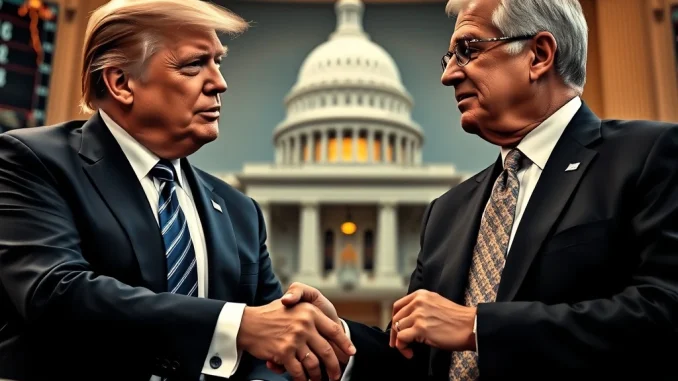
In a notable shift from his previously confrontational stance, former President Donald Trump indicated in late July 2025 that terminating Federal Reserve Chair Jerome Powell’s position was “not necessary.” This marks a significant departure from earlier rhetoric, which often saw Trump publicly expressing frustration over the Fed’s interest rate policies and even a renovation project at its headquarters. Describing a recent conversation with Powell as “productive” and “not tense,” Trump framed the potential dismissal as a “big move” that could significantly destabilize financial markets. This recalibration underscores a pragmatic approach, balancing political pressure with practical economic considerations. The shift in the Trump Powell dynamic is a key takeaway for anyone monitoring the interplay between politics and central banking.
Why Market Stability Matters: Avoiding Economic Turmoil
Trump’s acknowledgment of the potential for market instability if he were to remove Powell highlights a core concern for any administration: maintaining a predictable economic environment. Financial markets react sharply to perceived political interference in independent institutions. The very suggestion of such a move had previously introduced uncertainty, with investors closely scrutinizing the Fed’s policy decisions for signs of political influence. Prioritizing market stability aligns with broader economic goals, even when there are disagreements over specific monetary policies. A stable market fosters investor confidence, encourages investment, and supports overall economic growth, all of which are critical for a robust economy.
Upholding Federal Reserve Independence: Legal and Institutional Pillars
One of the most critical aspects of this episode is the implicit recognition of the Federal Reserve independence. Legal experts have consistently pointed out that removing a Fed chair without due cause could trigger extensive legal challenges, given the institution’s statutory autonomy. This independence is not merely a formality; it is a fundamental pillar of U.S. monetary policy, designed to shield the central bank from short-term political pressures. By avoiding direct action against Jerome Powell, Trump appears to acknowledge this dynamic, opting instead for rhetorical pressure to influence policy outcomes. This approach, mirroring past strategies, allows for public criticism without directly undermining the institutional authority of the Fed.
Broader Implications for US Monetary Policy
The episode extends beyond the direct relationship between Trump and Powell, reigniting important debates about the Fed’s role in an increasingly polarized political climate. The central bank’s mandate to control inflation and maximize employment is legally protected, and its credibility hinges on its ability to resist external pressures. While Trump has consistently advocated for lower interest rates to stimulate growth, these desires often conflict with the Fed’s inflation-focused policies. This ongoing tension between executive authority and the central bank’s operational autonomy highlights the complex challenges in navigating U.S. monetary policy. The public stance taken by Trump, framing his decision as one of necessity rather than principle, attempts to avoid escalating a conflict that could undermine both his agenda and the Fed’s institutional authority.
What’s Next for Jerome Powell and the Fed?
With the immediate threat of dismissal off the table, Jerome Powell and the Federal Reserve can continue to focus on their dual mandate: achieving maximum employment and maintaining price stability. However, the public discourse around the Fed’s independence is unlikely to fade. Analysts will continue to scrutinize every statement and decision, looking for subtle indications of political influence or shifts in policy direction. The incident serves as a powerful reminder of the unique position of the Fed—a powerful, independent body tasked with steering the nation’s economy amidst shifting political winds. Its ability to navigate these pressures while upholding its mandate will be crucial for future economic stability.
In conclusion, former President Trump’s decision to back off from firing Federal Reserve Chair Jerome Powell marks a significant moment in the ongoing narrative of executive power versus central bank autonomy. Driven by concerns over market stability and potential legal challenges, this strategic shift highlights the pragmatic realities of governing the world’s largest economy. While the immediate crisis has been averted, the underlying tensions surrounding the Fed’s independence and its role in shaping monetary policy will undoubtedly remain a focal point for investors, policymakers, and the public alike. The careful balance between political objectives and economic governance continues to define the landscape for the US economy and, by extension, global markets, including the dynamic world of cryptocurrencies.
Frequently Asked Questions (FAQs)
1. Why did former President Trump consider firing Jerome Powell?
Former President Trump had publicly expressed frustration with Jerome Powell and the Federal Reserve’s interest rate policies, believing they were hindering economic growth. He often advocated for lower interest rates to stimulate the economy, which sometimes conflicted with the Fed’s independent decisions.
2. What were the main reasons Trump decided against firing Powell?
Trump cited concerns about potential market instability and significant legal risks as primary reasons for backing off. Removing a Fed chair without justification could lead to protracted legal challenges due to the Federal Reserve’s statutory independence, and such a move could severely rattle financial markets.
3. What is the significance of Federal Reserve independence?
Federal Reserve independence is crucial because it allows the central bank to make monetary policy decisions based on economic data and its dual mandate (maximum employment and price stability), free from short-term political pressures. This autonomy is vital for maintaining credibility, stability, and long-term economic health.
4. How does the relationship between the President and the Fed Chair impact financial markets?
The relationship significantly impacts financial markets. Any perceived political interference or conflict can introduce uncertainty, leading to market volatility. Investors prefer predictability and rely on the Fed’s independence to make sound monetary policy decisions, which in turn influences investment decisions and overall economic confidence.
5. What is the Federal Reserve’s dual mandate?
The Federal Reserve’s dual mandate, as set by Congress, is to achieve maximum employment and maintain stable prices (control inflation). These two goals are often balanced against each other in the Fed’s policy decisions.
6. How might this decision affect future U.S. monetary policy?
While the immediate threat to Powell’s tenure is resolved, the episode highlights ongoing tensions between political leadership and economic governance. It reinforces the importance of the Fed’s independence, but also signals that public pressure from the executive branch remains a factor that policymakers and markets will continue to monitor when assessing future U.S. monetary policy decisions.