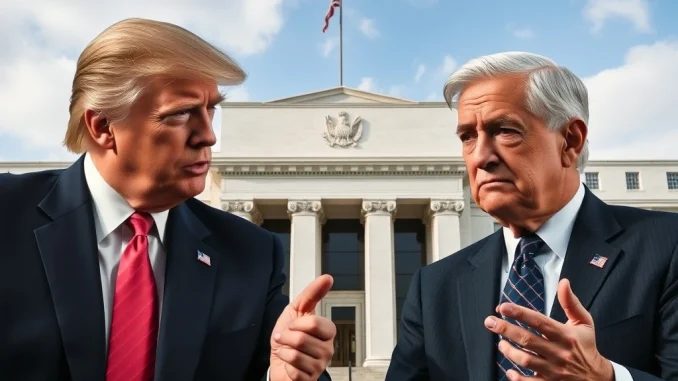
In the dynamic world of finance, where every whisper from a central bank can send ripples through global markets, including the volatile crypto space, recent events have once again put the spotlight on the delicate balance between political influence and institutional independence. When Donald Trump recently visited the Federal Reserve, his direct challenge to Chair Jerome Powell regarding interest rate cuts and the cost of the Fed’s headquarters renovation sent a clear message. For those invested in cryptocurrencies, understanding these high-level economic discussions is crucial, as the Federal Reserve’s decisions on interest rates can significantly impact liquidity, investor sentiment, and ultimately, the value of digital assets. This high-stakes exchange not only highlights the ongoing tensions between political leaders and the nation’s central bank but also underscores the persistent debate over the direction of U.S. economic policy.
Why is Trump Pressing Jerome Powell for Rate Cuts?
During his July 23, 2025, visit to the Federal Reserve, former President Donald Trump wasted no time in urging Chair Jerome Powell to lower interest rates. This isn’t a new stance for Trump; he has consistently advocated for expansionary monetary policy, believing that lower rates can stimulate economic growth, boost employment, and generally invigorate the economy. His argument centers on the idea that the current economic climate warrants more aggressive stimulus than the Fed has been willing to provide.
Trump’s rationale for pushing for rate cuts can be broken down into several key points:
- Stimulating Growth: Lower interest rates make borrowing cheaper for businesses and consumers, encouraging investment, spending, and expansion. This, in theory, leads to higher GDP growth.
- Boosting Markets: Cheaper money can also inflate asset prices, including stocks and real estate, which can create a ‘wealth effect’ and encourage further spending.
- Reducing Debt Burden: For a government with significant national debt, lower rates reduce the cost of servicing that debt.
- Political Positioning: Advocating for policies that promise economic booms can be a powerful message to voters, especially heading into a potential 2028 presidential election bid.
His direct approach, stating, “These overbudget managers need to be fired,” and vowing to replace project leaders if necessary, reflects his characteristic combative rhetoric. This public intervention, while not immediately altering monetary policy, certainly amplifies the ongoing debate about the Fed’s role in public economic governance and its perceived responsiveness to political pressures.
The Federal Reserve’s Independence Under Fire: A Critical Look
The core of the tension between political figures like Donald Trump and the Federal Reserve lies in the concept of central bank independence. The Fed operates as an independent agency within the government, a structure designed to shield its monetary policy decisions from short-term political pressures. This independence is widely considered crucial for maintaining economic stability and the Fed’s credibility.
However, this independence is often a point of contention for politicians who believe the Fed’s policies are either too restrictive or too lax for their economic agendas. Trump’s persistent push for rate cuts exemplifies this conflict. A Washington-based economist noted, “The Fed’s credibility hinges on its independence,” warning that sustained political pressure could complicate its ability to respond effectively to future economic crises.
Why is this independence so vital?
- Long-Term Focus: An independent Fed can make decisions based on long-term economic health rather than short-term electoral cycles.
- Inflation Control: Without political interference, the Fed is better positioned to make tough decisions, like raising rates to combat inflation, even if unpopular.
- Market Confidence: Investors and markets trust a central bank that makes decisions based on data and economic mandates, not political whims. Erosion of this trust can lead to instability.
The exchange between Trump and Powell underscored this fundamental tension. While Powell reiterated that the modernization project remains on schedule for completion by 2027, his assurance also subtly reinforced the Fed’s commitment to its operational continuity and independence amidst political discourse.
Unpacking the Debate: Interest Rates, Inflation, and Economic Growth
The debate over interest rates is a complex one, balancing the desire for robust economic growth with the need to control inflation. Donald Trump’s economic philosophy prioritizes aggressive fiscal and monetary stimulus to drive growth, often accepting a higher risk of inflation.
Conversely, the Federal Reserve’s dual mandate typically involves maximizing employment while maintaining price stability (controlling inflation). Raising interest rates is a tool to cool an overheating economy and curb inflation, while lowering them is meant to stimulate economic activity.
Consider the different perspectives:
- Pro-Rate Cut Argument (Trump’s View):
- Unlocks greater economic potential by making capital cheaper.
- Reduces the cost of mortgages, car loans, and business investments.
- Can lead to job creation and wage growth.
- Pro-Inflation Control Argument (Fed’s Mandate):
- Unchecked inflation erodes purchasing power and can destabilize the economy.
- High inflation can lead to uncertainty, deterring long-term investment.
- Maintaining price stability provides a stable foundation for sustainable growth.
A 2024 Council of Economic Advisers report, cited in the original discussion, warned that political interference in central banking decisions could indeed lead to inflationary pressures and weaken investor confidence. This highlights the delicate balancing act that the Federal Reserve must perform, making data-driven decisions that are often unpopular in the short term but aim for long-term economic health. For crypto investors, these rate discussions are paramount, as lower rates can make riskier assets like cryptocurrencies more attractive, while higher rates tend to have the opposite effect.
Trump’s Economic Policy Vision: What Does it Mean for the Future?
Donald Trump’s engagement with the Federal Reserve and its projects also reflects strategic positioning ahead of the 2028 presidential election. His combative rhetoric aligns with a broader economic philosophy that emphasizes deregulation, tax cuts, and a strong push for domestic growth, often with a more protectionist trade stance. His focus on fiscal responsibility, exemplified by his criticism of the Fed’s renovation costs, appeals to a segment of voters who prioritize government efficiency and reduced spending.
His economic policy vision, if implemented, could have several implications:
- Aggressive Stimulus: A continued push for lower interest rates and potentially higher government spending.
- Deregulation: Efforts to reduce regulatory burdens on businesses, which proponents argue fosters innovation and growth.
- Trade Policies: A focus on ‘America First’ trade policies, potentially involving tariffs and renegotiated agreements.
Critics, however, may view his remarks as partisan attacks on federal agencies, potentially undermining institutional trust. The renovation project, which has faced scrutiny for delays and rising costs, became a focal point of Trump’s criticism, serving as a tangible example he used to illustrate his broader concerns about bureaucratic inefficiency and mismanagement.
The interplay between Trump’s populist economic message and the Fed’s technocratic approach to monetary policy will undoubtedly remain a significant theme in the coming years, shaping not only traditional markets but also influencing the broader sentiment in the digital asset landscape.
The Fed’s Renovation: A Symbol of Scrutiny for Trump
Beyond the monetary policy debate, the Federal Reserve’s ongoing headquarters renovation project became an unexpected lightning rod for Donald Trump’s criticism. He slammed the project for what he perceived as excessive costs and poor management, using it as an example of governmental inefficiency.
The modernization project is a multiyear effort to upgrade the Fed’s infrastructure. While such projects are common for large, aging institutions, their cost and timeline can easily become targets for public scrutiny, especially when political figures seek to highlight government spending.
Powell’s assurance that the project remains on schedule for completion by 2027 provides a tangible benchmark. The project’s success in meeting its timeline will likely influence public perceptions of the Fed’s management and transparency. Should delays or cost overruns resurface, political pressure on the Fed may intensify, providing further ammunition for critics.
This renovation project, while seemingly a minor detail, symbolizes broader tensions between political influence and technical execution. By linking the project’s management to his economic agenda, Trump effectively shifted the narrative from infrastructure logistics to a more ideological conflict about fiscal responsibility and bureaucratic accountability. For now, the agency’s adherence to its timeline underscores its focus on long-term operational goals rather than short-term political outcomes.
In the near term, the Federal Reserve remains committed to data-driven decision-making, with officials emphasizing that policy adjustments will depend on economic indicators rather than political pressures. While Trump’s visit did not alter immediate monetary policy, it certainly amplified the Fed’s role in public debates about economic governance. The challenge for policymakers lies in balancing accountability with institutional independence, a task complicated by increasing partisan scrutiny. The outcome of these ongoing debates will not only shape the future of the U.S. economy but also indirectly influence the global financial landscape, including the evolving crypto markets.
Frequently Asked Questions (FAQs)
Q1: Why is the Federal Reserve independent of political influence?
The Federal Reserve was designed to be independent to ensure its monetary policy decisions are based on economic data and long-term stability rather than short-term political cycles or pressures. This independence helps maintain the Fed’s credibility and its ability to act decisively to control inflation or stimulate growth, even if those actions are unpopular with politicians.
Q2: What are the main arguments for and against lowering interest rates?
Arguments for lowering interest rates include stimulating economic growth by making borrowing cheaper for businesses and consumers, boosting employment, and increasing asset values. Arguments against lowering them too aggressively or at the wrong time include risking higher inflation, creating asset bubbles, and potentially destabilizing the economy by encouraging excessive risk-taking.
Q3: How might the Federal Reserve’s decisions impact the cryptocurrency market?
The Federal Reserve’s interest rate decisions significantly impact liquidity and investor sentiment across all financial markets, including cryptocurrency. Lower interest rates generally make riskier assets, like cryptocurrencies, more attractive as investors seek higher returns. Conversely, higher rates can lead investors to shift funds to safer, interest-bearing assets, potentially reducing demand for crypto.
Q4: What is the significance of the Fed’s headquarters renovation project?
The renovation project is a multiyear effort to upgrade the Federal Reserve’s infrastructure. While a necessary operational undertaking, it became a symbol of government spending and efficiency for critics like Donald Trump. Its progress and adherence to the 2027 deadline are now under increased public and political scrutiny, influencing perceptions of the Fed’s management and transparency.
Q5: Can a U.S. President fire the Federal Reserve Chair?
No, a U.S. President cannot directly fire the Federal Reserve Chair for policy disagreements. The Chair serves a four-year term, and while appointed by the President and confirmed by the Senate, they can only be removed for ’cause’ (e.g., misconduct or dereliction of duty), not for policy differences. This legal protection reinforces the Fed’s independence.