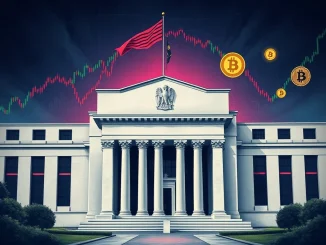
In the dynamic world of finance, where traditional markets often cast long shadows over the burgeoning cryptocurrency landscape, understanding the intricate dance between political power and central banking is absolutely crucial. Recent events involving former President Donald Trump and the Federal Reserve have once again thrust the independence of monetary policy into the spotlight, creating ripples that could indirectly influence everything from bond yields to Bitcoin’s volatility. Let’s dive into this high-stakes encounter and explore its profound implications.
The Unprecedented Showdown: Trump’s Pressure on the Federal Reserve
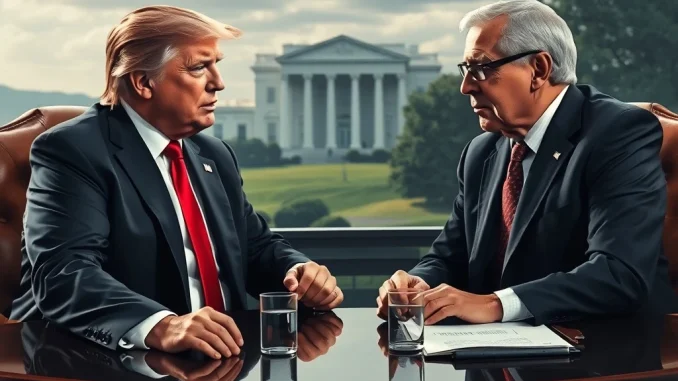
On July 3, 2025, President Donald Trump’s visit to the Federal Reserve headquarters ignited a fresh wave of scrutiny regarding the delicate balance between political leadership and the nation’s monetary policy. This wasn’t just a casual meeting; it was the culmination of months of public disputes over the direction of interest rates. During this highly anticipated encounter, Trump reiterated his aggressive push for a significant 3-percentage-point rate cut, a move that would dramatically alter the economic landscape. He also took the opportunity to criticize the Fed’s Washington building renovation, humorously claiming it cost over $3.1 billion [1].
The tension in the room was palpable. Federal Reserve Chair Jerome Powell, a steadfast advocate for the Fed’s autonomy, was observed visibly disagreeing with Trump’s remarks throughout the visit [1]. This public display of friction underscored the deep ideological chasm between the administration’s desire for immediate economic stimulus and the central bank’s commitment to its long-term mandate.
Why Lower Interest Rates Became a Flashpoint
President Trump’s persistent advocacy for lower Interest Rates stemmed from his longstanding frustration with the Fed’s prevailing 4.3% short-term rate policy. His belief was simple: a reduction in borrowing costs would provide a significant boost to the American economy. “We would be helped if interest rates were lower,” he remarked, even engaging in a moment described as both informal and emblematic of the underlying tension – a slap on Powell’s arm [2].
Beyond the policy debate, Trump also couldn’t resist mocking the renovation project as a “difficult task,” contrasting sharply with Powell’s assertion that the work would conclude in 2027 [1]. Despite these moments of public disagreement, Trump later described the meeting as “very productive” and surprisingly “no tension,” while acknowledging Powell’s assurance that the U.S. economy was “in really good shape” [1]. This contradictory messaging only added to the complexity of the narrative surrounding the Fed’s independence.
The Sacred Cow: Federal Reserve Independence
The encounter between President Trump and Chairman Powell underscored broader concerns about the politicization of Monetary Policy. Historically, the Federal Reserve has operated with a degree of independence to make decisions based on economic data rather than political expediency. This autonomy is considered crucial for maintaining economic stability and preventing inflation.
Trump’s repeated threats to replace Powell—labeling him “too late” and “lacking intelligence”—highlighted significant risks to the Fed’s autonomy [6]. Such rhetoric, while perhaps intended to exert pressure, can erode public trust in the institution’s ability to act impartially. However, by July 24, 2025, reports indicated a tempering of Trump’s rhetoric, citing warnings from advisors about potential market volatility. Former Treasury Secretary J. Bessent notably stated, “Trump is not going to fire Powell,” emphasizing the potential damage to the Fed’s credibility [3, 4]. This shift reflected cautious deliberation within the administration and financial circles, acknowledging the severe repercussions of undermining central bank independence.
Jerome Powell’s Steadfast Stance and the Dual Mandate
Analysts observed that the Federal Reserve’s dual mandate—controlling inflation and maximizing employment—remains a powerful counterweight to political pressures. While Trump advocated for lower rates to stimulate growth, Chairman Powell’s cautious approach aligned with the Fed’s technical assessment of prevailing economic conditions [1]. The visit, though theatrical and widely publicized, did not ultimately alter the Fed’s stance, reinforcing its institutional independence.
The episode reignited crucial debates about the precise boundaries of political influence over monetary policy. Trump’s public posturing, including his quip about appointing himself to the Fed, drew significant criticism for undermining central bank autonomy [7]. Yet, the Fed’s measured response, rooted firmly in economic data rather than political rhetoric, reaffirmed its critical role as an apolitical institution. Experts consistently caution that while elected officials may advocate for specific policies, the Fed’s credibility hinges entirely on its ability to act independently [4].
Navigating Economic Uncertainty: The Path Forward
This high-profile visit ultimately served as a compelling case study in the fragility and resilience of institutional boundaries. While Trump’s actions highlighted deep ideological divides concerning economic management, the Fed’s adherence to its mandated objectives underscored the inherent resilience of its independence. As the 2025 election cycle rapidly approaches, the intricate interplay between political pressure and central bank autonomy will undoubtedly remain a critical focal point for global markets, policymakers, and indeed, the broader financial community, including those closely watching the cryptocurrency space for indirect impacts.
The Ripple Effect: How Traditional Finance Impacts Crypto
While this article focuses on traditional finance, it’s vital for crypto enthusiasts to understand these dynamics. Decisions made by the Federal Reserve on Interest Rates and overall monetary policy have a direct impact on the broader financial system. Lower rates can make traditional investments less attractive, potentially driving capital into alternative assets like cryptocurrencies. Conversely, higher rates can increase the cost of capital, potentially reducing speculative investment in riskier assets. The stability and independence of institutions like the Fed are fundamental to overall market confidence, which in turn affects investor sentiment across all asset classes, including digital assets. Therefore, keeping an eye on these macro-economic shifts is an essential part of a holistic investment strategy, even for crypto.
Conclusion: A Test of Institutional Resilience
The dramatic encounter between President Trump and Federal Reserve Chairman Jerome Powell was more than just a political spat; it was a crucial test of the Federal Reserve’s cherished independence. Despite intense pressure and public criticism, the Fed demonstrated its commitment to its dual mandate, prioritizing economic stability over short-term political gains. This episode serves as a powerful reminder of the delicate balance required to maintain a credible and effective central bank. As the economic landscape continues to evolve, the resilience of institutions like the Federal Reserve will be paramount in navigating future challenges and ensuring a stable financial environment for all.
Frequently Asked Questions (FAQs)
Q1: What was the main point of contention between President Trump and the Federal Reserve?
The primary point of contention was President Trump’s strong demand for a 3-percentage-point cut in interest rates, which he believed would significantly boost the U.S. economy. The Federal Reserve, led by Chairman Jerome Powell, maintained its independence and adhered to its data-driven assessment of economic conditions, resisting political pressure for such a drastic cut.
Q2: Why is the Federal Reserve’s independence considered so important?
The Federal Reserve’s independence is crucial because it allows the central bank to make monetary policy decisions based on economic data and long-term stability, rather than short-term political cycles or pressures. This autonomy helps to prevent inflation, maintain price stability, and foster maximum employment, ensuring the credibility of the nation’s financial system.
Q3: What is the Federal Reserve’s “dual mandate”?
The Federal Reserve’s dual mandate refers to its two primary objectives: to achieve maximum employment and to maintain price stability (i.e., control inflation). These two goals often require a careful balancing act in setting monetary policy, such as adjusting interest rates.
Q4: How did markets react to the public dispute between Trump and Powell?
While the immediate market reaction to specific public spats can vary, persistent political pressure on the Federal Reserve generally introduces uncertainty. Advisers warned President Trump about potential market volatility if he were to take drastic actions like firing Chairman Powell, indicating that financial markets value the Fed’s independence and predictable policy-making.
Q5: What are the potential indirect impacts of these traditional finance events on the cryptocurrency market?
Decisions by the Federal Reserve, particularly on interest rates and monetary policy, significantly influence the broader financial landscape. Lower interest rates can make traditional investments less attractive, potentially driving capital into riskier assets like cryptocurrencies. Conversely, higher rates can increase the cost of capital and reduce speculative investment. Overall market confidence, often tied to central bank stability, also impacts investor sentiment across all asset classes, including crypto.
Q6: Was Chairman Powell actually slapped on the arm by Trump?
Yes, reports indicated that President Trump did slap Chairman Powell on the arm during their meeting. This action was described as both informal and emblematic of the tension between the two figures, highlighting the unconventional nature of their interactions.