In the volatile world of finance, where every political tremor can send ripples through global markets, a recent event has captured the attention of investors, economists, and even the cryptocurrency community. On July 24, 2025, a surprise Trump Fed Visit sent shockwaves, dramatically escalating tensions between the U.S. President and Federal Reserve Chair Jerome Powell. For those navigating the digital asset landscape, understanding these macroeconomic shifts is crucial, as they often dictate broader market sentiment and liquidity flows. This unprecedented move by the President underscores a critical standoff over monetary policy, with far-reaching implications for the economy and your portfolio.
Trump Fed Visit: An Unprecedented Showdown
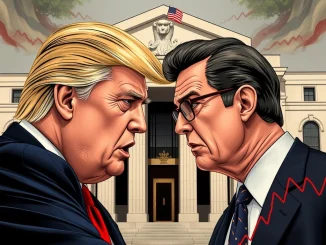
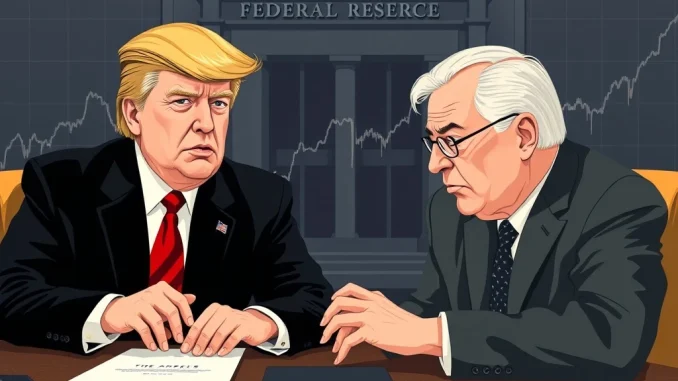
The unexpected appearance of President Donald Trump at the Federal Reserve headquarters in Washington, D.C., on July 24, 2025, marked a significant escalation in the ongoing public dispute over economic direction. This was the first official presidential visit to the Fed in nearly two decades, signaling a rare and potent challenge to the central bank’s autonomy. The White House confirmed the visit, though specifics regarding a face-to-face meeting with Chairman Powell remained undisclosed. Trump has consistently voiced strong criticism of the Fed’s decisions, particularly its maintenance of the short-term interest rate at 4.3% in 2025. He labels these decisions as ‘unfair’ and ‘harmful to American workers,’ pushing for rate cuts to stimulate economic growth amid rising trade tensions.
This long-standing feud isn’t just about interest rates. Trump has also accused Powell of mismanaging costs related to historic Fed building renovations and failing to adequately address inflation. The Fed, on its part, has maintained a cautious stance, asserting its need to fully assess the impact of Trump’s tariffs before making any policy adjustments. Treasury Secretary Scott Bessent attempted to calm concerns, stating there was ‘nothing that tells me that [Powell] should step down right now.’ However, market data from Polymarket indicated low probabilities of Powell’s immediate resignation, with only 1% predicting a step down by July 31, and 14% forecasting a dismissal attempt by August 31. Longer-term odds suggested a 19% chance of his removal by 2025.
Jerome Powell’s Stance: Navigating Political Pressure
Federal Reserve Chair Jerome Powell finds himself in a precarious position, tasked with upholding the Fed’s dual mandate of maximum employment and price stability amidst intense political scrutiny. His tenure has been marked by a steadfast commitment to data-driven decision-making, often prioritizing long-term economic health over short-term political demands. Despite the public attacks from the President, Powell has largely maintained a composed demeanor, reiterating the Fed’s independence and its focus on economic fundamentals. The challenge for Powell is to balance the need for policy flexibility with the imperative to resist perceived political interference, which could undermine the institution’s credibility both domestically and internationally.
The market’s cautious reaction to the visit underscores the perceived stability of Powell’s position, at least for now. While presidential influence is undeniable, the Fed’s legal mandate provides a strong shield. Analysts like those from Bloomberg Intelligence suggest that while Trump’s influence is ‘symbolic for now,’ it could evolve into a ‘real threat if the Fed doesn’t adjust its course.’ This delicate dance between political will and economic independence is a defining characteristic of modern central banking, and Powell’s handling of this pressure will be a key determinant of his legacy.
Monetary Policy Under Fire: Interest Rates and Economic Impact
At the heart of the conflict lies Monetary Policy, specifically the Federal Reserve’s management of interest rates. Trump’s repeated demands for rate cuts are rooted in a desire to stimulate economic growth, particularly as trade tensions escalate and global economic headwinds gather. He argues that lower rates would make borrowing cheaper for businesses and consumers, thereby boosting investment and spending. However, the Fed’s current stance, maintaining the short-term interest rate at 4.3%, reflects a different assessment of the economic landscape. The central bank is wary of cutting rates too soon, potentially reigniting inflationary pressures or creating asset bubbles.
The debate over interest rates highlights a fundamental tension in economic governance:
- Stimulus vs. Stability: Presidents often favor lower rates for immediate growth, while central banks prioritize long-term stability and inflation control.
- Inflation Concerns: The Fed’s mandate includes curbing inflation. Premature rate cuts could exacerbate price increases, eroding purchasing power.
- Global Context: The impact of trade wars and global economic slowdowns complicates policy decisions, requiring careful assessment of external factors.
Trump’s rhetoric, often portraying the Fed as detached from the struggles of ‘American workers,’ aims to garner public support for his economic agenda. This public targeting of a central bank official is seen by former central bank officials as unprecedented, risking the institution’s non-partisan image.
What Do Surging Treasury Yields Mean for Investors?
One of the most immediate market reactions to the heightened political drama was the rise in Treasury Yields, which climbed to 4.4% on the day of the visit. Treasury yields are a critical barometer of investor sentiment and expectations for future economic growth and inflation. When yields rise, it often signals that investors are demanding a higher return for lending money to the U.S. government, typically due to increased inflation expectations or a perception of greater risk.
Here’s what the surge in yields implies:
- Market Uncertainty: Investors are bracing for potential instability arising from the political clash over central bank independence.
- Inflation Expectations: A rise in yields can sometimes indicate higher inflation expectations, as lenders seek to compensate for the erosion of their money’s value.
- Cost of Borrowing: Higher Treasury yields typically translate to higher borrowing costs across the economy, impacting everything from mortgage rates to corporate loans.
- Impact on Equities: Higher yields can make bonds more attractive relative to stocks, potentially drawing investment away from equity markets.
For crypto investors, rising Treasury yields can sometimes signal a ‘risk-off’ environment, where traditional safe-haven assets become more appealing. While cryptocurrencies are often seen as uncorrelated, they are not immune to broad shifts in macroeconomic sentiment, and a tightening financial environment can impact liquidity and investor appetite for riskier assets.
Protecting Central Bank Independence: A Global Concern
The core of the current standoff revolves around the principle of Central Bank Independence. This concept posits that a nation’s central bank should operate free from direct political interference, allowing it to make monetary policy decisions based solely on economic data and its mandated objectives, rather than political expediency. The Federal Reserve’s independence is enshrined in law, designed to ensure that its decisions serve the long-term health of the economy, insulating it from the short-term electoral cycles of political leaders.
Why is independence so crucial?
- Credibility: An independent central bank is perceived as more credible, leading to more stable inflation expectations and greater market confidence.
- Long-Term Focus: It allows the central bank to make unpopular but necessary decisions for long-term economic stability, such as raising interest rates to curb inflation.
- Avoidance of Political Cycles: It prevents monetary policy from being manipulated for political gain, which could lead to boom-bust cycles.
Critics argue that Trump’s public attacks risk undermining this foundational principle, potentially eroding public trust in the Fed and its ability to manage the economy effectively. While the President has the authority to nominate a successor to the Fed Chair, Senate confirmation remains a significant hurdle, providing a check on presidential power. The broader implications for U.S. economic policy remain uncertain, but the current situation highlights the delicate balance between democratic accountability and institutional autonomy.
Conclusion: The Standoff Continues
The surprise Trump Fed Visit has undoubtedly intensified the friction between the White House and the Federal Reserve, underscoring a deep ideological divide over the direction of U.S. monetary policy. While Treasury Secretary Bessent attempted to calm the waters, the rise in Treasury yields to 4.4% signals that markets are acutely aware of the stakes involved. This clash over interest rates and central bank independence will continue to be a dominant narrative, shaping investor sentiment and economic expectations. For now, Jerome Powell’s tenure remains intact, and the Fed continues to defend its data-driven approach. The world watches closely to see how this unprecedented standoff evolves, and what it means for the stability of the U.S. economy and, by extension, global financial markets, including the dynamic world of digital assets.
Frequently Asked Questions (FAQs)
Q1: Why did President Trump visit the Federal Reserve headquarters?
President Trump’s unannounced visit to the Federal Reserve headquarters was a direct escalation of his ongoing public dispute with Federal Reserve Chair Jerome Powell over monetary policy. He has repeatedly criticized Powell for maintaining interest rates at 4.3% and has called for rate cuts to stimulate economic growth, accusing the Fed of mismanaging costs and failing to address inflation.
Q2: What is the significance of the 4.4% rise in Treasury yields?
The rise in Treasury yields to 4.4% indicates that investors are reacting cautiously to the heightened political tensions between the White House and the Federal Reserve. Higher yields often reflect increased market uncertainty, rising inflation expectations, or a demand for higher returns due to perceived risk, and can lead to higher borrowing costs across the economy.
Q3: What is Central Bank Independence and why is it important?
Central Bank Independence refers to the idea that a nation’s central bank, like the Federal Reserve, should operate free from direct political interference. This independence is crucial because it allows the central bank to make monetary policy decisions based solely on economic data and its mandated objectives (like price stability and maximum employment), rather than being swayed by short-term political pressures or electoral cycles. It enhances the central bank’s credibility and its ability to manage the economy effectively over the long term.
Q4: How does this political tension affect cryptocurrency markets?
While cryptocurrency markets are often seen as distinct from traditional finance, they are not entirely immune to macroeconomic shifts. Heightened political tensions and uncertainty in traditional markets, especially concerning monetary policy and interest rates, can lead to broader ‘risk-off’ sentiment. This can impact liquidity, investor appetite for riskier assets like cryptocurrencies, and overall market sentiment, making it crucial for crypto investors to monitor these developments.
Q5: What are President Trump’s main criticisms of Jerome Powell?
President Trump’s main criticisms of Jerome Powell include maintaining the short-term interest rate at 4.3% in 2025, which Trump views as ‘unfair’ and ‘harmful’ to American workers. He has also accused Powell of mismanaging costs tied to Fed building renovations and failing to adequately address inflation, consistently calling for rate cuts to boost economic growth.