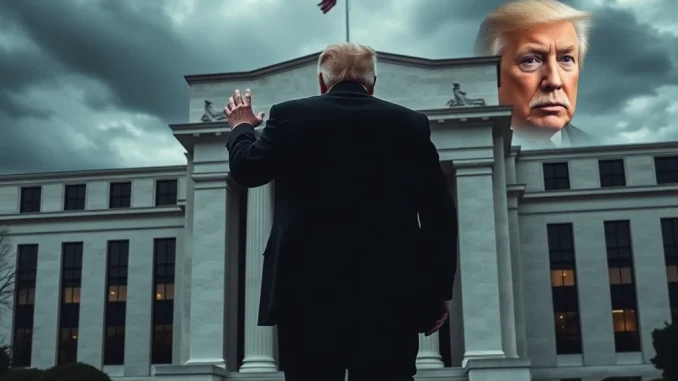
The political landscape recently witnessed a significant tremor: an unannounced visit by former President Donald Trump to the Federal Reserve’s Washington, D.C., headquarters. This sudden appearance on July 18 sent ripples of speculation through financial markets and political circles, marking an unprecedented escalation in his long-standing feud with Federal Reserve Chair Jerome Powell. For anyone tracking the intricate dance between politics and economics, especially its potential ripple effects on the broader US economy, this event demands closer scrutiny.
The Unannounced Trump Fed Visit: A New Peak in Tensions?
The surprise Trump Fed visit, confirmed by the White House, occurred on July 18 at 23:00 Turkish time. Details of the visit, including whether a private meeting with Chair Powell took place, remain shrouded in secrecy [1]. This dramatic move follows months of increasingly sharp criticism from Trump directed at the central bank and its leader. He has repeatedly called for Powell’s resignation, accusing the Fed’s interest rate policies of harming the US economy and labeling Powell a “stupid” and “terrible” leader [2].
The timing of this visit, as Trump’s term as president nears its end, underscores the intensity of the friction. Earlier remarks from Trump even suggested Powell would be “out pretty soon anyway,” hinting at a removal within eight months, despite Powell’s term not expiring until early 2026 [3]. These actions are part of a broader narrative challenging the core principle of Federal Reserve independence.
Jerome Powell Under Fire: A History of Presidential Pressure
The relationship between presidents and Federal Reserve chairs has always been delicate, but Trump’s public and persistent attacks on Jerome Powell have been uniquely aggressive. Trump’s frustration primarily stems from the Fed’s interest rate decisions, which he believes have stifled economic growth and countered his administration’s agenda. This public pressure creates a challenging environment for the Fed, forcing it to navigate a fine line between maintaining its independent mandate and managing public perception.
Key points in this escalating tension include:
- Repeated Calls for Resignation: Trump has consistently demanded Powell’s removal, a highly unusual step for a sitting president regarding a Fed chair.
- Public Insults: Labeling Powell as “stupid” and “terrible” represents a direct and personal attack on the Fed leader’s competence.
- Hints of Removal: Suggestions of removing Powell before his term expires, despite legal complexities, highlight the extent of Trump’s desire for control over monetary policy.
Threats to Federal Reserve Independence: What’s at Stake?
The concept of Federal Reserve independence is foundational to its credibility and effectiveness. It ensures that monetary policy decisions are made based on economic data and the Fed’s dual mandate (maximum employment and price stability), rather than short-term political expediency. Trump’s actions, including the unannounced Trump Fed visit and discussions about investigating the central bank’s $2.5 billion renovation project [4], directly challenge this independence.
Why is Fed independence crucial?
| Aspect | Importance of Independence |
|---|---|
| Credibility | Ensures markets trust the Fed’s decisions are data-driven, not politically motivated. |
| Long-Term Focus | Allows the Fed to make decisions for the long-term health of the US economy, even if unpopular in the short term. |
| Inflation Control | Prevents political pressure from leading to excessive money printing, which can cause inflation. |
| Global Trust | Maintains international confidence in the stability and reliability of the U.S. financial system. |
Treasury Secretary Scott Bessent has even signaled preparations for a potential successor to Powell, with candidate announcements expected by December 2025 or January 2026 [5]. This further fuels speculation about the future leadership and direction of the central bank.
Navigating Monetary Policy Amidst Political Storms
Despite the intense political pressure, Fed officials have historically maintained that their monetary policy decisions are guided solely by economic indicators [8]. However, analysts suggest that such persistent criticism could subtly influence the Fed’s communication strategies, even if its core policy decisions remain data-driven. While June meeting minutes showed no immediate plans to cut rates, the central bank might adjust its messaging to preempt further criticism [6].
The president’s shifting stance—alternating between threats to replace Jerome Powell and claims of allowing him to serve out his term [7]—has created significant uncertainty. A House Republican faction reportedly advised Trump to avoid abrupt policy changes, highlighting concerns about destabilizing the Fed’s credibility [7]. This internal debate within the Republican party itself underscores the gravity of challenging the central bank’s autonomy.
Impact on the US Economy: Beyond the Headlines
The ongoing tension between the White House and the Federal Reserve has tangible implications for the US economy. Uncertainty about monetary policy direction, especially if the Fed’s independence is perceived to be compromised, can lead to increased market volatility. Businesses and investors rely on a stable and predictable monetary policy environment to make long-term decisions. When this stability is questioned, it can affect investment, hiring, and overall economic growth.
The Fed’s ability to effectively manage inflation and employment is paramount. If political interference becomes a significant factor, it could undermine the Fed’s tools and potentially lead to less optimal economic outcomes. The global financial community also closely watches the independence of major central banks like the Federal Reserve, as it impacts confidence in the stability of the dollar and international markets.
Conclusion: A Delicate Balance for the Future
The Trump Fed visit and the ongoing tensions with Jerome Powell underscore a critical juncture for the Federal Reserve independence. While the Fed has historically asserted its autonomy, the relentless political pressure forces it to navigate a delicate balance between its mandate and public perception. As markets and policymakers watch for signs of collaboration or conflict, the potential implications for future monetary policy and central bank governance are significant. The health and stability of the US economy depend on maintaining this crucial institutional independence.
Frequently Asked Questions (FAQs)
Q1: Why did Donald Trump visit the Federal Reserve headquarters unannounced?
A1: The exact reason for the unannounced visit on July 18 remains undisclosed. However, it occurred amidst escalating public criticism from Trump regarding Federal Reserve Chair Jerome Powell’s interest rate policies and the Fed’s overall management of the economy.
Q2: What is the significance of Federal Reserve independence?
A2: Federal Reserve independence is crucial because it allows the central bank to make monetary policy decisions based on economic data and its dual mandate (maximum employment and price stability) rather than short-term political pressures. This helps maintain the Fed’s credibility, fosters long-term economic stability, and controls inflation.
Q3: How has Trump’s criticism affected Jerome Powell and the Fed?
A3: Trump’s persistent public criticism, including calls for Powell’s resignation and personal insults, has put significant pressure on Jerome Powell and the Fed. While the Fed maintains its decisions are data-driven, analysts suggest it may influence the central bank’s communication strategies to manage public perception and preempt further political attacks.
Q4: What are the potential implications of political pressure on monetary policy?
A4: Political pressure on monetary policy can lead to uncertainty in financial markets, potentially affecting investment and economic growth. If the Fed’s independence is compromised, it could undermine its ability to effectively manage inflation and employment, leading to less optimal outcomes for the US economy.
Q5: Is there a possibility of Jerome Powell being replaced soon?
A5: While Trump has hinted at removing Jerome Powell before his term expires in early 2026, the legal mechanisms for such a removal are complex and unprecedented. Treasury Secretary Scott Bessent has indicated that preparations for a potential successor are underway, with candidate announcements expected by late 2025 or early 2026, aligning with a potential change in presidential administrations.