For those tracking the broader economic landscape that often influences cryptocurrency markets, recent developments involving former President Donald Trump and the Federal Reserve are particularly noteworthy. Trump’s unprecedented public criticism of the Fed’s leadership and its substantial $2.5 billion renovation project has ignited a fresh wave of political tension, raising questions about the central bank’s independence and its future direction. This isn’t just about a building; it’s about power, transparency, and the very foundation of US monetary policy.
Trump Fed Renovation: A Deep Dive into the Controversy
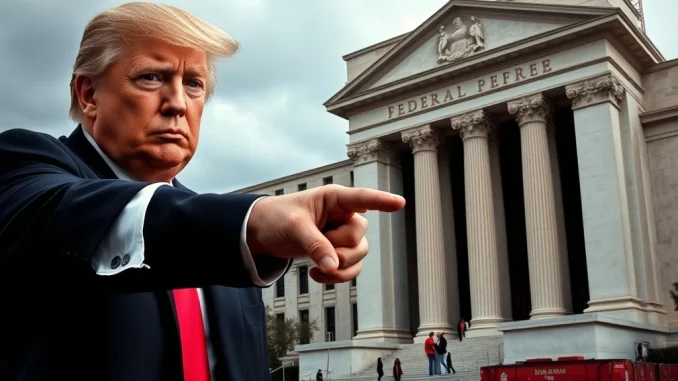
The core of the recent uproar stems from former President Donald Trump’s rare visit to the Federal Reserve’s headquarters. This visit, only the fourth by a U.S. president in history, was far from a ceremonial one. Trump seized the opportunity to lambast the Fed’s ongoing $2.5 billion renovation project, branding it as “wasteful” and a misallocation of taxpayer funds. He argued that such extravagant spending on “bureaucratic prestige” diverts focus from the Fed’s primary mandates: managing inflation and employment.
The project, which involves restoring two 19th-century buildings in Washington, D.C., has been a point of contention. Reports suggest that even some Fed staff privately acknowledged that constructing new facilities might have been more cost-effective than preserving the aging structures. Trump leveraged this point, citing documents to underscore his accusations of excessive spending and lack of transparency. The delayed public disclosure of renovation costs during a press briefing further fueled his critique, positioning the Trump Fed renovation as a symbol of financial mismanagement.
Understanding the Federal Reserve’s Role and Renovation Rationale
The Federal Reserve operates as the central banking system of the United States, playing a crucial role in shaping the nation’s economic stability. Its responsibilities include conducting monetary policy, supervising and regulating banking institutions, maintaining financial stability, and providing financial services to depository institutions. The Fed often justifies infrastructure projects like the renovation as essential for modernizing facilities, ensuring operational efficiency, and maintaining the integrity of its vast operations.
However, the timing and scale of this particular renovation have drawn heightened scrutiny. While the Fed asserts the necessity of modernizing its infrastructure, the optics of a multi-billion-dollar overhaul amidst economic uncertainties and public calls for fiscal prudence have made it a politically sensitive issue. This project, intended to upgrade and restore historical buildings, is presented by the Fed as a long-term investment in its operational capabilities.
Jerome Powell Under Fire: The Cost of Central Bank Independence
At the center of this escalating drama is Jerome Powell, the current Chairman of the Federal Reserve. Nominated by Trump in 2017, Powell has faced consistent and often harsh criticism from the former president, particularly regarding interest rate policies. Trump’s latest attack, focusing on the renovation costs, is seen as another attempt to exert pressure on Powell and potentially challenge his leadership.
The White House, under Trump, even hinted that the project’s management could provide a legal basis to scrutinize Powell’s tenure under federal procurement laws. This aligns with a broader pattern of questioning the Fed’s decisions and its perceived lack of accountability. For Powell, navigating these public accusations while upholding the Fed’s statutory independence is a significant challenge, as the institution’s credibility hinges on its ability to operate free from political interference.
Navigating US Monetary Policy Amidst Political Scrutiny
The ongoing political tension surrounding the Fed has direct implications for US monetary policy. The central bank’s core mandate is to achieve price stability and maximum employment. Its tools, such as setting interest rates, are critical for steering the economy. When the Fed’s independence is publicly challenged, it can create uncertainty in global markets and potentially undermine the effectiveness of its policy decisions.
Analysts worldwide are closely monitoring this confrontation, as any perceived erosion of the Fed’s autonomy could lead to instability. The sustained criticism from a prominent political figure risks framing the Fed as an institution out of touch with public sentiment, complicating its ability to communicate and implement policies effectively. Maintaining public trust and market confidence is paramount for the Fed, especially when its decisions directly impact economic growth and stability.
The Escalating Debate on Central Bank Independence
The confrontation between Trump and the Fed highlights a perennial debate: the extent of central bank independence. The Fed’s independence is a cornerstone of its effectiveness, designed to insulate monetary policy decisions from short-term political pressures. This allows the central bank to make tough, long-term economic decisions that might be unpopular but necessary.
However, critics argue that such independence can lead to a lack of accountability, especially when significant taxpayer funds are involved in projects like the $2.5 billion renovation. Trump’s actions test the boundaries of executive influence over an independent agency. While the Fed has legal safeguards, public challenges risk eroding institutional confidence and trust. The outcome of this particular dispute could set precedents for future interactions between the executive branch and the nation’s most powerful financial institution.
The escalating dispute between Donald Trump and the Federal Reserve over the $2.5 billion renovation project underscores deeper tensions regarding economic priorities, transparency, and the critical principle of central bank independence. While the Fed defends its spending as necessary for modernization, the political optics and Trump’s persistent criticisms have thrust the institution into an uncomfortable spotlight. As global markets watch closely, the ability of the Federal Reserve to maintain its credibility and focus on its core mandate amidst such public scrutiny will be a defining factor in the stability of US monetary policy and the broader economic landscape. This ongoing saga serves as a stark reminder of the delicate balance between political oversight and institutional autonomy.
Frequently Asked Questions (FAQs)
What is the main point of contention between Donald Trump and the Federal Reserve?
The primary point of contention is the Federal Reserve’s $2.5 billion renovation project, which Donald Trump has publicly criticized as wasteful and misaligned with economic priorities, accusing the Fed of prioritizing “bureaucratic prestige” over public interest.
Why is the Federal Reserve’s independence important?
The Federal Reserve’s independence is crucial because it allows the central bank to make monetary policy decisions based on economic data and long-term stability goals, free from short-term political pressures that could lead to inflationary policies or other economic distortions.
Who is Jerome Powell and why is he relevant to this issue?
Jerome Powell is the current Chairman of the Federal Reserve. He was nominated by Donald Trump but has since faced repeated criticism from Trump, particularly regarding interest rates and now the renovation costs. Powell is central to the dispute as he leads the institution under scrutiny.
How does this political tension impact US monetary policy?
Political tensions, especially public challenges to the Fed’s independence, can create uncertainty in financial markets and potentially undermine the effectiveness of the Fed’s monetary policy decisions. It can also erode public and market confidence in the institution’s ability to achieve price stability and maximum employment.
Has a U.S. president visited the Federal Reserve headquarters before?
Yes, Donald Trump’s visit was only the fourth time a U.S. president has visited the Fed headquarters. Previous visits include Franklin D. Roosevelt (1937), Gerald Ford (1975), and George W. Bush (2006), each under different circumstances.