In the ever-evolving landscape where traditional finance often dictates the currents of the cryptocurrency market, a significant development is unfolding that demands the attention of every digital asset investor. Former U.S. President Donald Trump has reignited his fervent campaign to push the Federal Reserve towards aggressive interest rate cuts, a move that could send ripples through global markets, including the volatile world of crypto. While seemingly a conventional economic debate, the intense Trump Fed pressure highlights the delicate balance between political influence and central bank independence, a dynamic that directly impacts liquidity and investor sentiment in both traditional and decentralized finance.
The Mounting Trump Fed Pressure: A Direct Confrontation
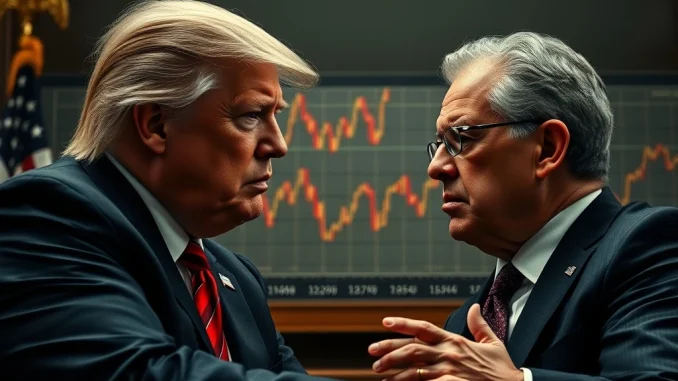
On July 24, 2025, former U.S. President Donald Trump made an unprecedented visit to the Federal Reserve’s headquarters, intensifying his public calls for lower interest rates. This encounter, the first presidential visit to the Fed in nearly two decades, underscored the escalating tensions between the administration and the central bank’s leadership. Trump’s direct appeal to Fed Chair Jerome Powell was clear: stimulate economic growth by reducing borrowing costs. This direct engagement marks a significant moment, emphasizing the extraordinary Trump Fed pressure to alter current monetary policy. During his visit, Trump also critiqued the Fed’s $2.5 billion renovation project, a symbolic jab at government spending, though Powell clarified these costs stemmed from a prior initiative. The former president’s consistent advocacy for rate cuts, despite the Fed maintaining rates at 4.3% for seven consecutive months, reveals a deep-seated frustration with the central bank’s current stance.
Why Are Interest Rate Cuts So Crucial to Trump’s Economic Vision?
Donald Trump’s consistent push for interest rate cuts stems from a belief that lower rates will ignite stronger economic growth. His argument is rooted in conventional economic theory: cheaper borrowing costs encourage businesses to invest, expand, and hire, while also making it more affordable for consumers to purchase homes and big-ticket items. From his perspective, the Fed’s steady rate of 4.3% has been a drag on the economy, hindering potential expansion and making U.S. exports less competitive. He views lower rates as a direct stimulus that would:
- Reduce the cost of borrowing for businesses and consumers.
- Potentially boost stock market performance, reflecting increased corporate profits.
- Weaken the dollar, making U.S. goods more attractive internationally.
- Encourage investment and job creation.
This perspective contrasts sharply with the Fed’s mandate, which balances growth with price stability, particularly controlling inflation. The debate highlights differing priorities: immediate economic acceleration versus long-term stability and inflation management.
Jerome Powell‘s Stance: Defending Fed Independence
Federal Reserve Chair Jerome Powell faced direct presidential scrutiny during Trump’s visit, yet he maintained a measured and firm stance. While acknowledging the need for data-driven decisions, Powell strategically avoided direct confrontation, instead emphasizing the Fed’s unwavering commitment to its independence. He corrected factual inaccuracies regarding the renovation costs without retreating from the central bank’s institutional autonomy. Powell’s response reflected a careful balance: being transparent and responsive to questions while unequivocally upholding the Fed’s credibility and non-political decision-making process. Despite Trump’s earlier hints about potentially removing Powell from office, the former president distanced himself from such remarks during the visit, calling the idea “highly unlikely.” This public shift, however, did not deter Trump from continuing his public advocacy for policy changes. For Jerome Powell, the challenge is to navigate intense political scrutiny while ensuring the Fed’s decisions are perceived as impartial and based solely on economic data, not political expediency.
The Broader Implications for Monetary Policy and Markets
The highly publicized exchange between Trump and Powell carries significant implications for monetary policy and market dynamics. Markets initially reacted to Trump’s earlier comments about Powell, with stocks falling and bond yields rising, until the president clarified his stance. This volatility underscores the sensitivity of financial markets to perceived political interference in central bank operations. Analysts consistently stress that the Fed’s independence is a critical factor in maintaining long-term economic stability and investor confidence. Any hint that monetary policy decisions could be swayed by political pressure rather than economic fundamentals can erode trust and introduce significant uncertainty. The Fed’s dual mandate—to achieve maximum employment and price stability—requires it to make tough, sometimes unpopular, decisions. If political influence becomes a dominant factor, the effectiveness of monetary policy tools could be compromised, leading to:
- Increased market volatility due to unpredictable policy shifts.
- Erosion of the Fed’s credibility on the global stage.
- Potential for inflation if rates are cut prematurely without economic justification.
- Distorted investment signals, as decisions become less about fundamentals and more about political rhetoric.
The upcoming July 29–30 Federal Open Market Committee (FOMC) meeting will be a crucial test of whether Powell’s insistence on data-driven decisions can withstand escalating executive branch pressure.
Navigating Economic Uncertainty and Ensuring Economic Stability
As the July rate decision approaches, the Federal Reserve faces a delicate balancing act. While Trump’s calls for immediate cuts align with his economic agenda, the central bank must weigh inflationary risks and potential market repercussions. Powell’s assertion that the Fed will remain data-driven suggests a reluctance to yield to political pressures, even as the administration intensifies its public messaging. The outcome will test the limits of the Fed’s independence and the extent to which political rhetoric can influence monetary policy in an era of heightened executive-legislative tensions. For the broader economy, maintaining economic stability is paramount. This involves:
- Controlling inflation to preserve purchasing power.
- Fostering sustainable job growth.
- Ensuring financial system resilience.
- Providing a predictable policy environment for businesses and investors.
The visit also spotlighted broader debates about federal spending and institutional accountability. Trump’s critique of the Fed’s renovation costs aligned with his broader skepticism of government expenditures, a recurring theme in his public messaging. Powell defended the project, citing unforeseen expenses and long-term cost savings from consolidating facilities, but the exchange underscored the political risks of high-profile infrastructure projects. Ultimately, the Fed’s ability to chart an independent course, free from political interference, is crucial for long-term economic stability and the health of the financial system, including its indirect impact on the evolving cryptocurrency landscape.
Conclusion
The recent encounter between Donald Trump and Jerome Powell vividly illustrates the ongoing tension between political aspirations and the independent role of the Federal Reserve. Trump’s persistent calls for interest rate cuts underscore his desire for rapid economic stimulation, while Jerome Powell remains committed to a data-driven approach, defending the Fed’s crucial autonomy. This dynamic interplay between the executive branch and the central bank has significant implications for monetary policy, market confidence, and ultimately, economic stability. As the Fed prepares for its next critical decision, the world watches to see if the institution can withstand intense Trump Fed pressure and continue to steer the economy based on its mandate, ensuring a predictable and resilient financial future for all.
Frequently Asked Questions (FAQs)
Q1: What is the Federal Reserve’s primary role?
A1: The Federal Reserve, often called the Fed, is the central bank of the United States. Its primary roles include conducting national monetary policy, supervising and regulating banking institutions, maintaining financial stability, and providing financial services to depository institutions, the U.S. government, and foreign official institutions. Its dual mandate is to achieve maximum employment and price stability (low and stable inflation).
Q2: Why does Donald Trump advocate for interest rate cuts?
A2: Donald Trump advocates for interest rate cuts primarily to stimulate economic growth. He believes lower rates make it cheaper for businesses to borrow and invest, leading to job creation and expansion. Additionally, lower rates can boost consumer spending and make U.S. exports more competitive by potentially weakening the dollar.
Q3: How does the Fed’s independence affect the economy?
A3: The Federal Reserve’s independence is considered vital for long-term economic stability. It allows the Fed to make policy decisions based on economic data and its dual mandate (maximum employment and price stability) rather than short-term political pressures. This independence helps maintain credibility, reduces market volatility, and ensures consistent monetary policy, which is crucial for investor confidence and predictable economic planning.
Q4: What are the potential impacts of interest rate changes on cryptocurrency?
A4: Changes in traditional interest rates can indirectly affect the cryptocurrency market. Lower interest rates typically make traditional investments like bonds less attractive, potentially encouraging investors to seek higher returns in riskier assets like stocks or cryptocurrencies. Conversely, higher rates can draw capital away from speculative assets. Additionally, changes in liquidity due to monetary policy shifts can impact the overall flow of funds into and out of digital assets.
Q5: What is the significance of the upcoming FOMC meeting mentioned in the article?
A5: The Federal Open Market Committee (FOMC) meeting is where the Federal Reserve’s monetary policy decisions are made, including whether to raise, lower, or maintain interest rates. The upcoming July 29–30 meeting is significant because it will reveal whether the Fed, under Jerome Powell, will yield to external political pressure for interest rate cuts or continue its data-driven approach, directly impacting market expectations and economic outlook.