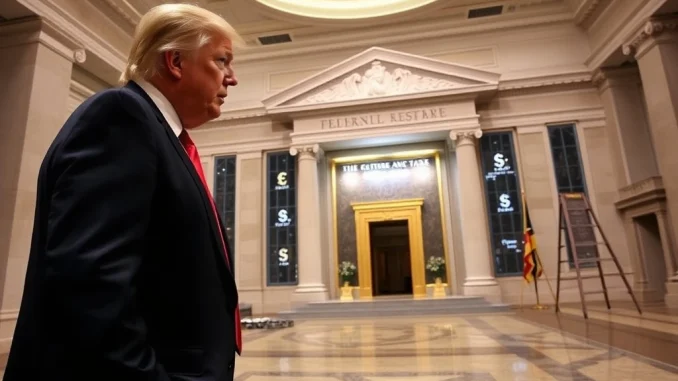
In the dynamic world of cryptocurrencies, external macroeconomic factors often dictate market movements as much as internal innovations. Recently, an unprecedented event has sent ripples through financial circles: Donald Trump’s planned inspection of the Federal Reserve’s ongoing $3.1 billion headquarters renovation. This highly unusual engagement by a non-incumbent president with the Fed’s physical operations has ignited a crucial debate, with significant implications for central bank independence, monetary policy, and naturally, the very future of the crypto market. For anyone holding Bitcoin or other digital assets, understanding this evolving narrative around the Trump Fed relationship is paramount.
Unpacking the Trump Fed Renovation Inspection
The news, initially reported by the Walter Bloomberg economic news account and later confirmed by the White House, marks a unique moment in U.S. financial history. While presidential interactions with the central bank are not unheard of, a detailed inspection of a renovation project by a former president is exceptionally rare. This visit raises immediate questions about its intent and potential implications for monetary policy governance.
The Federal Reserve, as the U.S. central banking system, holds a pivotal role in shaping economic stability. Its functions include:
- Setting monetary policy (e.g., interest rates)
- Regulating banks
- Overseeing the financial system
Trump’s visit, occurring amidst a major infrastructure project, has drawn scrutiny over potential signals about accountability for public spending or, more significantly, future policy influence. This perceived politicization of the Fed’s operations could introduce uncertainty into markets, a concern that reverberates across all asset classes, including cryptocurrencies.
Why Central Bank Independence Matters
The concept of central bank independence is widely regarded as essential for credible economic management. Why is this autonomy so critical?
A truly independent central bank can make decisions based purely on economic data and long-term stability goals, free from short-term political pressures. This separation ensures:
- Credibility: Markets trust that monetary policy decisions are not swayed by electoral cycles or partisan agendas.
- Stability: It allows the central bank to act decisively during crises, implementing unpopular but necessary measures without fear of political backlash.
- Inflation Control: An independent Fed is better positioned to prioritize price stability, even if it means raising interest rates when politicians might prefer lower rates for economic stimulus.
Analysts note that any perceived erosion of this principle could lead to market volatility, as investors react to perceived instability in policy frameworks. The current discourse highlights a fundamental tension between the desire for transparency and accountability, and the need for the Fed to remain apolitical to be effective.
Monetary Policy’s Ripple Effect on Global Markets
The Fed’s decisions on interest rates, inflation targets, and quantitative easing directly impact asset valuations across the board. This is where the discussion truly converges with your crypto investments. Understanding the nuances of monetary policy is key to navigating both traditional and digital asset markets.
Consider the following:
Interest Rate Hikes: When the Fed raises rates, it typically makes traditional, yield-bearing assets (like bonds) more attractive. This can redirect capital away from riskier investments, potentially dampening demand for cryptocurrencies.
Dovish Policies (Lower Rates/QE): Conversely, when the Fed adopts more accommodative policies, it can boost speculative trading. With lower returns elsewhere, investors might seek higher yields in riskier assets, including digital currencies.
Inflation Concerns: Cryptocurrencies like Bitcoin are often viewed as inflation hedges. If the Fed’s ability to control inflation is questioned due to political interference, the appeal of Bitcoin as a hedge could strengthen, but it could also lead to broader economic uncertainty that impacts all assets.
The direct correlation between Fed actions and market sentiment cannot be overstated. Any signal that the Fed’s independence is compromised could introduce an unpredictable variable into these established relationships.
The Cryptocurrency Impact: Navigating Uncertainty
For cryptocurrency investors, the event underscores the need to monitor both Fed communications and broader economic signals with heightened vigilance. The potential for political influence on the Fed has a direct cryptocurrency impact that warrants careful consideration.
Here’s how this dynamic plays out in the crypto space:
- Heightened Volatility: Persistent inflation or aggressive monetary tightening could heighten crypto market volatility, as investors adjust their risk appetite.
- Safe Haven Narrative: If trust in traditional financial institutions or government-backed currencies erodes due to political interference, the ‘safe haven’ narrative for assets like Bitcoin might gain traction, but this often comes with increased price swings.
- Regulatory Scrutiny: The visit also reignites discussions about the Fed’s evolving role in an era of digital finance. As cryptocurrencies gain mainstream traction, central banks face growing pressure to adapt their regulatory approaches without compromising their core mandates. This balancing act will likely remain a focal point for policymakers and market participants alike.
The perceived stability or instability of the U.S. financial framework, influenced by events like Trump’s visit, can directly influence the flow of capital into and out of digital assets.
Mitigating Market Volatility: Investor Strategies
In an environment where political oversight intersects with central bank operations, anticipating and managing market volatility becomes even more crucial for investors. While no strategy guarantees success, several approaches can help mitigate risks:
Diversification: Don’t put all your eggs in one basket. Diversifying your crypto portfolio across different asset classes (e.g., Bitcoin, Ethereum, stablecoins, DeFi tokens) can help spread risk.
Focus on Fundamentals: Prioritize projects with strong use cases, robust technology, active development, and a clear path to adoption. These projects tend to be more resilient during turbulent times.
Stay Informed: Continuously monitor macroeconomic news, Fed announcements, and political developments. Understanding the ‘why’ behind market movements empowers better decision-making.
Risk Management: Implement stop-loss orders, take profits at predetermined levels, and only invest what you can afford to lose. Volatility is inherent in crypto, and sound risk management is your best defense.
A stable, predictable policy environment typically supports risk-on sentiment, while uncertainty can lead to caution and sell-offs. Your ability to adapt to these shifts will be key.
Conclusion
Donald Trump’s planned inspection of the Federal Reserve headquarters is more than just a renovation tour; it’s a symbolic event that has reignited a critical debate about political oversight and central bank independence. This tension directly impacts the credibility of monetary policy, influencing everything from interest rates to inflation, and consequently, the valuation and stability of the cryptocurrency market. For crypto investors, this moment underscores the interconnectedness of traditional finance and the digital asset space. As the lines between political influence and economic autonomy continue to be debated, staying informed and adopting resilient investment strategies will be paramount to navigating the evolving financial landscape.
Frequently Asked Questions (FAQs)
Q1: What was the primary reason for Donald Trump’s planned visit to the Federal Reserve?
A1: Donald Trump’s planned visit was an inspection of the Federal Reserve’s ongoing $3.1 billion headquarters renovation. While the stated reason was an inspection, it has ignited a broader debate about political oversight and central bank independence, especially given his non-incumbent status.
Q2: Why is central bank independence considered crucial for economic stability?
A2: Central bank independence ensures that monetary policy decisions are made based on economic data and long-term stability goals, free from short-term political pressures or electoral cycles. This fosters credibility, allows for decisive action during crises, and helps maintain price stability without partisan influence.
Q3: How do the Federal Reserve’s actions, particularly its monetary policy, affect cryptocurrency markets?
A3: The Fed’s monetary policy decisions, such as interest rate changes, directly impact asset valuations. Rate hikes can make traditional assets more attractive, potentially reducing demand for riskier crypto investments. Conversely, dovish policies can boost speculative trading in digital assets. Additionally, cryptocurrencies like Bitcoin are often viewed as inflation hedges, making them sensitive to Fed actions aimed at controlling price stability.
Q4: What are the potential risks of increased political attention or interference in the Federal Reserve’s operations?
A4: Excessive scrutiny or pressure could undermine the Fed’s ability to act decisively during crises and make unpopular but necessary decisions. Any perceived politicization of its operations could introduce uncertainty into markets, erode investor trust, and lead to increased market volatility as investors react to perceived instability in policy frameworks.
Q5: What should cryptocurrency investors consider in light of these developments?
A5: Cryptocurrency investors should closely monitor Fed communications and broader economic signals. Persistent inflation or aggressive monetary tightening could heighten crypto market volatility. Strategies such as diversification, focusing on projects with robust fundamentals, and implementing sound risk management are key to navigating macroeconomic shifts and potential market volatility.