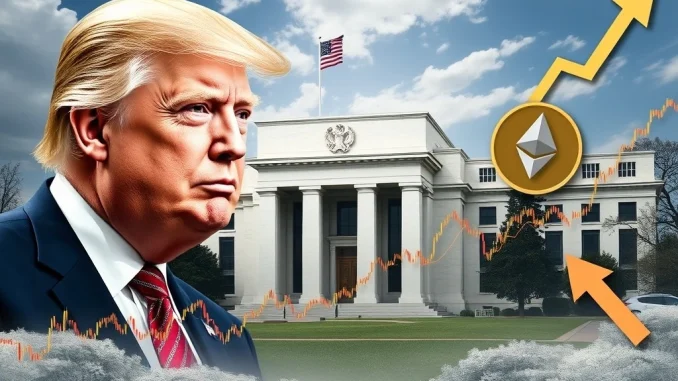
Are you a crypto enthusiast watching the market’s every twist and turn? Then you know that macroeconomic forces often dictate the rhythm of digital assets. Recently, the dynamic between former U.S. President Donald Trump and the Federal Reserve has taken center stage, sparking significant discussions and potential shifts in the crypto market. This isn’t just about political theater; it’s about real-world implications for your digital portfolio, especially concerning Bitcoin volatility.
The Trump Fed Dynamic: A Deep Dive into Political Influence
The relationship between political leadership and central bank independence is a cornerstone of stable economies. Yet, former President Donald Trump’s recent direct engagement with Federal Reserve Chairman Jerome Powell has reignited a critical debate. During a visit to the Fed’s headquarters, Trump made his preferences clear: he wants lower interest rates. This isn’t a new stance for Trump, who consistently advocated for reduced borrowing costs during his presidency, believing they are key to stimulating economic growth.
This high-profile interaction isn’t merely a political formality; it underscores the inherent tension between a president’s economic philosophy and the central bank’s mandate. Trump’s argument centers on the idea that lower rates can:
- Stimulate business investment and expansion.
- Boost consumer spending through cheaper credit.
- Create more jobs, leading to overall economic prosperity.
- Reduce the federal government’s debt servicing costs, potentially freeing up funds for other initiatives.
However, this approach is not without its critics. Many economists and policymakers warn that overly accommodative monetary policy, driven by political pressure, carries significant risks. These include inflationary pressures, where too much money chases too few goods, and the formation of asset bubbles, particularly in sectors like real estate or, indeed, cryptocurrencies, where low-yield environments often push speculative capital into riskier assets.
How Interest Rates Shape the Crypto Market Landscape
For the cryptocurrency market, the Federal Reserve’s policy direction is not just a factor; it’s often a critical determinant of sentiment and price action. Historically, periods of accommodative monetary policy—characterized by low interest rates and quantitative easing—have coincided with increased investor interest in riskier assets, including Bitcoin and Ethereum.
Why does this happen? When traditional safe-haven investments like bonds offer diminishing returns in a low-rate environment, investors often seek higher yields elsewhere. Digital assets, despite their inherent volatility, can become attractive alternatives. This shift of capital toward cryptocurrencies can amplify their price movements, leading to periods of significant growth, but also heightened Bitcoin volatility. Conversely, when rates rise, capital tends to flow back into less risky, interest-bearing assets, potentially cooling down the crypto market.
Consider the following impacts:
- Risk-On Sentiment: Lower rates encourage investors to take on more risk, benefiting growth assets like tech stocks and cryptocurrencies.
- Inflation Hedge Narrative: Some investors view Bitcoin as a hedge against inflation, a concern often amplified during periods of loose monetary policy.
- Dollar Strength: Fed policies directly impact the U.S. dollar’s strength. A weaker dollar, often a result of lower rates, can make dollar-denominated assets like Bitcoin more attractive to international buyers.
The Fed’s decisions are therefore positioned as a key driver of macroeconomic sentiment in the crypto space, making the central bank’s independence a topic of intense interest for crypto investors.
Navigating Bitcoin Volatility Amidst Macroeconomic Shifts
The very concept of the Fed’s operational independence is a cornerstone of its credibility. This independence ensures that decisions are based on economic data and long-term stability rather than short-term political agendas. Chairman Powell, despite being appointed by Trump in 2017, has consistently emphasized this commitment to data-driven policy.
However, public demands from high-profile figures like Trump inherently challenge these boundaries of executive influence. Analysts are keenly watching how these interactions play out, noting that persistent pressure from the White House could erode investor confidence in the Fed’s autonomy. This erosion of trust could potentially destabilize broader financial markets, including crypto, by introducing uncertainty into policy expectations. For instance, if markets perceive that the Fed might bow to political pressure, it could lead to unpredictable swings in asset prices, making Bitcoin volatility even more pronounced.
The Fiscal Accountability Angle: Beyond Interest Rates
Beyond the interest rate debate, Trump’s criticism of the Fed’s $3.1 billion building renovation cost reflects a broader fiscal ideology. His scrutiny aligns with a pattern of emphasizing budget efficiency and taxpayer accountability, even for institutions largely self-funded through operations. While focused on a specific project, this signals a broader approach to economic management that prioritizes cost control and direct oversight. This could potentially influence future policy debates on public spending, even impacting how the government approaches digital currency initiatives or blockchain technology integration.
Understanding the Monetary Policy Debate and its Digital Asset Repercussions
The economic implications of Trump’s demands are multifaceted and far-reaching. Lower rates, as he argues, could indeed boost GDP growth and corporate profitability. However, the counter-argument highlights the risk of inflationary surges if demand significantly outpaces supply. For markets, the Fed’s perceived independence is a critical stabilizing factor. Any erosion of this independence could lead to currency volatility, reduced investor trust, and unpredictable capital flows.
Globally, markets remain highly sensitive to U.S. monetary policy shifts, given the U.S. dollar’s dominant role in international trade and capital flows. A shift in the Fed’s stance, whether real or perceived as politically influenced, can trigger ripple effects across currencies, commodities, and, inevitably, digital assets.
As the U.S. navigates its political landscape, particularly heading into an election year, the dialogue between political leaders and the Federal Reserve is likely to intensify. While the central bank’s independence is legally protected, the sheer visibility of political pressures may amplify market reactions to policy decisions. Investors, especially those in the crypto market, must navigate this evolving landscape by closely monitoring both official Fed statements and the broader political environment for signals of policy direction. Understanding these dynamics is crucial for making informed decisions and managing risk in a volatile market.
In conclusion, the interplay between political influence, central bank independence, and monetary policy is a complex web that directly impacts the stability and direction of the crypto market. Trump’s pressure on the Fed serves as a potent reminder that even decentralized assets like Bitcoin are not immune to the gravitational pull of global macroeconomic forces. As an investor, staying informed about these macro trends, understanding the potential for Bitcoin volatility driven by such debates, and adapting your strategy accordingly will be key to navigating the exciting yet unpredictable world of digital finance.
Frequently Asked Questions (FAQs)
Q1: Why does Donald Trump want lower interest rates?
Donald Trump consistently advocates for lower interest rates because he believes they stimulate economic growth by making it cheaper for businesses to borrow and invest, and for consumers to spend. He also argues that lower rates reduce the federal government’s debt servicing costs.
Q2: How does the Federal Reserve’s independence relate to the crypto market?
The Federal Reserve’s independence is crucial for market stability. If markets perceive that the Fed is succumbing to political pressure rather than acting solely on economic data, it can introduce uncertainty and erode investor confidence. This can lead to increased volatility across all asset classes, including the crypto market, as investors become less certain about future monetary policy decisions.
Q3: What is the historical relationship between interest rates and Bitcoin’s price?
Historically, periods of low interest rates have often coincided with increased investor interest in riskier assets like Bitcoin. When traditional investments offer low returns, capital tends to flow into assets with higher growth potential. Conversely, rising interest rates can make safer, interest-bearing assets more attractive, potentially drawing capital away from the crypto market and contributing to Bitcoin volatility.
Q4: What are the risks of politically influenced monetary policy?
Politically influenced monetary policy carries several risks, including the potential for inflationary pressures if rates are kept too low for too long, the formation of asset bubbles, and a loss of credibility for the central bank. Such a scenario could destabilize financial markets and lead to unpredictable economic outcomes.
Q5: How can crypto investors navigate the current macroeconomic environment?
Crypto investors should closely monitor both Federal Reserve statements and broader political developments for signals regarding monetary policy direction. Understanding the potential impact of interest rate changes and debates over central bank independence on the crypto market is crucial for making informed investment decisions and managing risk effectively.