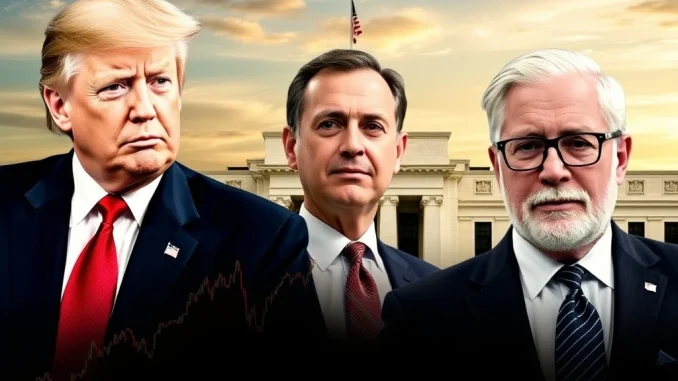
The Federal Reserve’s decisions profoundly influence global financial markets, including the dynamic world of cryptocurrencies. Every shift in monetary policy, from interest rates to quantitative easing, sends ripples across asset classes. Therefore, the individuals shaping these policies hold immense power. Recently, reports indicate former U.S. President Donald Trump is actively considering key figures for the Federal Reserve. These potential appointments could dramatically reshape the institution’s direction, leading to significant Crypto Market Implications for investors and enthusiasts alike. Understanding these potential changes is crucial for navigating future market volatility.
Trump’s Fed Choices: A Critical Juncture for Economic Policy
Former President Donald Trump is reportedly weighing two prominent individuals to potentially replace recently ousted Federal Reserve Governor Lisa Cook. These candidates are Stephen Miran, who chairs the White House National Economic Council, and David Malpass, the former president of the World Bank. The Wall Street Journal brought this news to light, sparking discussions across financial circles. Such high-level appointments at the Federal Reserve are always scrutinized. This is because they dictate the future of the nation’s monetary policy. Moreover, they indirectly influence global economic stability and the valuation of various assets, including digital currencies. These choices reflect a specific economic philosophy that could steer the U.S. economy in new directions.
The Federal Reserve, often simply called ‘the Fed,’ operates as the central bank of the United States. Its primary responsibilities include conducting monetary policy, supervising and regulating banking institutions, and maintaining the stability of the financial system. It also provides financial services to depository institutions, the U.S. government, and foreign official institutions. The composition of its Board of Governors is therefore critically important. Any changes in leadership can signal a shift in approach. Investors, economists, and cryptocurrency enthusiasts closely watch these developments. They understand the far-reaching consequences of such personnel decisions. The stakes are undeniably high for the global financial landscape.
Stephen Miran Policy: A Focus on Trade and Tariffs
Stephen Miran stands out as a strong proponent of a more protectionist trade policy. Last year, he published a significant guide outlining his vision for restructuring the global trade system. In this document, Miran advocated for the strategic use of coercive measures, such as tariffs, to reduce the U.S. trade deficit. His philosophy centers on rebalancing international trade relationships. He believes this approach strengthens domestic industries and employment. This perspective aligns with an ‘America First’ economic agenda. Such a stance could lead to significant shifts in how the U.S. interacts with global markets. It might also influence domestic inflation and economic growth trajectories.
Miran’s potential appointment to the Federal Reserve Board would introduce a voice with distinct views on global trade. This could influence the Fed’s assessment of inflation. Tariffs, for example, can increase the cost of imported goods. This, in turn, may contribute to domestic price increases. Therefore, a Fed governor with Miran’s background might push for policies that consider trade imbalances as a significant factor in monetary decisions. This approach contrasts with more traditional, globally integrated economic models. Consequently, his presence could lead to more hawkish stances on inflation, potentially advocating for tighter monetary policy. These shifts could impact the overall economic environment, affecting risk assets like cryptocurrencies.
Understanding Miran’s Economic Philosophy
- Trade Deficit Reduction: Miran champions policies aimed at shrinking the U.S. trade deficit.
- Strategic Tariffs: He advocates for tariffs as a tool to achieve trade rebalancing.
- Domestic Industry Support: His policies prioritize strengthening American manufacturing and jobs.
- Inflationary Pressure: Tariffs can increase import costs, potentially fueling domestic inflation.
His economic worldview suggests a potential for increased volatility in international trade relations. This could lead to periods of economic uncertainty. Financial markets often react to such uncertainty. Investors might seek safe-haven assets or re-evaluate their exposure to riskier investments. The implications for the cryptocurrency market are noteworthy. For instance, heightened trade tensions could affect global supply chains. This could lead to inflationary pressures that might either boost Bitcoin as a hedge or dampen overall market sentiment for all assets. Therefore, Miran’s Stephen Miran Policy could introduce a new dynamic to the Fed’s deliberations.
David Malpass Role: A Global Perspective on Finance
David Malpass brings a different, yet equally impactful, set of experiences to the table. He served as the president of the World Bank from 2019 to 2023. During his tenure, Malpass focused on global development and poverty reduction. He also emphasized fiscal responsibility and structural reforms in developing economies. His background is deeply rooted in international finance and economic development. This offers a contrast to Miran’s more domestically focused trade views. Malpass previously held senior positions in the U.S. Treasury Department during the Trump administration. He also worked at Bear Stearns as its chief economist. His extensive career demonstrates a broad understanding of both domestic and international financial systems.
Malpass’s experience at the World Bank gives him a unique perspective on global economic interconnectedness. He has witnessed firsthand the challenges of sovereign debt, international trade, and currency fluctuations. His approach tends to favor market-oriented solutions and prudent fiscal policies. If appointed to the Federal Reserve, Malpass might emphasize the importance of a strong dollar and sound financial regulation. He could also advocate for policies that foster stable international capital flows. These are critical considerations for a globalized economy. His presence on the Board could therefore lead to a more internationally-aware approach to monetary policy. This would contrast with a purely domestic focus. Therefore, understanding the potential David Malpass Role is vital.
Key Aspects of Malpass’s Background
- World Bank Leadership: Served as president, focusing on global development and reforms.
- Fiscal Conservatism: Advocates for responsible government spending and debt management.
- International Finance Expertise: Deep understanding of global markets and economic interdependence.
- Strong Dollar Advocate: Likely to support policies that maintain the dollar’s strength.
His potential influence on the Fed could lean towards a more orthodox, stability-oriented monetary policy. This might involve a greater emphasis on controlling inflation through conventional means. It could also include a cautious approach to unconventional monetary tools. A strong dollar, often a consequence of tighter monetary policy, can impact commodity prices and global trade. For cryptocurrencies, a strengthening dollar typically makes dollar-denominated assets, including digital ones, less attractive to international investors. Conversely, it can exert downward pressure on their prices. Thus, Malpass’s economic philosophy could usher in a period of more predictable, yet potentially tighter, monetary conditions.
The Federal Reserve Impact: Steering the US Economy
The Federal Reserve’s primary mandate involves maintaining maximum employment and price stability. To achieve these goals, the Fed uses several powerful tools. These include setting the federal funds rate, conducting open market operations, and managing the discount rate. Each of these tools influences the cost and availability of money and credit in the economy. Changes in these policies directly affect everything from mortgage rates to business investment. Therefore, the selection of Fed governors is a highly political and economically sensitive process. These individuals shape the financial environment for years to come. Their collective decisions can either stimulate growth or curb inflation, depending on the prevailing economic conditions.
The philosophical leanings of new appointees can significantly alter the Fed’s overall direction. A board with a more hawkish stance might prioritize inflation control, even at the risk of slower economic growth. Conversely, a dovish board might emphasize employment growth, tolerating slightly higher inflation. These distinctions are not merely academic. They have tangible consequences for every American and for global markets. For example, a hawkish Fed might raise interest rates more aggressively. This makes borrowing more expensive. It can slow down economic activity. On the other hand, a dovish Fed might keep rates lower for longer. This encourages spending and investment. Understanding these nuances is key to predicting future economic trends. This also applies to their profound Federal Reserve Impact on digital assets.
Key Functions of the Federal Reserve
- Monetary Policy: Influences money supply and credit conditions.
- Bank Supervision: Regulates and oversees banking institutions.
- Financial Stability: Mitigates systemic risks in the financial system.
- Payment Services: Provides services to the banking sector and government.
The potential appointments of Miran and Malpass highlight the ongoing debate within economic policy circles. Miran’s focus on trade and tariffs could lead to unique inflationary pressures and a more nationalistic economic outlook. Malpass’s global finance background might promote fiscal prudence and a strong dollar. The blend of these perspectives, or the dominance of one, will ultimately define the Fed’s path. This uncertainty itself can create market reactions. Investors and analysts constantly monitor these signals. They adjust their strategies accordingly. The future composition of the Federal Reserve Board is therefore a major determinant of the economic climate. This includes its significant influence on the volatile cryptocurrency markets.
Crypto Market Implications: How Fed Policy Affects Digital Assets
The Federal Reserve’s monetary policy decisions directly influence the cryptocurrency market. This connection is multifaceted and complex. When the Fed adopts a hawkish stance, often characterized by rising interest rates, it generally makes riskier assets less attractive. Cryptocurrencies, while gaining mainstream acceptance, are still largely considered risk assets. Higher interest rates increase the cost of borrowing. This reduces the capital available for speculative investments. It also makes traditional, lower-risk investments, such as bonds, more appealing. Consequently, this can lead to a decrease in demand for cryptocurrencies. It can also cause a downward pressure on their prices. Therefore, the potential for a more hawkish Fed under new leadership could present challenges for the crypto market.
Conversely, a dovish Fed policy, typically involving lower interest rates and quantitative easing, can boost the appeal of cryptocurrencies. When interest rates are low, investors often seek higher returns in alternative assets. This includes digital currencies. Moreover, quantitative easing, which increases the money supply, can lead to inflation concerns. Many investors view Bitcoin, in particular, as a hedge against inflation due to its finite supply. In such scenarios, demand for cryptocurrencies can surge. This drives prices higher. Therefore, the economic philosophies of Stephen Miran and David Malpass, if translated into Fed policy, could significantly impact the market sentiment for Bitcoin, Ethereum, and other digital assets. These Crypto Market Implications are closely watched by all participants.
Direct Connections Between Fed Policy and Crypto
- Interest Rates: Higher rates can reduce appetite for risk assets like crypto.
- Inflation: Concerns about inflation often boost Bitcoin’s appeal as a store of value.
- Dollar Strength: A stronger dollar can make dollar-denominated crypto less attractive globally.
- Economic Growth: A robust economy generally supports risk-on assets, including crypto.
Stephen Miran’s focus on tariffs could, for example, lead to domestic inflation. This might initially boost Bitcoin as an inflation hedge. However, if the Fed under Miran then responds with aggressive rate hikes, the positive effect could be negated. David Malpass’s emphasis on fiscal prudence and a strong dollar could lead to tighter monetary conditions. This could put sustained pressure on crypto prices. The interplay of these potential policies creates a complex landscape for digital asset investors. Therefore, closely monitoring the statements and actions of new Fed governors will be essential. This will help anticipate market movements. The future direction of the crypto market is inextricably linked to the decisions made within the hallowed halls of the Federal Reserve.
Navigating Uncertainty: What Crypto Investors Should Watch
Given the significant potential changes at the Federal Reserve, cryptocurrency investors must remain vigilant. The appointments of Stephen Miran and David Malpass, or any other candidates, will signal the likely direction of U.S. monetary policy. Investors should pay close attention to any public statements made by these individuals, particularly regarding inflation, interest rates, and the strength of the U.S. dollar. These indicators provide crucial insights into future policy actions. For example, hawkish rhetoric could suggest upcoming rate hikes. This would typically be a bearish signal for risk assets, including cryptocurrencies. Conversely, dovish comments might indicate a more accommodative monetary environment, potentially bullish for crypto.
Beyond individual statements, observing key economic data releases is also vital. Inflation reports, employment figures, and GDP growth numbers all influence the Fed’s decision-making process. A strong economy with rising inflation might prompt a more aggressive Fed. This would affect crypto. Conversely, signs of economic slowdown or disinflation could lead to a more cautious approach. This could potentially support digital assets. Furthermore, global economic developments, trade relations, and geopolitical events will continue to play a role. These factors can either reinforce or counteract the domestic economic trends. Therefore, a holistic view of the global financial landscape is necessary for informed decision-making in the crypto space. The Federal Reserve Impact extends far beyond national borders.
Key Indicators for Crypto Investors
- Fed Commentary: Speeches and minutes from FOMC meetings.
- Inflation Data: CPI and PCE reports.
- Employment Reports: Non-farm payrolls, unemployment rates.
- Global Economic Trends: International trade, geopolitical stability.
Ultimately, the Federal Reserve’s composition and its policy trajectory will remain a dominant force in financial markets. For cryptocurrency investors, this means integrating macro-economic analysis into their investment strategies. While the decentralized nature of cryptocurrencies often positions them as an alternative to traditional finance, they are not immune to its gravitational pull. The potential shifts under consideration by Donald Trump for the Federal Reserve Board represent a pivotal moment. Their decisions will shape not only the U.S. economy but also the global financial environment where digital assets operate. Staying informed and adaptable will be paramount for navigating the evolving landscape of the crypto market.
Conclusion: The Far-Reaching Implications of Fed Leadership
The potential appointments of Stephen Miran and David Malpass to the Federal Reserve Board represent a critical moment for U.S. economic policy. Donald Trump’s choices for these influential roles could usher in significant changes to the Fed’s approach to monetary policy, trade, and international finance. Miran’s focus on tariffs and trade rebalancing, contrasted with Malpass’s background in global development and fiscal prudence, presents a fascinating dynamic. These differing philosophies could lead to varied responses to inflation, interest rates, and the overall health of the economy. The consequences will extend far beyond traditional markets, deeply affecting the trajectory of the cryptocurrency space.
As the U.S. navigates complex economic challenges, the leadership at the Federal Reserve will play an instrumental role. Cryptocurrency investors, in particular, must understand how these potential shifts in monetary policy could impact their portfolios. Whether through a stronger dollar, inflationary pressures, or changes in risk appetite, the decisions made by the Fed’s governors will undoubtedly ripple through the digital asset ecosystem. Staying informed about Trump’s Fed Choices and their potential Crypto Market Implications is not just an academic exercise; it is a fundamental aspect of prudent investment in today’s interconnected financial world. The coming months will reveal the true impact of these pivotal appointments.
Frequently Asked Questions (FAQs)
Q1: Who are Stephen Miran and David Malpass?
Stephen Miran is the chairman of the White House National Economic Council, known for advocating tariffs to reduce the U.S. trade deficit. David Malpass is the former president of the World Bank, recognized for his expertise in international finance and fiscal responsibility. Both are reportedly being considered by Donald Trump for positions on the Federal Reserve Board.
Q2: How do Federal Reserve appointments affect the economy?
Federal Reserve appointments are crucial because they influence the direction of U.S. monetary policy. The Fed sets interest rates, manages the money supply, and regulates banks. Changes in leadership can lead to shifts in these policies, affecting inflation, employment, economic growth, and the overall stability of financial markets.
Q3: What is the potential impact of these appointments on cryptocurrency markets?
Potential Federal Reserve appointments can significantly impact cryptocurrency markets. A more hawkish Fed, for example, might raise interest rates, making risk assets like crypto less attractive. Conversely, policies leading to inflation concerns could boost Bitcoin’s appeal as a hedge. The specific economic philosophies of appointees like Miran and Malpass will dictate these potential shifts.
Q4: What are Stephen Miran’s key economic views?
Stephen Miran is known for his views on restructuring global trade. He advocates for using coercive measures, such as tariffs, to reduce the U.S. trade deficit. His policy aims to bolster domestic industries and employment, potentially leading to inflationary pressures due to increased import costs.
Q5: How might David Malpass’s background influence the Fed?
David Malpass’s extensive background at the World Bank and U.S. Treasury gives him a global perspective. He tends to favor market-oriented solutions, fiscal prudence, and a strong U.S. dollar. If appointed, he might push for more orthodox monetary policies, emphasizing stability and inflation control through conventional means.
Q6: Why should crypto investors pay attention to Federal Reserve news?
Crypto investors should pay close attention to Federal Reserve news because the Fed’s decisions on interest rates, inflation, and economic growth directly influence the broader financial environment. These macro-economic factors significantly affect investor sentiment and capital flows into risk assets, including cryptocurrencies. Understanding these dynamics is essential for informed investment decisions.