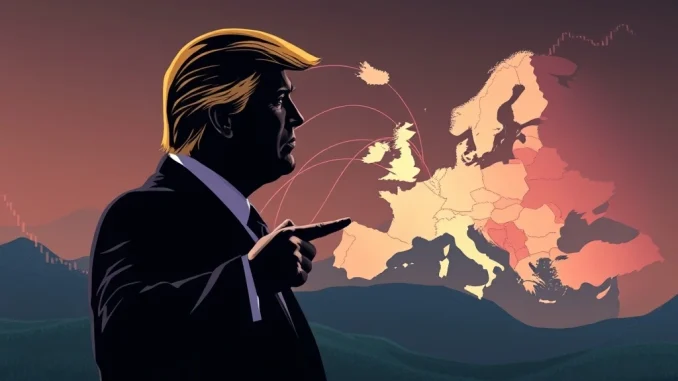
In a pronouncement that has sent ripples across global capitals, former President Donald Trump delivered a pointed message to European nations: ‘GET YOUR ACT TOGETHER!’ While the original source material was brief, the essence of his declaration centered on two critical areas. For the cryptocurrency community, understanding these geopolitical shifts is paramount, as they often precede significant movements in digital asset markets. This article will delve into the core of Trump’s Europe Warning and its potential ramifications.
Understanding Trump’s Europe Warning: The Core Issues
Donald Trump’s consistent rhetoric during and after his presidency has often highlighted two key areas concerning Europe: defense spending and trade imbalances. While specific details of his latest warning remain under wraps in the original snippet, historical context strongly suggests these are the ‘two things’ he refers to. Let’s break them down:
- Defense Spending (NATO Contributions): A long-standing point of contention for Trump has been what he perceives as insufficient defense contributions from European NATO members. He has frequently argued that the United States bears an disproportionate share of the alliance’s financial burden. His warnings often imply that if European nations do not increase their military spending to the agreed-upon 2% of GDP, the U.S. might reconsider its commitments.
- Trade Imbalances and Economic Policy: The second ‘thing’ likely refers to trade practices and economic relationships. Trump has previously criticized European trade policies, particularly those he views as disadvantageous to American industries. This often includes tariffs, regulations, and market access issues. His ‘get your act together’ sentiment here would likely push for more favorable trade agreements for the U.S.
These warnings are not new, but their reiteration, especially from a prominent political figure, can significantly influence market sentiment and policy discussions across continents.
Broader Implications: Are Geopolitical Tensions on the Rise?
Such direct warnings from a former U.S. President, who may yet return to power, inevitably raise questions about escalating Geopolitical Tensions. Europe, already navigating complex internal and external challenges, faces a potential shift in its relationship with a key ally. The implications are multi-faceted:
- NATO’s Future: A continued push for increased defense spending, or even threats of withdrawal, could destabilize the alliance, forcing European nations to rapidly re-evaluate their security strategies and potentially increase their own military expenditures significantly.
- Trade Wars Resurgence: Renewed focus on trade imbalances could lead to tariffs and counter-tariffs, impacting global supply chains and consumer prices. Industries reliant on international trade, from automotive to agriculture, would feel the pinch.
- Diplomatic Strain: Public warnings can strain diplomatic relations, making cooperation on other critical global issues, such as climate change, technological regulation, or humanitarian crises, more challenging.
For investors, rising geopolitical friction introduces uncertainty, often leading to a flight to perceived safe-haven assets, or conversely, a sell-off in riskier ones.
Navigating Global Economic Stability in Uncertain Times
The interplay between political rhetoric and economic reality is profound. Warnings of this nature directly impact perceptions of Global Economic Stability. When major economic blocs like the U.S. and Europe face potential disagreements on fundamental issues, the ripple effect is felt worldwide.
Consider the potential scenarios:
| Scenario | Economic Impact | Potential Crypto Reaction |
|---|---|---|
| Increased European Defense Spending | Boosts defense industries, potentially shifts government budgets away from social programs. | Initial uncertainty, but long-term might see some capital reallocation if traditional investments become less attractive. |
| Trade Disputes Intensify | Higher import costs, reduced exports, potential inflation, supply chain disruptions. | Increased demand for decentralized assets as a hedge against inflation and de-globalization, but also initial panic selling. |
| Weakened NATO Alliance | Regional instability, increased military spending burden on Europe, potential for new alliances. | Significant flight to quality within crypto (Bitcoin), but overall market could see downturn due to systemic risk. |
These scenarios underscore how political warnings, even if not immediately translated into policy, can shape economic expectations and investment strategies.
What This Means for Market Volatility and Beyond
Expectations of political shifts, especially from a figure like Trump, are a primary driver of Market Volatility. Financial markets dislike uncertainty, and warnings about core alliances and trade agreements create just that. Here’s how it could play out:
- Traditional Markets: Stock markets, particularly those with significant international exposure, may experience heightened swings. Currency markets could also see fluctuations as investors react to perceived strengths or weaknesses of major economies.
- Commodities: Gold and other traditional safe-haven commodities might see increased demand, while oil prices could react to any perceived geopolitical instability affecting supply routes.
- Investor Sentiment: A cautious sentiment might prevail, leading investors to pull back from riskier assets or adopt a wait-and-see approach. This can lead to reduced liquidity and sharper price movements.
Understanding these broader market dynamics is crucial for anyone involved in digital assets, as crypto markets often mirror or amplify trends seen in traditional finance, especially during periods of high uncertainty.
Cryptocurrency Implications: A Safe Haven or Further Risk?
The central question for our readers is, how do these geopolitical rumblings affect Cryptocurrency Implications? The answer is nuanced, as crypto’s role in a volatile global landscape continues to evolve.
On one hand, some cryptocurrencies, particularly Bitcoin, are often touted as ‘digital gold’ or a hedge against traditional financial system instability. If global economic stability is indeed threatened by trade wars or geopolitical fragmentation, investors might increasingly look to decentralized assets that are not directly tied to any single nation-state’s policies or traditional banking systems. This could drive demand and price appreciation for certain digital assets.
However, increased market volatility in traditional finance can also spill over into crypto markets. During periods of extreme fear, investors may liquidate all assets, including cryptocurrencies, to cover margin calls or simply move to cash. The nascent nature of the crypto market also means it can be more susceptible to rapid price swings based on news and sentiment, sometimes magnifying the effects of broader economic concerns.
Key considerations for crypto investors:
- Bitcoin’s Role: Monitor Bitcoin’s performance as a potential safe-haven asset. Its limited supply and decentralized nature make it attractive during periods of fiat currency debasement or geopolitical uncertainty.
- Altcoin Sensitivity: Smaller altcoins might be more sensitive to overall market sentiment. A downturn in traditional markets due to geopolitical concerns could lead to disproportionate losses in less established digital assets.
- Regulatory Environment: Geopolitical shifts could also influence the pace and nature of cryptocurrency regulation. Nations might become more protective of their financial systems, potentially leading to stricter controls or, conversely, a push for innovation to maintain competitiveness.
Staying informed about global political and economic developments is no longer just for traditional investors; it’s essential for anyone navigating the dynamic world of digital assets.
Conclusion: Preparing for an Evolving Global Landscape
Donald Trump’s ‘get your act together’ warning to Europe, likely centered on defense spending and trade, serves as a powerful reminder of the interconnectedness of global politics and financial markets. While the immediate impact on daily life might seem distant, the potential for escalating geopolitical tensions, shifts in global economic stability, and heightened market volatility is real. For the cryptocurrency community, these developments are not merely background noise; they are critical indicators that can influence the trajectory of digital assets. As the world continues to navigate these complex dynamics, remaining vigilant, diversifying portfolios, and understanding the broader economic currents will be paramount for both traditional and crypto investors alike.
Frequently Asked Questions (FAQs)
Q1: What were the ‘two things’ Trump likely warned Europe about?
While not explicitly stated in the brief content, based on Donald Trump’s past rhetoric and policy focus, the ‘two things’ he likely warned Europe about are insufficient defense spending (specifically regarding NATO contributions) and trade imbalances, pushing for more favorable economic policies for the United States.
Q2: How do geopolitical warnings like this affect global economic stability?
Geopolitical warnings can significantly impact global economic stability by creating uncertainty. They can lead to concerns about potential trade wars, strained diplomatic relations, and shifts in international alliances, all of which can disrupt supply chains, influence currency values, and affect investor confidence worldwide.
Q3: What does ‘Market Volatility’ mean in this context, and how does it relate to Trump’s warning?
Market volatility refers to rapid and unpredictable price changes in financial markets. Trump’s warnings, especially from a figure who could influence future policy, introduce uncertainty about international relations and economic policies. This uncertainty can cause investors to react quickly, leading to increased buying or selling pressure across stock, bond, and commodity markets, resulting in higher volatility.
Q4: Are cryptocurrencies considered a safe haven during periods of geopolitical tension?
The role of cryptocurrencies, particularly Bitcoin, as a safe haven during geopolitical tension is a debated topic. Some argue that their decentralized nature makes them attractive as a hedge against traditional financial instability. However, crypto markets can also be highly volatile and are not immune to broader market downturns, especially during extreme fear. It depends on the specific circumstances and investor sentiment.
Q5: How should crypto investors prepare for potential geopolitical shifts?
Crypto investors should prepare by staying informed about global political and economic developments, as these can influence market sentiment. Consider diversifying your portfolio, understanding the potential impact of different scenarios (e.g., trade wars, currency fluctuations) on various digital assets, and recognizing that even decentralized markets can react to traditional financial stressors.