In the volatile world of global economics, trade disputes can send ripples across markets, influencing everything from supply chains to investment decisions. The latest flashpoint centers on a critical standoff between the United States and the European Union, with implications that could redefine transatlantic relations and impact global economic stability. At the heart of this dispute is former President Donald Trump’s demand for the EU to significantly reduce its tariffs, a move that has sparked threats of massive retaliation from Brussels. For investors and market watchers, understanding the nuances of these US trade negotiations is paramount.
Trump’s Bold EU Trade Standoff: The 30% Tariff Demand
Former President Donald Trump has made it clear: a trade agreement with the European Union hinges on their willingness to slash a 30% tariff on U.S. goods. Describing this as a ‘buy down’ requirement, Trump’s stance underscores his administration’s consistent strategy of leveraging tariffs as a negotiation tool. Speaking ahead of a trip to Scotland, he candidly assessed the odds of a U.S.-EU deal at a precarious ’50-50′ or even lower, highlighting Washington’s firm position on tariff reductions against the EU’s perceived urgency to finalize an agreement.
The proposed 30% levy, initially announced in July 2025, targets a range of high-value European exports. Imagine the impact on industries reliant on:
- French cheese: A staple in many households, potentially facing significant price hikes.
- Italian leather goods: Luxury items that could become far more expensive for American consumers.
- German electronics: From high-tech machinery to consumer gadgets, these could see their competitiveness erode.
This aggressive demand sets the stage for a high-stakes negotiation, where both sides are acutely aware of the economic consequences.
EU Tariffs and the $109 Billion Retaliation Threat
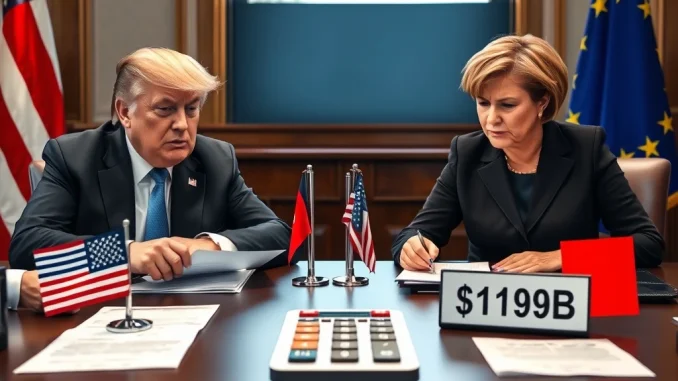
The European Union has not taken Trump’s demands lightly. In a show of resolve, Brussels has prepared a formidable counter-punch: retaliatory tariffs exceeding €93 billion ($109 billion) on American imports should negotiations collapse. This robust response signals the EU’s determination to protect its economic interests and avoid unilateral concessions. The potential for these EU tariffs to escalate into a full-blown trade conflict is a significant concern for global markets.
The EU’s prepared measures highlight a crucial aspect of modern trade disputes: the tit-for-tat nature of tariff imposition. When one major economic bloc imposes duties, the other often responds in kind, creating a cycle that can harm industries and consumers on both sides. This potential escalation underscores the fragility of the current trade environment and the urgent need for a diplomatic resolution.
Navigating US Trade Negotiations: High Stakes and Shifting Sands
Trump’s approach to trade negotiations often involves using economic pressure to achieve concessions, a strategy seen in past agreements. For instance, the U.S.-Japan agreement saw Japan offering investment commitments in exchange for tariff reductions. However, EU diplomats have signaled no intention of replicating such terms, complicating the current US trade negotiations.
The European Commission views preventing the 30% tariff as its paramount objective. European Commission President Ursula von der Leyen is slated to meet Trump in Scotland, a meeting deemed pivotal to breaking the impasse. Both sides face immense pressure to resolve the dispute before August 1, the looming deadline when the tariffs are set to take full effect. Adding to the complexity, EU trade officials have voiced frustration over what they perceive as shifting U.S. positions, citing Trump’s abrupt reversal in July of a ban on steel and aluminum imports—a key demand in previous EU negotiations.
The unpredictability of these talks is a constant theme. Peter Navarro, a former White House trade adviser, cautioned against treating the EU’s public statements on compromise with anything but skepticism, emphasizing the fluid nature of Trump’s negotiation tactics. This environment of uncertainty makes forecasting outcomes particularly challenging for businesses and investors alike.
Global Trade War Implications: Beyond Tariffs
The potential for a global trade war extends far beyond the immediate imposition of tariffs. Trump’s ’50-50′ assessment of a deal’s likelihood hints at a willingness to walk away if the EU fails to meet his terms, a stance that could severely strain transatlantic trade relations. This reflects a broader emphasis on economic nationalism and skepticism towards multilateral agreements, a hallmark of Trump’s foreign policy.
During his remarks, Trump also reiterated calls for the EU to:
- Limit immigration: Framing this as interconnected with trade priorities.
- Reduce reliance on wind power: Suggesting a shift away from certain renewable energy sources.
This multifaceted approach underscores a strategic focus on reshaping U.S. economic policy through bilateral negotiations rather than traditional multilateral frameworks. The outcome of the Trump-von der Leyen meeting is thus pivotal, not just for trade, but for the future direction of international economic cooperation.
Conclusion: A Critical Juncture for Transatlantic Trade
The looming deadline and the stark difference in negotiation stances place transatlantic trade relations at a critical juncture. A failure to reach an agreement could trigger an unprecedented escalation of tensions with the EU, the U.S.’s largest trade partner, potentially disrupting global supply chains and causing significant economic fallout. Conversely, a successful deal would demonstrate the Trump administration’s ability to blend punitive measures with pragmatic economic incentives, setting a precedent for future trade negotiations. Businesses and consumers globally will be watching closely, as the decisions made in the coming weeks will undoubtedly shape the economic landscape for years to come.
Frequently Asked Questions (FAQs)
Q1: What is Donald Trump’s primary demand regarding EU tariffs?
Donald Trump is demanding that the European Union reduce its 30% tariff on U.S. goods to secure a trade agreement. He refers to this as a “buy down” requirement, indicating that the EU must offset this tariff burden, likely through trade concessions or financial mechanisms.
Q2: What is the EU’s response to Trump’s tariff demands?
The EU has prepared retaliatory tariffs exceeding €93 billion ($109 billion) on American imports. This measure is intended to counter any tariffs imposed by the U.S. and signals the EU’s resolve to avoid making unilateral concessions.
Q3: What specific European goods are targeted by the proposed 30% U.S. tariff?
The proposed 30% U.S. levy, initially announced in July 2025, targets various European exports, including French cheese, Italian leather, and German electronics.
Q4: When is the deadline for these trade negotiations?
Both sides face pressure to resolve the dispute before August 1, when the U.S. tariffs are set to take full effect.
Q5: How does Trump’s approach to EU trade negotiations compare to past agreements?
Trump’s approach mirrors the U.S.-Japan agreement, where Japan offered investment commitments in exchange for tariff reductions. However, EU diplomats have indicated no plans to replicate such terms, complicating the current negotiations.
Q6: What are the broader implications if no trade deal is reached?
A failure to reach an agreement could escalate tensions with the EU, the U.S.’s largest trade partner, and disrupt global supply chains. It also reflects Trump’s emphasis on economic nationalism and skepticism of multilateral agreements, potentially reshaping global economic policy.