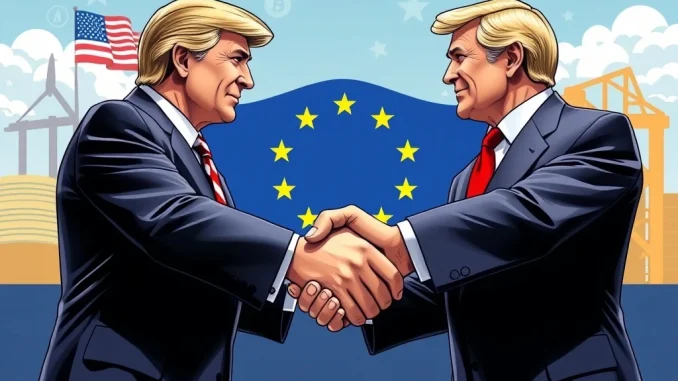
The world watched with bated breath as President Donald Trump and European Commission President Ursula von der Leyen forged a landmark agreement on July 27, 2025. This pivotal Trump EU Trade Deal, valued at an astounding $1.35 trillion, didn’t just avert a looming trade war; it sent shockwaves through financial markets, most notably sparking an incredible Bitcoin price surge that saw the digital asset nearing $120,000. For crypto enthusiasts and investors, this wasn’t just a political headline—it was a clear signal of renewed global economic stability and a testament to digital assets’ growing influence.
What’s the Core of the Historic Trump EU Trade Deal?
On a momentous Sunday, July 27, 2025, President Donald Trump announced a significant $1.35 trillion trade agreement with the European Union. This deal, confirmed alongside European Commission President Ursula von der Leyen, marks a pivotal shift in U.S. trade policy and aims to redefine economic relations between the two powers. The core of this agreement centers on a 15% tariff applied to most EU goods. While this rate is lower than the daunting 30% threat previously floated by Trump, it is notably higher than the existing 10% tariffs on specific items like auto exports.
A crucial aspect of this compromise is the explicit exclusion of automobiles from the 15% tariff rate. This aligns with Trump’s consistent strategy of leveraging tariffs not merely as punitive measures but as tools to secure reciprocal investments and concessions. In return for these tariff adjustments, the EU has made substantial commitments:
- $750 billion purchase of U.S. energy: A significant move aimed at bolstering U.S. energy independence and positioning the U.S. as a key global energy supplier.
- $600 billion investment in U.S. infrastructure: This commitment is designed to strengthen the U.S. industrial base, create jobs, and enhance domestic capabilities.
This comprehensive Trump EU Trade Deal effectively averted a potential trade war that had been a looming threat since July 1, when President Trump first signaled his intent to raise tariffs. The immediate impact on financial markets was swift and varied, reflecting the complex nature of such a significant international agreement.
Why Did We See Such a Significant Bitcoin Price Surge?
The announcement of the trade deal immediately resonated across financial markets, and nowhere was this more evident than in the cryptocurrency sector. Bitcoin, the leading digital asset, surged dramatically, reaching levels near $120,000. This impressive Bitcoin price surge reflects a wave of optimism among crypto investors regarding the deal’s implications for global economic stability and reduced geopolitical uncertainty. The digital currency market often acts as a barometer for global sentiment, and this positive reaction underscored a newfound confidence.
Beyond Bitcoin, other major cryptocurrencies also experienced significant gains. Binance Coin (BNB), for instance, reached record highs, further emphasizing the crypto sector’s overwhelmingly positive response to the averted trade conflict. The rationale is clear: a stable global economy, free from the disruptions of trade wars, encourages investment in risk assets, and cryptocurrencies are increasingly seen as a viable, albeit volatile, investment class in such environments.
Traditional markets, however, showed a more mixed reaction. U.S. stock futures initially dipped as investors grappled with the implications of higher tariff risks, even if they were lower than initially threatened. Yet, as the full scope of the deal—particularly its success in preventing a full-blown trade war escalation—became clearer, these markets stabilized, reflecting a cautious optimism. The divergence in immediate reactions highlights the distinct risk appetites and analytical frameworks employed by traditional and crypto investors.
How Does This Agreement Reshape Global Trade Dynamics?
The strategic significance of this agreement extends far beyond its immediate economic impacts. By securing substantial EU investments, the U.S. aims to strengthen its industrial base and reduce reliance on foreign supply chains, a key objective for the Trump administration. The energy component, in particular, is a game-changer. By positioning the U.S. as a primary energy supplier to the EU, the deal reinforces broader geopolitical goals, notably countering Russian influence in European energy markets. This move diversifies Europe’s energy sources and enhances U.S. strategic leverage on the global stage, profoundly impacting Global Trade Dynamics.
This approach mirrors a similar arrangement President Trump previously secured with Japan, where a $550 billion investment was obtained in exchange for 15% tariffs on Japanese goods. This pattern underscores a consistent trade strategy:
- Leveraging Tariffs: Using the threat or imposition of tariffs as a bargaining chip.
- Securing Reciprocal Benefits: Demanding substantial investments or market access in return for tariff adjustments.
- Prioritizing Domestic Industries: Focusing on deals that directly benefit U.S. manufacturing, energy, and infrastructure.
While the 15% rate is a compromise from the initial 30% threat, it unmistakably signals a new phase in international trade relations—one that blends aggressive protectionism with strategic investment incentives to reshape existing trade frameworks and influence global power balances.
Is This a New Chapter for US Trade Policy?
The Trump EU Trade Deal represents a defining moment for US Trade Policy, solidifying a distinctive approach that has been a hallmark of the Trump administration. This strategy is characterized by a willingness to challenge established norms and use tariffs as a potent tool for negotiation rather than just protection. The deal’s focus on energy and infrastructure investments directly aligns with President Trump’s broader economic goals, which include reducing persistent U.S. trade deficits and enhancing national energy independence.
Analysts note that this deal showcases a consistent, results-oriented approach. Instead of traditional multilateral negotiations, this administration favors bilateral agreements where specific, measurable commitments are secured. This strategy aims to bring manufacturing back to American shores, create domestic jobs, and ensure that trade relationships are perceived as mutually beneficial, with tangible gains for the U.S. economy. This isn’t merely about imposing taxes on imports; it’s about engineering a strategic rebalancing of global economic power through targeted agreements.
What Challenges Lie Ahead for This Tariff Agreement?
Despite the celebratory announcements, the implementation of this Tariff Agreement is not without its challenges. Critics are quick to point out that the deal may not fully resolve long-standing structural issues, such as persistent barriers to American agricultural exports in Europe. For instance, while the agreement addresses industrial goods and investments, the intricacies of agricultural trade often involve complex regulations and cultural preferences that are harder to shift through tariff negotiations alone.
Furthermore, the success of the agreement hinges significantly on the materialization of the pledged investments. Ensuring that the promised $750 billion in U.S. energy purchases and $600 billion in U.S. infrastructure investments genuinely come to fruition will require meticulous oversight and continued cooperation between the U.S. and EU. There’s also the ongoing challenge of avoiding potential EU retaliatory measures if unforeseen issues arise or if the perceived benefits do not align with expectations. As the U.S. and EU finalize the intricate details, attention will undoubtedly turn to these implementation hurdles and the broader implications for maintaining stable, cooperative relations between two of the world’s largest economic powers.
Conclusion
The landmark Trump EU Trade Deal, announced on July 27, 2025, marks a significant moment in global trade relations. By averting a potential trade war and implementing a 15% tariff coupled with substantial EU investments in U.S. energy and infrastructure, the agreement has demonstrated a unique blend of aggressive protectionism and strategic economic incentives. The immediate positive market reactions, particularly the notable Bitcoin price surge, underscore a renewed sense of stability and confidence in the global economy.
While this agreement offers significant benefits in terms of strengthening the U.S. industrial base, reducing trade deficits, and enhancing energy independence, challenges remain. The long-term success of this new phase in US Trade Policy will depend on effective implementation, resolving lingering trade barriers, and fostering continued cooperation between the U.S. and EU. As Global Trade Dynamics continue to evolve, this Tariff Agreement stands as a testament to a strategic approach that prioritizes domestic industries through controlled adjustments and large-scale foreign investments, shaping the economic landscape for years to come.
Frequently Asked Questions (FAQs)
1. What is the core of the Trump EU Trade Deal?
The core of the Trump EU Trade Deal, announced on July 27, 2025, is a $1.35 trillion agreement that includes a 15% tariff on most EU goods. In return, the EU committed to purchasing $750 billion in U.S. energy and investing an additional $600 billion in U.S. infrastructure.
2. How did this deal impact cryptocurrency markets, specifically Bitcoin?
The deal triggered a significant positive reaction in cryptocurrency markets. Bitcoin surged to nearly $120,000, and Binance Coin also reached record highs. This reflects optimism about global economic stability and reduced trade war uncertainty, making risk assets like cryptocurrencies more attractive to investors.
3. What are the key financial commitments from the European Union?
The EU committed to two major financial actions: purchasing $750 billion in U.S. energy products and investing $600 billion in U.S. infrastructure projects. These commitments are central to the reciprocal benefits sought by the U.S. in the agreement.
4. What are the potential challenges in implementing this Tariff Agreement?
Key challenges include ensuring that the pledged EU investments materialize as promised, addressing long-standing structural issues such as barriers to U.S. agricultural exports in Europe, and avoiding potential retaliatory measures from the EU if unforeseen issues arise during implementation.
5. How does this deal reflect Trump’s broader US Trade Policy?
This deal is a clear example of Trump’s broader US Trade Policy, which leverages tariffs as a tool for negotiation to secure reciprocal investments and benefits. It prioritizes reducing trade deficits, enhancing energy independence, and strengthening the domestic industrial base through bilateral agreements rather than traditional multilateral frameworks.