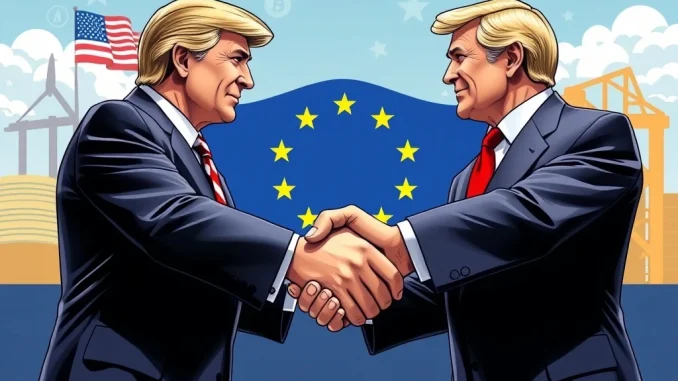
The global economic landscape just got a seismic shift, and surprisingly, its ripples were felt immediately in the volatile world of cryptocurrencies. In a move that surprised many, Bitcoin’s price surged following the announcement of a landmark Trump EU Trade Deal. What does this massive agreement entail, and why did it send positive shockwaves through digital asset markets? Let’s dive deep into the details of this historic pact, its implications for global commerce, and its unexpected influence on crypto.
Understanding the Trump EU Trade Deal: A New Era?
On July 24, 2025, after months of intense negotiations held at a golf resort in Scotland, President Donald Trump unveiled what he enthusiastically described as “the biggest of all the deals.” This landmark agreement with the European Union is poised to redefine transatlantic economic relations. European Commission President Ursula von der Leyen echoed the sentiment, calling it a “huge deal” that promises “stability and predictability” for trade between the two economic powerhouses.
At its core, the deal addresses longstanding tensions, particularly concerning the U.S.-EU trade deficit, which sees the EU holding a significant $235 billion annual surplus with the U.S. Trump’s administration has consistently emphasized fairness in trade, and this agreement aims to rebalance the scales while enabling reciprocal market access for both sides.
Key components of this unprecedented agreement include:
- Tariff Reduction: A significant cut in tariffs on most EU exports to the U.S. to a standardized 15%. This is a considerable reduction from the 30% threat previously issued by the Trump administration, offering a middle ground that reduces immediate trade friction.
- EU Market Access: The EU commits to opening its markets to U.S. goods at 0% tariffs, creating a more favorable environment for American exports.
- Massive Investments: The EU has pledged a staggering $600 billion investment in U.S. infrastructure and various industries.
- Energy & Equipment Purchases: A commitment from the EU to purchase $750 billion in American energy resources and military equipment.
These figures are substantial, designed to strengthen bilateral economic ties and foster job creation on both sides of the Atlantic. The pact marks a clear departure from earlier, more aggressive threats, such as the proposed 50% tariffs on steel and aluminum imports, which had previously fueled global market uncertainty.
Decoding US EU Tariffs: What’s Changed for Businesses?
For businesses operating across the Atlantic, the new framework around US EU Tariffs brings a welcome dose of clarity and reduced volatility. The shift from a potential 30% or even 50% tariff rate to a consistent 15% offers a more predictable environment for planning and operations.
Previously, the specter of escalating trade wars loomed large, creating uncertainty for supply chains, import/export costs, and consumer prices. The new 15% tariff on EU exports to the U.S., coupled with the EU’s commitment to 0% tariffs on U.S. goods entering its markets, aims to alleviate these concerns. German Chancellor Friedrich Merz welcomed the agreement, highlighting its success in preventing “needless escalation” while safeguarding Europe’s core economic interests.
The immediate impact for businesses includes:
- Reduced Cost Uncertainty: Companies can better forecast their import/export costs without the constant threat of sudden tariff hikes.
- Enhanced Market Access: U.S. businesses gain significant advantages with zero tariffs on their exports to the vast EU market.
- Stabilized Supply Chains: Predictable tariff rates contribute to more stable and efficient global supply chains, reducing risks for manufacturers and distributors.
This balanced approach aims to facilitate smoother trade flows and reduce the financial burden on consumers who often bear the brunt of higher tariffs through increased prices.
Boosting Transatlantic Trade: The Investment and Energy Nexus
Beyond tariffs, the financial commitments outlined in the deal are pivotal for boosting Transatlantic Trade and fostering deeper economic integration. The pledges by the EU for significant investment and energy purchases are designed to create a symbiotic relationship, benefiting both economies.
Key Financial Commitments:
| Commitment Type | Value | Primary Beneficiary |
|---|---|---|
| EU Investment in U.S. Infrastructure & Industries | $600 Billion | U.S. Economy, Job Creation |
| EU Purchases of U.S. Energy & Military Equipment | $750 Billion | U.S. Energy Sector, Defense Industry |
The $600 billion investment from the EU into U.S. infrastructure and industries is expected to stimulate job growth, modernize critical sectors, and enhance American competitiveness. This influx of capital could fuel innovation and expand production capabilities across various sectors, from technology to manufacturing.
Equally significant is the $750 billion commitment to purchase American energy resources. For the EU, this move bolsters energy security, diversifying its energy supply and potentially reducing reliance on other volatile regions. For the U.S., it opens up massive export opportunities for its burgeoning energy sector, further strengthening bilateral economic ties and reducing the trade deficit. This component also includes military equipment purchases, underscoring a broader strategic alignment.
The Bitcoin Market Impact: A Digital Bellwether?
One of the most immediate and intriguing reactions to the trade deal was observed in the cryptocurrency markets. Bitcoin, often seen as a bellwether for broader market sentiment and macroeconomic stability, experienced a notable price surge shortly after the announcement. This reaction underscores how interconnected global economics and digital assets have become.
Investors often view major trade agreements as factors that reduce macroeconomic risks. When there’s less uncertainty surrounding global trade, capital markets tend to react positively. The reduction in trade tensions between two of the world’s largest economic blocs signals a more stable global environment, which can encourage investment across various asset classes, including cryptocurrencies.
The positive sentiment surrounding the trade deal likely contributed to a ‘risk-on’ attitude among investors. With the threat of escalating trade wars diminished, the perceived stability of traditional markets improved, leading some to allocate capital to higher-risk, higher-reward assets like Bitcoin. This short-term market adjustment aligns with historical precedents where geopolitical and economic stability often correlates with positive crypto performance, though experts remain cautious about long-term financial stability given the inherent volatility of digital assets.
Securing the Future: EU Investment US and Long-Term Stability
While the initial reactions to the deal have been largely positive, its long-term success hinges on navigating several political and logistical hurdles. European Commission President Ursula von der Leyen highlighted the necessity for EU officials to secure approval from member states and lawmakers for the agreement’s full implementation. This process can be complex, involving diverse national interests and legislative procedures.
A key area that analysts have pointed out is the absence of detailed timelines or explicit enforcement mechanisms for the EU’s substantial energy and investment pledges. While the commitments of $600 billion in EU Investment US and $750 billion in energy purchases are impressive on paper, their practical realization will require consistent political will and coordinated efforts across numerous EU member states. This leaves some questions unanswered regarding the pace and specifics of implementation.
The agreement’s symbolic significance cannot be overstated. It represents a renewed commitment to transatlantic cooperation and a strategic effort to rebalance economic relations. By facilitating increased U.S. energy imports, the EU aims to bolster its energy security, while simultaneously fostering market shifts beneficial to both sides. However, the true measure of the deal’s success will be its ability to overcome potential political resistance, ensure adherence to its terms, and deliver tangible economic benefits over the coming years.
Conclusion
The new Trump EU Trade Deal marks a pivotal moment in global economic diplomacy. By slashing tariffs, securing monumental investments, and facilitating significant energy purchases, the agreement promises a future of greater stability and predictability for transatlantic trade. The immediate positive market responses, including a notable surge in Bitcoin’s price, underscore the widespread relief and optimism this pact has generated.
While the path to full implementation may involve political complexities and the need for clear enforcement mechanisms, the foundational commitments laid out in this deal represent a powerful step towards economic rebalancing and enhanced cooperation. For businesses, consumers, and even cryptocurrency investors, this agreement signals a renewed era of partnership and prosperity across the Atlantic.
Frequently Asked Questions (FAQs)
What are the main terms of the Trump EU Trade Deal?
The core terms include a reduction of tariffs on most EU exports to the U.S. to 15%, while the EU will open its markets to U.S. goods at 0% tariffs. Additionally, the EU committed to investing $600 billion in U.S. infrastructure and industries, and purchasing $750 billion in American energy and military equipment.
How will the new US EU Tariffs affect businesses?
Businesses can expect reduced cost uncertainty and greater predictability for import/export operations due to the standardized 15% tariff rate on EU exports to the U.S. U.S. businesses will also benefit from 0% tariffs on their goods entering the EU market, potentially increasing market access and competitiveness.
What is the significance of the EU’s investment and energy commitments to the US?
The $600 billion EU investment in the U.S. is expected to stimulate job creation and industrial growth. The $750 billion commitment to purchase U.S. energy and military equipment enhances the EU’s energy security through diversification and provides significant export opportunities for American American industries, strengthening bilateral economic ties.
Why did Bitcoin’s price surge after the announcement of the deal?
Bitcoin’s price surge is attributed to investors viewing the reduced macroeconomic risks positively. Major trade agreements like the Trump EU Trade Deal signal greater global economic stability, which can lead to a ‘risk-on’ sentiment, encouraging investment in various asset classes, including cryptocurrencies.
What are the potential challenges for the deal’s long-term success?
The deal faces challenges in securing approval from all EU member states and lawmakers. Additionally, the absence of detailed timelines or explicit enforcement mechanisms for the EU’s investment and energy pledges raises questions about the pace and specifics of implementation, requiring ongoing political will and coordination.