In the dynamic world of global finance, where market sentiments can shift on a dime, major geopolitical developments often send ripples far beyond their immediate impact. For those keenly observing the cryptocurrency landscape, understanding the broader economic currents is paramount. The recent resolution of a looming tariff war between the United States and the European Union is one such pivotal event, potentially signaling a period of greater stability that could indirectly influence market confidence and investment flows. Let’s delve into how this significant Trump trade deal unfolded and what it means for the global economy.
Trump EU Trade Deal: Averted Crisis and New Commitments
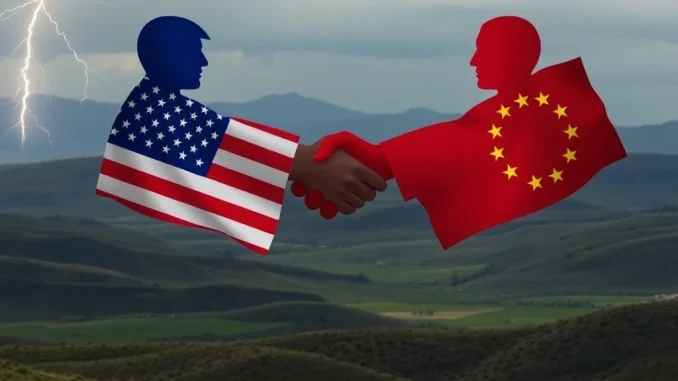
On July 28, 2025, a collective sigh of relief echoed across global markets as U.S. President Donald Trump announced a groundbreaking trade agreement with the European Union. This accord, reached after months of intense negotiations, successfully pulled both economic powerhouses back from the brink of a full-blown transatlantic tariff war. The deal, confirmed jointly by President Trump and European Commission President Ursula von der Leyen, introduces a significant 15% across-the-board tariff on EU imports to the U.S. This rate marks a substantial reduction from the previously threatened 30% rate, which was slated to take effect just days later on August 1.
This adjustment applies uniformly to all EU goods, with reciprocal adjustments for U.S. exports to the EU, ensuring a balanced approach. The agreement effectively sidesteps the punitive measures that had raised serious concerns for businesses and consumers on both sides of the Atlantic. Beyond tariff reductions, the agreement outlines several key commitments from the EU, designed to bolster American industry and strengthen economic ties:
- $600 Billion Investment: A massive pledge to invest in American industry.
- $150 Billion Procurement: Commitment to purchase U.S. energy and military equipment.
- Open Markets: The EU has agreed to open its markets further to U.S. goods and facilitate tariff-free trade among its member states for certain products.
These measures align with President Trump’s broader strategy to fortify domestic manufacturing and reduce reliance on foreign supply chains, signaling a strategic shift in global economic partnerships.
Decoding the Tariff War: What Was at Stake?
To fully appreciate the significance of this agreement, it’s crucial to understand the high stakes involved in the brewing tariff war. Prior to this deal, trade relations between the U.S. and the EU had been fraught with tension. The U.S. had already imposed significant tariffs:
- 50% on EU steel and aluminum imports.
- 25% on cars and car parts.
These measures were met with strong opposition from the EU, which had prepared a list of retaliatory tariffs on approximately $100 billion worth of American exports. This list included iconic American products such as aircraft, motorcycles, and bourbon whiskey, threatening to escalate the conflict into a damaging cycle of tit-for-tat protectionism. Such an escalation would have had far-reaching consequences, disrupting global supply chains, increasing consumer costs, and potentially dampening economic growth worldwide.
The negotiations themselves had been marked by considerable uncertainty. President Trump himself had previously estimated only a “50-50 chance” of reaching an agreement during their June 21 meeting in Scotland. The looming August 1 deadline, which Commerce Secretary Howard Lutnick had confirmed would not be extended, added immense pressure to finalize a deal. This urgency underscored the high-stakes nature of Trump’s trade diplomacy, where the threat of tariffs was wielded as a powerful bargaining chip.
Economic Investment: Promises and Skepticism
The centerpiece of the agreement, the EU’s pledge of a $600 billion economic investment in American industry, has undoubtedly captured headlines. This commitment, alongside the $150 billion in energy and military equipment procurement, is framed as a substantial win for U.S. economic interests. However, this ambitious pledge has not been without its critics, particularly from Wall Street analysts who question its feasibility and the mechanisms for its enforcement.
Skepticism largely stems from previous experiences. For instance, a similar U.S.-Japan trade agreement included a $550 billion investment offer from Tokyo. Yet, analysts remain unconvinced about the EU’s ability to deliver comparable commitments, primarily due to the lack of binding enforcement mechanisms. Treasury Secretary Scott Bessent had previously championed Japan’s offer as a model for other trade partners, but the absence of concrete, enforceable accountability measures for the EU’s investment pledges raises legitimate questions about their ultimate realization.
Why the skepticism? Unlike direct government-to-government transfers, large-scale private sector investments are influenced by market conditions, corporate strategies, and regulatory environments. Without clear frameworks, incentives, or penalties, such pledges can be difficult to track and ensure. This nuanced perspective highlights that while the headline figures are impressive, the devil often lies in the details of implementation.
Navigating Transatlantic Tariffs: Trump’s Diplomatic Playbook
The resolution of the transatlantic tariffs dispute offers a clear illustration of President Trump’s distinctive approach to international trade. His strategy consistently prioritized bilateral negotiations over multilateral frameworks, leveraging the threat of tariffs as a primary bargaining tool to reshape existing trade relationships. By applying direct economic pressure on trading partners, the administration aimed to secure terms more favorable to U.S. industries and workers.
This approach, while often contentious, has yielded results in some instances, forcing partners to the negotiating table. The EU’s inclusion of significant energy and defense purchases in the agreement directly aligns with Trump’s stated goals of strengthening domestic manufacturing and reducing reliance on external suppliers. However, it’s worth noting that not all contentious issues were resolved. For example, pharmaceuticals were explicitly excluded from the agreement, with Trump stating that drug price negotiations would remain a separate issue. This signals that while immediate trade tensions have been diffused, complex and sensitive areas of economic policy continue to be points of contention.
The Road Ahead for US EU Trade Relations
While this agreement successfully stabilizes immediate trade dynamics and averts a potentially damaging tariff war, its long-term effectiveness largely hinges on the EU’s ability to meet its ambitious investment targets. The ongoing absence of robust, enforceable mechanisms for these substantial commitments leaves room for continued skepticism and potential future friction. Beyond the immediate deal, broader structural issues in US EU trade relations remain unaddressed. These include:
- Market access for digital services.
- Regulatory differences across various sectors.
- Intellectual property rights.
These complex matters were not part of this specific agreement and are likely to resurface in future negotiations, ensuring that transatlantic trade diplomacy will remain an active and evolving arena. The timing of the agreement, finalized just days before the critical August 1 deadline, truly underscores the high-stakes nature of Trump’s trade diplomacy. It sets a significant precedent for how the U.S. intends to engage with other trade partners, with ongoing discussions between Treasury Secretary Bessent and Chinese officials expected to follow a similar dynamic of tariff-based pressure.
In conclusion, the U.S.-EU trade agreement represents a crucial moment of de-escalation, providing immediate relief from the specter of a damaging tariff war. The 15% tariff cut and the EU’s significant investment pledges signal a renewed effort to stabilize transatlantic economic ties. However, the path ahead is not entirely clear. The true success of this agreement will depend on the concrete realization of the EU’s commitments and the willingness of both sides to tackle the deeper, unresolved structural issues that underpin their complex economic relationship. For global markets, and by extension, the cryptocurrency ecosystem, stability in major trade blocs is always a welcome development, fostering an environment where innovation and investment can thrive without the shadow of protectionist threats.
Frequently Asked Questions (FAQs)
Q1: What was the primary outcome of the Trump EU trade agreement?
The primary outcome was the prevention of a major transatlantic tariff war. The agreement includes a 15% across-the-board tariff reduction on EU imports to the U.S. (down from a threatened 30%) and reciprocal adjustments for U.S. exports. Additionally, the EU pledged a $600 billion investment in American industry and $150 billion in U.S. energy and military equipment.
Q2: Why were analysts skeptical about the EU’s $600 billion investment pledge?
Analysts expressed skepticism due to the lack of binding enforcement mechanisms for the investment pledges. Concerns arise from similar past agreements, like the U.S.-Japan deal, where large investment offers didn’t always translate into concrete, trackable commitments without clear accountability frameworks.
Q3: What specific tariffs were previously imposed by the U.S. on EU goods?
Prior to this agreement, the U.S. had imposed 50% tariffs on EU steel and aluminum, and 25% on cars and car parts. The EU was preparing retaliatory measures on $100 billion of American exports, including aircraft and bourbon whiskey.
Q4: How does this deal reflect President Trump’s trade diplomacy strategy?
The deal exemplifies President Trump’s strategy of prioritizing bilateral negotiations and using the threat of tariffs as a bargaining tool to secure favorable terms for U.S. industries. It aims to reshape trade relationships by direct pressure rather than through multilateral frameworks.
Q5: What unresolved issues remain between the U.S. and the EU despite this agreement?
While the immediate tariff dispute is resolved, several structural issues remain unaddressed. These include market access for digital services, regulatory differences across various sectors, and the specific issue of pharmaceutical drug price negotiations, which Trump stated would remain separate.
Q6: How might this trade deal indirectly impact cryptocurrency markets?
While not directly related to cryptocurrencies, major trade agreements that reduce geopolitical and economic tensions often contribute to broader market stability and investor confidence. A more stable global economic environment, free from the disruptions of a tariff war, can foster a more favorable climate for all asset classes, including digital assets, by reducing systemic risk and encouraging investment.