In a move poised to reshape the landscape of international commerce, President Donald Trump has announced a groundbreaking **Trump EU Trade Deal**. This agreement, laden with significant financial commitments and new tariff structures, is sending ripples across global markets and sparking intense debate among economists and political analysts alike. For those watching the broader economic stage, especially its indirect influence on digital assets and market stability, understanding the nuances of such high-stakes negotiations is crucial. Will this deal usher in a new era of prosperity, or does it carry hidden risks that could ripple through various sectors, including the crypto space?
Unpacking the **Trump EU Trade Deal**: A New Era of Commerce?
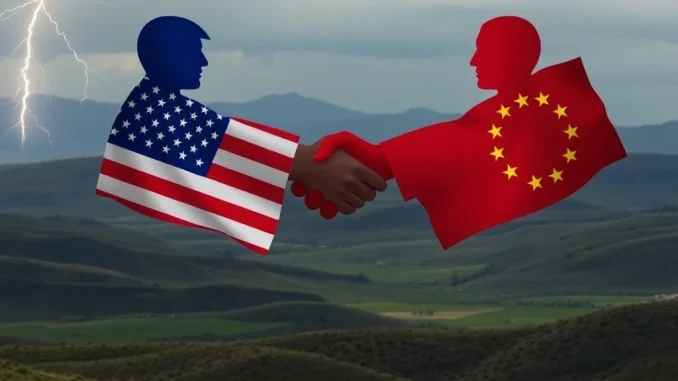
President Trump’s latest announcement details a substantial trade agreement with the European Union, echoing a similar arrangement recently struck with Japan. The core components of this landmark deal include:
- $600 billion investment: Pledged by the EU towards U.S. infrastructure and manufacturing sectors.
- $750 billion in energy purchases: The EU commits to buying vast amounts of American energy products over a three-year period, aligning with Trump’s term.
- Significant weapons purchases: The deal also includes the acquisition of substantial U.S. defense equipment.
- 15% tariff on EU exports: In exchange for these commitments, a 15% tariff will be applied to EU exports to the U.S.
This follows a comparable deal with Japan, which promised $550 billion in investments to key U.S. industrial sectors under a similar 15% tariff framework. These agreements represent a deviation from Trump’s earlier threats of higher tariffs (25% on Japan, 30% on the EU), attributed by U.S. Treasury’s Scott Bessent to innovative financing mechanisms within these agreements. The immediate implications of this **Trump EU Trade Deal** are vast, signaling a strategic shift in U.S. trade policy aimed at securing significant economic concessions from key partners.
Navigating **Global Trade Tensions**: China’s Stance and Beyond
The recent trade agreements with the EU and Japan are not isolated events but rather part of a broader strategy to exert pressure on China. As the U.S. prepares for high-stakes negotiations with Beijing, these deals serve as a precedent, demonstrating what the U.S. administration aims to achieve. However, analysts caution that China’s economic resilience and strategic leverage in global supply chains may complicate U.S. efforts to replicate these successes.
Current negotiations between U.S. Treasury’s Scott Bessent and Chinese Vice Premier He Lifeng are set to commence in Stockholm, with the existing trade truce expected to extend by 90 days beyond its August 12 expiration. While Japan and the EU may have had limited options but to comply, experts like Jamie Cox of Harris Financial Group suggest that China is “unlikely to be as willing to fold.”
Beyond China, the U.S. has also imposed higher tariffs on other Asian countries, including 19% on the Philippines and Indonesia, and 20% on Vietnam. These measures are designed to deter the trans-shipment of Chinese goods through these nations, further intensifying **global trade tensions** and illustrating the administration’s aggressive stance on trade compliance.
The Promise of **US Investment**: Fact or Fiction?
A central pillar of these trade agreements is the massive influx of **US investment** pledged by trading partners. The $600 billion from the EU and $550 billion from Japan are touted as significant boosts to American infrastructure and manufacturing. However, skepticism abounds regarding the concrete details and legal enforceability of these pledges.
- Lack of Concrete Details: Analysts at Piper Sandler have expressed concerns that the Japanese investment lacks specific, actionable details, making it difficult to assess its real-world impact.
- Legal Challenges: The legal foundation of Trump’s tariff policies is under increasing scrutiny. A court hearing is scheduled to assess the lawfulness of using the International Emergency Economic Powers Act to justify these tariffs. If these tariffs are invalidated, the investment pledges tied to them could unravel before any funds are realized.
- Hesitancy from Trading Partners: The uncertainty surrounding the legal validity of the tariffs could make many trading partners hesitant to commit to long-term investments, fearing that the goalposts might shift.
European Commission President Ursula von der Leyen confirmed the EU’s $750 billion energy purchases would span three years, aligning with Trump’s term. Yet, the question remains: how much of this promised **US investment** will truly materialize if the underlying tariff framework is challenged or revoked?
Analyzing Trump’s **Tariff Strategy**: A Risky Gamble?
President Trump’s approach hinges on leveraging tariff threats as a primary bargaining chip to secure trade compliance and investment pledges. This **tariff strategy** has been evident in the deals with Japan and the EU, where initial threats of much higher tariffs were seemingly mitigated by the promise of substantial investments.
While the administration frames these deals as a “win” for American workers, the reliance on aggressive tariff threats carries significant risks:
- Legal Scrutiny: The escalating legal challenges to the president’s use of emergency powers for tariffs create an environment of regulatory unpredictability.
- Market Volatility: Financial markets have responded cautiously, with U.S. stocks fluctuating amid uncertainty over trade policy. Businesses may avoid investing in such an unpredictable environment, as highlighted by a report from the Hoover Institution.
- Strained Relationships: The aggressive use of tariffs could further strain relationships with key international partners, particularly as China’s resistance to similar concessions grows.
The long-term effectiveness of this **tariff strategy** remains a subject of intense debate, with economists highlighting the potential for prolonged volatility and retaliatory measures that could undermine the very economic benefits sought.
Forecasting the **Economic Impact**: What’s Next for Global Markets?
The immediate **economic impact** of the Trump EU trade deal is complex and multifaceted. While proponents highlight the potential for job creation and economic growth from the promised investments, critics point to the inherent instability introduced by shifting tariff policies.
Key considerations for the future include:
- Market Confidence: The unpredictability of trade policy can erode business confidence, leading to delayed investments and cautious spending.
- Supply Chain Realignments: Tariffs encourage businesses to reconsider their global supply chains, potentially leading to higher costs or less efficient production in the short term.
- Inflationary Pressures: Tariffs on imports can increase consumer prices, potentially leading to inflationary pressures.
- Global Recession Risk: A prolonged trade war, especially if China does not yield, could escalate into a broader global economic slowdown.
The administration’s ability to secure similar concessions from China will be a critical test. Should China remain unyielding, the **economic impact** could diverge significantly from the positive outcomes projected by the U.S. administration, potentially leading to a more fractured and volatile global trading system.
In conclusion, the **Trump EU Trade Deal** marks a significant moment in global trade relations. While it promises substantial **US investment** and aims to alleviate certain **global trade tensions**, the reliance on an aggressive **tariff strategy** introduces considerable risks and legal uncertainties. The true **economic impact** will unfold over time, depending on the materialization of investment pledges, the outcome of legal challenges, and critically, China’s response to continued U.S. pressure. Businesses, investors, and consumers alike will need to navigate a landscape increasingly shaped by these high-stakes trade maneuvers.
Frequently Asked Questions (FAQs)
What are the key financial terms of the Trump EU Trade Deal?
The deal includes a $600 billion investment from the EU into U.S. infrastructure and manufacturing, $750 billion in purchases of American energy products over three years, and unspecified but “vast amounts” of U.S. weapons. In return, a 15% tariff will be imposed on EU exports to the U.S.
How does this deal compare to the agreement with Japan?
The EU deal is similar to an earlier arrangement with Japan, which pledged $550 billion in investments to key U.S. industrial sectors under a 15% tariff framework. Both deals reflect a strategy of securing investment and purchases in exchange for a lower tariff rate than initially threatened.
What are the main concerns or criticisms regarding this trade deal?
Critics raise concerns about the lack of concrete details for the investment pledges, the legal basis for the tariffs (with a court hearing scheduled to assess their lawfulness), and the potential for regulatory unpredictability. There’s also skepticism about China’s willingness to comply as easily as Japan and the EU, which could prolong global trade tensions.
How might this deal impact global markets and the U.S. economy?
Financial markets have responded cautiously, with U.S. stocks fluctuating due to trade policy uncertainty. While the administration touts it as a “win,” economists warn of risks like prolonged volatility, potential retaliatory measures, and businesses avoiding investment in an unpredictable regulatory environment. The long-term economic impact will depend heavily on the deal’s stability and China’s future actions.
Is the 15% tariff a fixed rate, or could it change?
The 15% tariff is the agreed-upon rate for EU exports under this specific deal, a reduction from Trump’s initial threat of 30%. However, the legal challenges to the president’s use of the International Emergency Economic Powers Act to justify tariffs mean that the tariffs’ legality and thus their long-term stability could be challenged and potentially invalidated by courts.
What role does China play in the broader U.S. trade strategy?
The deals with the EU and Japan are seen as part of a broader U.S. strategy to pressure China into further concessions during upcoming high-stakes negotiations. The U.S. hopes these agreements will set a precedent, though analysts believe China will be less willing to yield, complicating efforts to replicate similar successes.