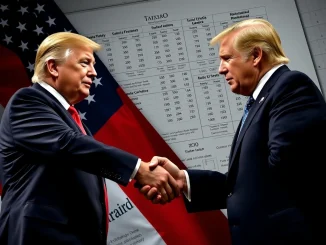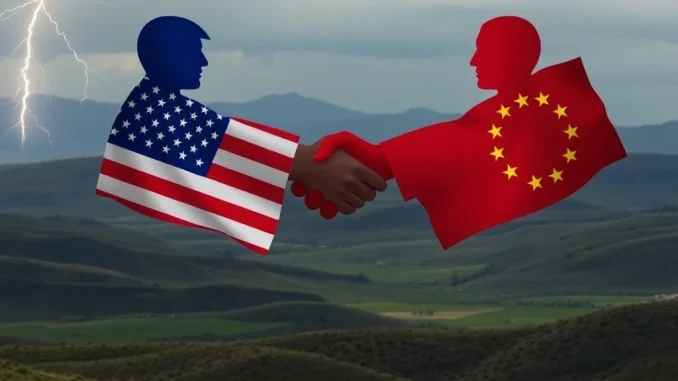
In the often-volatile world of global finance, major geopolitical shifts can send ripples across all markets, including the dynamic realm of cryptocurrencies. The recent breakthrough Trump EU trade agreement, which successfully averted a potential $1.9 trillion transatlantic trade war, serves as a prime example. While not directly about digital assets, this landmark deal significantly impacts global economic stability, influencing investor confidence and potentially shaping the broader financial landscape where crypto assets operate. Understanding these macro trends is crucial for any savvy crypto investor looking to navigate market volatility and identify emerging opportunities.
The Landmark Trump EU Trade Deal: Averted Disaster?
On July 25, 2025, President Donald Trump and European Commission President Ursula von der Leyen announced a pivotal trade agreement. This deal, forged after intense negotiations in Scotland, effectively halted a looming escalation of tariffs that threatened to disrupt an astonishing $1.9 trillion in annual bilateral trade. The core of the agreement centers on a new 15% across-the-board tariff on EU goods entering the U.S. This new rate aligns with the U.S.-Japan trade pact finalized earlier the same month, signaling a consistent approach in U.S. trade policy.
The stakes were incredibly high. President Trump had previously warned of raising tariffs from 10% to 30% on EU goods if a deal wasn’t reached by August 1. The EU, in response, had prepared retaliatory tariffs on $109 billion in U.S. exports, including critical sectors like aircraft and cars. This compromise, therefore, represents a significant de-escalation, moving from an average 4.8% tariff to 15%, but crucially, avoiding the economically devastating 30% threat. While the EU also pledged investments in U.S. industries and energy purchases, specific figures for these commitments remain largely undisclosed, adding a layer of ambiguity to the agreement’s full scope.
Navigating the Transatlantic Trade Landscape: What’s Changed?
The shift to a 15% tariff marks a notable change in the transatlantic trade relationship. While higher than the previous average, it’s a far cry from the punitive rates that were on the table. However, the agreement isn’t without its complexities, particularly concerning specific sectors:
- Automotive Sector: The U.S. already imposes a 25% tariff on EU cars and car parts. The new 15% rate doesn’t explicitly clarify whether automotive products will be included in this broad levy, leaving a key industry segment in limbo.
- Energy Commitments: The EU’s pledge to purchase U.S. liquefied natural gas (LNG) could significantly bolster U.S. energy exports. Yet, analysts, including Treasury Secretary Scott Bessent, have voiced skepticism about whether these foreign investment pledges will materialize in full.
- Investment Frameworks: Trump highlighted Japan’s $550 billion investment framework as a template for the EU. However, EU diplomats emphasize that the deal requires formal approval from member states, with some maintaining ‘red lines’ in sectors like steel, where a quota system was proposed to avoid immediate tariffs but is yet to be finalized.
This agreement reflects a strategic compromise, with both sides making concessions to avoid a larger economic confrontation.
The Trade War Averted: A Sigh of Relief for Global Markets?
The successful negotiation means a potential trade war averted, which offers a significant sigh of relief for global markets already grappling with challenges like inflation and energy shocks. The EU, in particular, was under immense pressure to avoid further economic fallout given its weakened state. For the U.S., the deal reinforces President Trump’s signature trade policy of leveraging tariffs to secure foreign investment – a strategy seen as contentious internationally but one he insists is critical for securing favorable terms.
However, public skepticism in the U.S. persists regarding the sustainability of this approach. A July 2025 Gallup poll showed Trump’s approval rating at 37%, down 10 points since January, indicating a divided public opinion on his trade tactics. While the immediate threat of a full-blown trade war has been mitigated, the underlying strategy continues to draw scrutiny.
Understanding EU Tariffs: The Devil in the Details
The EU’s acceptance of the 15% EU tariffs, despite the increase from their previous average, underscores the urgency to stabilize trade relations. The political pressure to finalize the deal quickly is immense, with U.S. Commerce Secretary Howard Lutnick reiterating the August 1 deadline as non-negotiable. This means tariffs would proceed if the agreement isn’t formally approved by EU member states soon.
The process of formal approval by EU member states is now underway. While a Greenland meeting of EU leaders broadly endorsed the outline, the specifics of investment commitments and the phasing out of existing tariffs remain crucial implementation details. The EU’s reliance on investment pledges rather than concrete, immediate concessions highlights an asymmetry in the negotiation dynamic, where the U.S. used the threat of tariffs as a primary lever.
Implications for the Global Economy: Beyond Borders
This agreement temporarily stabilizes U.S.-EU trade relations, but it leaves deeper structural issues unresolved. The deal’s impact on the broader global economy is multifaceted:
- Investor Confidence: By removing immediate uncertainty, the agreement can foster greater stability in traditional financial markets. This can indirectly benefit cryptocurrency markets, as increased confidence in the broader economic landscape often leads to a greater willingness to invest in speculative assets.
- Currency Stability: Reduced trade tensions can contribute to stronger fiat currencies, which can influence cryptocurrency trading pairs and overall market liquidity.
- Future Precedent: The deal reinforces a particular model of trade negotiation where tariffs are used as a primary tool to extract investment commitments. This strategy, while effective in this instance, remains contentious and could shape future international trade discussions.
- Lingering Uncertainty: The vague details surrounding EU investments and specific sector carve-outs mean that some level of uncertainty persists, reminding investors across all asset classes, including crypto, of the importance of diversification and risk management.
Ultimately, while not a direct driver of crypto prices, the stability offered by this agreement contributes to a more predictable macroeconomic environment, which is generally favorable for the long-term growth and maturation of the digital asset space.
Conclusion: A Fragile Truce?
The Trump-EU trade agreement represents a significant diplomatic and economic achievement, successfully pulling the world back from the brink of a potentially devastating $1.9 trillion transatlantic trade war. By establishing a 15% tariff and securing vague investment pledges, both sides found a temporary resolution to escalating tensions. However, the deal’s ultimate success hinges on the formal approval by EU member states and the actualization of the promised investments. For cryptocurrency investors, this macro-level stability, though potentially fragile, contributes to a less volatile global financial climate, making it a development worth monitoring as part of a comprehensive market outlook.
Frequently Asked Questions (FAQs)
Q1: What is the core of the Trump-EU trade agreement?
A1: The agreement primarily sets a 15% across-the-board tariff on EU goods entering the U.S., averting a potential escalation to 30%. In return, the EU pledged undisclosed investments in U.S. industries and energy purchases.
Q2: How much trade was at risk from the potential trade war?
A2: A staggering $1.9 trillion in annual bilateral trade between the U.S. and the EU was at risk of severe disruption if the trade war had escalated as threatened.
Q3: What are the key concessions made by the EU in this deal?
A3: The EU agreed to the 15% tariff rate, which is an increase from their previous average of 4.8%, and pledged investments in U.S. industries and energy purchases, particularly liquefied natural gas (LNG).
Q4: Are there any unresolved issues or ambiguities in the agreement?
A4: Yes, specific figures for EU investment commitments remain undisclosed. Additionally, it’s unclear whether the new 15% tariff explicitly includes contentious sectors like automotive products, and the steel quota system is yet to be finalized.
Q5: How does this agreement indirectly affect cryptocurrency markets?
A5: While not directly related, the agreement reduces global economic uncertainty and fosters stability in traditional financial markets. This increased confidence can indirectly benefit cryptocurrency markets by encouraging broader investment and reducing systemic risks, contributing to a more predictable environment for digital assets.
Q6: What is the timeline for the agreement’s finalization?
A6: The agreement requires formal approval by EU member states, a process expected to accelerate due to political urgency. U.S. Commerce Secretary Howard Lutnick reiterated an August 1 deadline for finalization, after which tariffs would proceed if the deal isn’t secured.