In the fast-paced world of cryptocurrency, understanding broader economic currents is paramount. Just as Bitcoin and altcoins react to global news, so too do they respond to major political and economic shifts. Currently, a significant driver of market sentiment, including potential ripple effects on digital assets, stems from the unpredictable nature of Trump economic policy. Let’s dive into how his recent statements and actions are fueling uncertainty and shaping investor strategies.
Trump’s Conflicting Dollar Policy: A Balancing Act?
US President Donald Trump has recently sent mixed signals regarding the nation’s currency. On one hand, he champions a robust dollar, stating on July 4, “I would never support a weak dollar,” and crediting its strength with curbing inflation. Yet, almost in the same breath, he acknowledges that a weaker dollar could boost US manufacturing competitiveness, remarking, “A weak dollar can make you more money.” This duality in his dollar policy creates a puzzle for investors, who are trying to discern whether these are genuine policy priorities or calculated ambiguities. Trump further complicated the narrative by saying, “I like a strong dollar,” while admitting, “I don’t lose sleep over it,” indicating a tolerance for currency fluctuations that can impact global trade and investment.
Trade Tariffs: Eating into Profits or Strategic Lever?
Beyond currency, Trump’s approach to trade continues to evolve. New trade tariffs have emerged as a significant factor, drawing varied responses from corporations. Reports indicate that these tariffs are impacting major companies’ profits, with executives citing rising costs as a key concern. Despite these challenges, the administration has finalized trade agreements with Japan and the Philippines. However, negotiations with China remain unresolved, adding another layer of complexity. Treasury Secretary Scott Bessent has even hinted at potential delays to tariff deadlines, increasing the ambiguity surrounding future trade relations. This highlights a strategy that uses tariffs as both a negotiating tool and a domestic economic lever, creating a dynamic and often unpredictable environment for businesses and investors alike.
Federal Reserve Decisions: Navigating Internal Divisions
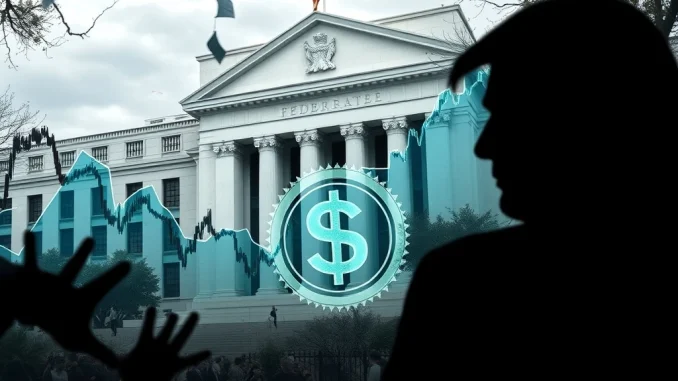
Compounding the existing market volatility, Trump’s interactions with Federal Reserve officials have introduced additional uncertainty. During a July 24 visit to the Fed’s headquarters, he reiterated his criticism of Chair Jerome Powell but clarified he would not replace him. This reversal of earlier threats provided some relief, as previous speculation had rattled markets. The Fed itself faces internal divisions regarding its monetary policy. Governor Christopher Waller has advocated for a July rate cut, citing slowing economic momentum, while Chair Powell urges patience, emphasizing the US economy’s resilience. This divergence in views within the central bank risks complicating its communication strategy ahead of its crucial upcoming rate decision. The impact of these Federal Reserve decisions on interest rates and the broader economy is closely watched by all market participants.
Understanding Market Volatility: Investor Strategies
Market reactions have clearly mirrored the administration’s indecisiveness. Major indices briefly paused their record-setting rally after Trump suggested reciprocal tariffs might be lower than anticipated, offering temporary relief to businesses. However, S&P 500 earnings reports reveal a mixed outlook, with projected year-over-year growth at 5.6%. Sectors heavily reliant on global supply chains face headwinds, while others adapt to the shifting trade dynamics. Analysts caution that Trump’s “brinkmanship” approach—threatening economic confrontation while simultaneously pursuing compromises—has created a particularly volatile environment for investors. This constant flux contributes significantly to overall market volatility, making it challenging for both traditional and crypto investors to plan effectively.
The Broader Impact of Trump Economic Policy
The lack of clarity in Trump economic policy, combined with the Federal Reserve’s uncertain path, is reshaping investment strategies across the board. This environment blends selective opportunities with emerging risks. As the administration prepares to finalize key trade decisions and the Fed navigates its rate policy, Trump’s ability to reconcile these conflicting signals will be a crucial test for investor confidence and overall economic outcomes. For now, markets remain on edge, awaiting consistency in a strategy that has consistently defied predictability. Investors must remain agile and informed to navigate these complex waters.
Summary: Navigating the Economic Crosscurrents
The current economic landscape is defined by the dynamic interplay of Trump’s evolving policies on the dollar and trade, coupled with the Federal Reserve’s internal deliberations. This creates a challenging environment characterized by significant market volatility. Investors are tasked with parsing conflicting signals, from a preference for a strong dollar to an acknowledgment of a weaker currency’s benefits, and from the imposition of tariffs to the pursuit of new trade agreements. The Fed’s cautious stance on interest rates, amidst calls for cuts, further adds to the uncertainty. Ultimately, the ability of the administration and the central bank to provide clear, consistent direction will be paramount in stabilizing markets and fostering investor confidence in the months ahead.
Frequently Asked Questions (FAQs)
1. Why are Trump’s dollar policies conflicting?
Trump’s dollar policy reflects a dual perspective: he prefers a strong dollar for its role in curbing inflation and signaling economic strength, but also acknowledges that a weaker dollar can boost US manufacturing competitiveness by making exports cheaper. This creates an apparent conflict in his public statements.
2. How do tariffs affect corporate profits?
Tariffs typically increase the cost of imported goods and raw materials for companies. This can reduce profit margins, especially for businesses reliant on global supply chains, as they either absorb the higher costs or pass them on to consumers.
3. What is the Federal Reserve’s current stance on interest rates?
The Federal Reserve, led by Chair Jerome Powell, has urged patience regarding interest rate decisions, emphasizing the economy’s resilience. However, there are internal divisions, with some governors advocating for rate cuts due to signs of slowing economic momentum.
4. How does political uncertainty impact market volatility?
Political uncertainty, especially regarding key economic policies like currency and trade, can lead to increased market volatility. Investors become unsure about future economic conditions and corporate earnings, leading to rapid price swings as they react to new information or speculation.
5. What is “brinkmanship” in economic policy?
Brinkmanship, in an economic context, refers to a strategy where a party (like a government) pushes a situation to the verge of a dangerous outcome (e.g., a trade war) in order to gain an advantage or force a compromise. It often involves threats or aggressive actions that create high uncertainty.
6. How can investors navigate this uncertain economic environment?
In an uncertain environment, investors can consider strategies such as diversification across different asset classes, staying informed about policy developments, maintaining a long-term perspective, and adapting their portfolios to potential shifts in trade dynamics and monetary policy. Consulting with a financial advisor can also be beneficial.