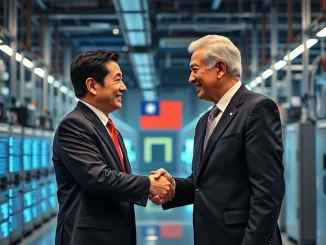
In an increasingly interconnected global economy, geopolitical shifts can send ripples across all financial markets, including the volatile world of cryptocurrencies. Recent statements by former U.S. President Donald Trump concerning **Trump Argentina China** military cooperation highlight such potential flashpoints. These warnings underscore the complex interplay of international relations and their indirect, yet significant, impact on global stability and investment climates. Understanding these dynamics is crucial for anyone monitoring global markets, as political rhetoric can quickly translate into economic consequences.
Understanding Trump’s Stance on Trump Argentina China Military Cooperation
Former U.S. President Donald Trump recently issued a strong admonition to Argentina. He explicitly stated that the South American nation should not engage in any form of **military cooperation** with China. This directive, as reported by Walter Bloomberg, reflects a consistent theme in Trump’s foreign policy approach: challenging China’s expanding global influence. His administration often viewed China’s activities, particularly in regions traditionally seen as within the U.S. sphere of influence, with suspicion. Therefore, this warning is not an isolated incident; it aligns with a broader strategy of countering Beijing’s strategic advances worldwide.
The warning comes at a sensitive time for global power dynamics. Many nations are navigating complex relationships with both the United States and China. Argentina, a significant player in South America, finds itself in a precarious position. Its decisions regarding international partnerships hold considerable weight. These choices could shape its economic future and its standing on the global stage. The U.S. views China’s military expansion, especially in Latin America, as a direct challenge to its regional security interests. This perspective frames much of Washington’s diplomatic efforts.
The Broader Context of US Foreign Policy in South America
Trump’s warning to Argentina is a clear manifestation of enduring **US foreign policy** objectives. Historically, the United States has considered Latin America its backyard, emphasizing regional stability and preventing the rise of hostile foreign powers. China’s increasing engagement in the region, encompassing trade, investment, and now potential military ties, directly challenges this long-held doctrine. Beijing has steadily expanded its economic footprint across South America. This includes significant investments in infrastructure, energy, and raw materials. Now, the potential for military collaboration raises new concerns in Washington.
The U.S. government fears that deeper military ties between China and countries like Argentina could lead to several undesirable outcomes. These include increased Chinese intelligence gathering capabilities, the establishment of logistical support facilities, or even the deployment of advanced military hardware. Such developments could fundamentally alter the strategic balance in the Western Hemisphere. Therefore, the warning is not merely about a single agreement. It is about preventing a broader shift in regional power dynamics. The U.S. aims to maintain its strategic advantage and influence.
Argentina’s Strategic Position and China’s Growing Influence
Argentina holds a significant strategic position in South America. It possesses vast natural resources, including agricultural land, minerals, and a growing energy sector. Its geographical location also provides access to both the Atlantic and Pacific oceans. For years, China has actively pursued stronger ties with Argentina. This engagement is part of its ‘Belt and Road Initiative’ (BRI), a global infrastructure development strategy. China’s investments in Argentina include projects in railways, hydropower, and even space observation facilities. These collaborations are primarily economic.
However, China’s interest extends beyond purely economic ventures. Beijing seeks to cultivate political influence and establish strategic partnerships globally. Offering military equipment, training, and joint exercises can deepen these relationships. For Argentina, aligning with China could offer access to alternative financing and advanced technology. This becomes particularly attractive when traditional Western partners impose conditions or restrictions. Nevertheless, such alignments come with their own set of considerations. They can lead to dependency and potential diplomatic friction with other major powers. Argentina must carefully weigh these factors.
The Implications of Potential Military Cooperation
The prospect of **military cooperation** between Argentina and China carries significant implications for regional and global security. Such cooperation can manifest in various forms. It could involve arms sales, joint military exercises, intelligence sharing, or the establishment of military bases. Each of these possibilities presents distinct challenges. For instance, advanced Chinese weaponry in Argentina could alter regional military balances. It might prompt neighboring countries to seek similar capabilities, potentially triggering an arms race. Joint exercises could also provide China with valuable operational experience in a new geopolitical theater.
Furthermore, increased Chinese military presence could complicate U.S. security operations in the Atlantic. It might also raise concerns about data security and the protection of sensitive information. From Argentina’s perspective, military cooperation could offer modernization for its armed forces. It could also provide an alternative to relying solely on Western suppliers. However, it also risks alienating its traditional allies and becoming entangled in the larger U.S.-China rivalry. The decision is not simple. It requires a careful balancing act between national interests and international pressures.
Navigating Geopolitical Tensions and South American Alliances
The situation highlights the escalating **geopolitical tensions** between the United States and China. Both superpowers are vying for influence across the globe. Latin America, historically under U.S. influence, has become a key battleground in this competition. China’s ‘debt-trap diplomacy’ and opaque lending practices are often criticized by the U.S. Washington argues these practices create unsustainable debt burdens and undermine sovereignty. Beijing, conversely, asserts its right to engage with sovereign nations without external interference. It emphasizes mutually beneficial partnerships.
This dynamic places significant pressure on **South American alliances**. Countries in the region often have strong economic ties with China. They also maintain historical diplomatic relationships with the U.S. Leaders must carefully calibrate their foreign policy decisions. They aim to secure economic benefits without compromising national security or regional stability. The potential for military cooperation with China could fracture existing regional blocs. It might also create new alignments. This complex geopolitical environment demands astute diplomacy and strategic foresight from all parties involved. The consequences of missteps could be far-reaching.
The Future Outlook for Argentina and Regional Stability
Argentina’s response to Trump’s warning will be closely watched. Its decision will reflect its sovereign foreign policy choices. It will also indicate its strategic priorities in a multipolar world. The country must weigh its economic needs against its security interests. It also needs to consider its relationships with major global powers. A closer alignment with China’s military could yield immediate benefits. However, it could also lead to long-term challenges in its relationship with the U.S. and its allies.
Ultimately, the episode underscores the ongoing global competition for influence. It highlights the complexities faced by developing nations. These nations seek to advance their interests while navigating the rivalries of great powers. The stability of South America, and indeed the global financial landscape, remains intricately linked to these evolving geopolitical dynamics. Any significant shift in alliances or military postures can have ripple effects, influencing everything from commodity prices to investor confidence, and even the perceived stability of alternative assets like cryptocurrencies.
Frequently Asked Questions (FAQs)
Why did former President Trump issue this warning to Argentina?
Former President Trump issued the warning to Argentina as part of a broader U.S. strategy to counter China’s expanding global influence, particularly in regions traditionally considered within the U.S. sphere of influence. The U.S. views deeper military ties between China and South American nations as a potential threat to regional security and stability.
What is China’s interest in Argentina and Latin America?
China’s interest in Argentina and Latin America is multifaceted. It primarily seeks economic opportunities, including access to natural resources, new markets for its goods, and infrastructure development projects through its Belt and Road Initiative. Beyond economics, China aims to cultivate political influence and establish strategic partnerships globally, which can include military cooperation to enhance its international standing.
How might military cooperation between Argentina and China impact U.S.-China relations?
Increased military cooperation between Argentina and China would likely heighten existing geopolitical tensions between the U.S. and China. The U.S. would view such developments as a direct challenge to its security interests in the Western Hemisphere, potentially leading to stronger diplomatic protests, economic sanctions, or increased U.S. military presence and engagement in the region. It could further strain an already complex relationship.
What are the potential consequences for Argentina if it pursues military cooperation with China?
If Argentina pursues military cooperation with China, it could face a range of consequences. These might include improved military capabilities and access to new technologies. However, it also risks alienating traditional Western allies, particularly the United States. This could lead to diplomatic friction, reduced access to Western financing, and potential entanglement in the U.S.-China rivalry, affecting its trade and investment relationships globally.
Is military cooperation common between nations?
Yes, military cooperation is very common between nations. It can take many forms, including arms sales, joint military exercises, intelligence sharing, security assistance, and military training programs. Countries engage in such cooperation to enhance their defense capabilities, foster alliances, deter aggression, and promote regional stability, often based on shared strategic interests or historical ties.