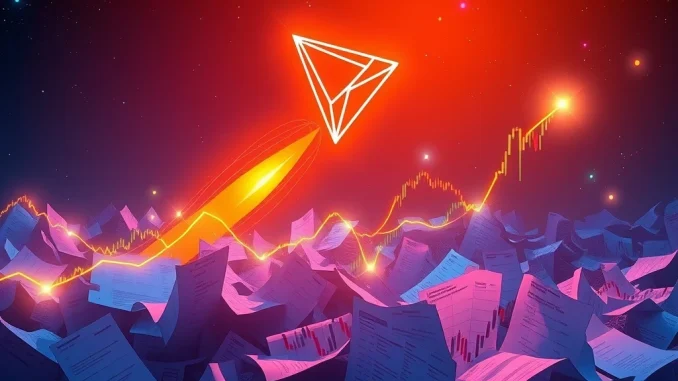
In a fascinating turn of events, the cryptocurrency market recently witnessed Tron (TRON) achieve a notable 5.77% surge, standing out amidst a broadly fragmented landscape for U.S. crypto-related equities. This unexpected upward movement in Tron price has ignited discussions about the underlying drivers and the broader implications for investors navigating a market increasingly shaped by both innovation and regulatory headwinds. What does Tron’s performance tell us about the current state of decentralized finance and the future of crypto investments?
Tron’s Remarkable Ascent: What’s Driving DeFi Momentum?
On July 23, 2025, while many crypto-related equities showed a mixed performance in pre-market trading, Tron (TRON) emerged as a clear leader, jumping an impressive 5.77%. This significant gain outpaced declines seen in other names like Sharplink Gaming (-0.97%) and Circle (-1.54%), highlighting a divergent investor sentiment within the sector. The rally in Tron was primarily attributed to renewed attention on decentralized finance (DeFi) advancements. Interestingly, this surge occurred without any recent corporate announcements regarding new product launches or major partnerships from the Tron Foundation.
Analysts suggest that such volatility often reflects the sector’s susceptibility to speculative trading rather than fundamental improvements. This makes it challenging for investors to distinguish between short-term momentum and sustainable value creation. The perceived DeFi momentum around Tron’s ecosystem, even without specific news, points to a broader investor appetite for protocols demonstrating resilience and potential for innovation in the decentralized space.
Crypto Stocks Divided: Navigating Market Volatility
The pre-market trading session showcased a starkly divided performance among crypto stocks. While Tron climbed, other major players experienced varied fortunes:
- Declines: Sharplink Gaming (-0.97%), Circle (-1.54%)
- Modest Gains: Coinbase (+0.25%), HOOD (+1.20%), BMNR (+1.80%)
This fragmentation underscores differing investor strategies. Some investors are clearly capitalizing on thematic plays within blockchain infrastructure and DeFi, while others are retreating amidst broader macroeconomic uncertainty. The broader market anxieties, including Federal Reserve policy expectations and persistent inflationary pressures, continue to weigh heavily on crypto equities. The sector’s performance remains closely tied to macroeconomic clarity, with a potential ‘dovish pivot’ by the Fed often seen as a speculative catalyst for high-growth stocks, including those in the crypto space. Understanding this market volatility is key for any investor.
Regulatory Scrutiny: A Headwind for Crypto Equities?
Beyond market dynamics, regulatory scrutiny continues to cast a long shadow over the crypto industry. Enforcement of anti-money laundering (AML) guidelines in both the U.S. and Europe is creating significant friction for crypto firms. This environment has fostered a cautious trading atmosphere where individual stock movements are often driven more by company-specific narratives than by sector-wide trends. The ongoing regulatory pressures contribute significantly to the perceived risk in the market, forcing companies to adapt their operations and compliance frameworks.
For investors, this means that even promising projects or companies can face headwinds due to an evolving regulatory landscape. The uncertainty surrounding future regulations adds another layer of complexity to investment decisions in the crypto equity space, making due diligence on regulatory compliance an increasingly vital factor.
Decoding Market Dynamics: Short-Term Gains vs. Sustainable Value
The mixed performance across crypto stocks, with Tron’s notable surge, highlights a critical challenge: distinguishing between short-term speculative gains and long-term sustainable value creation. While a significant price jump like Tron’s is exciting, the absence of specific corporate announcements suggests that market sentiment and speculative trading played a substantial role. This is characteristic of a nascent and often speculative market where rapid gains can be reversed just as quickly.
Investors should carefully evaluate whether a project’s fundamental technology, adoption, and use cases support its valuation, rather than solely relying on price movements driven by hype or temporary surges in DeFi momentum. Sustainable growth in the crypto sector will ultimately depend on real-world utility and robust infrastructure, not just speculative interest.
Investor Insights: Approaching the Crypto Market with Caution
Given the persistent regulatory uncertainties and macroeconomic volatility, investors are advised to approach the crypto equity space with a healthy degree of caution. While Tron’s pre-market surge suggests resilience in certain segments of the market, the broader sector’s trajectory will largely depend on the resolution of key uncertainties, particularly regarding regulatory clarity and the global economic outlook. The mixed performance underscores the fragmented nature of risk-taking in a market where compelling growth narratives and cautionary risks coexist.
For those considering investments, a diversified approach and a focus on projects with strong fundamentals and clear regulatory pathways might prove more prudent. Staying informed about both project-specific developments and broader market trends, including regulatory shifts, is essential for navigating this dynamic landscape effectively.
In conclusion, Tron’s recent surge offers a glimpse into the ongoing allure of DeFi and the potential for individual assets to defy broader market trends. However, the overall fragmented performance of crypto stocks, coupled with relentless regulatory scrutiny and macroeconomic pressures, paints a picture of a market still finding its footing. Investors must remain vigilant, prioritize understanding market volatility, and base decisions on comprehensive analysis rather than fleeting surges. The crypto journey continues to be one of both immense opportunity and significant challenge.
Frequently Asked Questions (FAQs)
Q1: What caused Tron’s recent 5.77% price surge?
Tron’s recent 5.77% price surge was primarily attributed to renewed attention on decentralized finance (DeFi) advancements within its ecosystem. Interestingly, this occurred without any specific corporate announcements or new partnerships, suggesting a strong component of speculative trading and positive market sentiment.
Q2: How did other crypto stocks perform compared to Tron?
Other U.S. crypto-related equities displayed a fragmented performance. While Tron gained significantly, some like Sharplink Gaming and Circle experienced declines. Others, such as Coinbase, HOOD, and BMNR, saw modest gains, indicating a mixed investor sentiment across the sector.
Q3: What role does regulatory scrutiny play in the crypto market?
Regulatory scrutiny, particularly the enforcement of anti-money laundering (AML) guidelines in the U.S. and Europe, creates friction for crypto firms. This environment leads to a cautious trading atmosphere, where individual stock movements are often driven more by company-specific narratives than by sector-wide trends, adding a layer of uncertainty for investors.
Q4: Is Tron’s surge indicative of a broader market recovery?
While Tron’s surge shows resilience in a specific segment, it’s not necessarily indicative of a broader market recovery. The overall crypto market performance remains closely tied to macroeconomic clarity, Federal Reserve policy expectations, and ongoing regulatory developments. The fragmented performance suggests that market conditions are still highly volatile and uncertain.
Q5: What should investors consider when approaching crypto equities now?
Investors should approach the crypto equity space with caution due to persistent regulatory uncertainties and macroeconomic volatility. It’s advisable to focus on projects with strong fundamentals, clear use cases, and robust regulatory compliance. Diversification and continuous monitoring of both project-specific news and broader market trends are crucial.