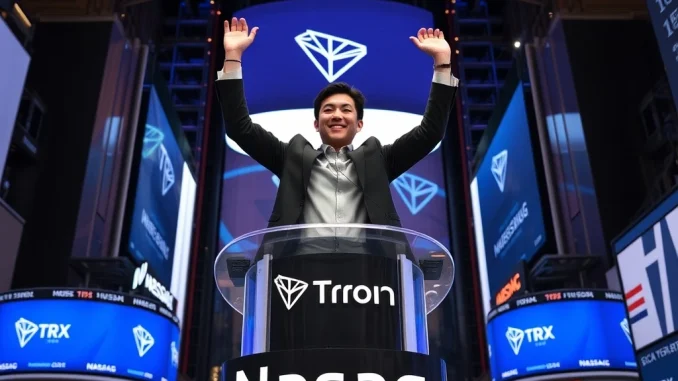
In a truly monumental moment for the cryptocurrency world, Tron Inc. (Nasdaq: TRON) officially rang the opening bell at the Nasdaq Stock Exchange in New York City’s Times Square on July 24, 2025. This landmark event, led by founder and CEO Justin Sun, marks Tron’s evolution from a prominent blockchain platform to a publicly traded entity. The ceremony followed a significant $100 million reverse merger with SRM Entertainment, drawing immense attention from both crypto enthusiasts and institutional investors alike. This bold move underscores Tron’s strategic ambition to bridge the gap between traditional finance and blockchain innovation, showcasing a pivotal step for the entire industry.
Tron Nasdaq Listing: A Monumental Leap for Blockchain Integration
The decision by Tron Nasdaq to go public through a reverse merger is a game-changer, not just for the Tron ecosystem, but for the broader cryptocurrency landscape. This move provides a new level of legitimacy and visibility, potentially attracting a wave of institutional capital that has historically been hesitant to enter the volatile crypto markets. Ringing the Nasdaq bell isn’t merely a ceremonial gesture; it’s a powerful statement about the increasing maturity and acceptance of blockchain technology in mainstream financial systems.
The public listing offers several key benefits:
- Enhanced Credibility: Operating as a publicly traded company on a major exchange like Nasdaq subjects Tron Inc. to stricter regulatory scrutiny and reporting standards, which can foster greater trust among investors.
- Access to Capital: The listing opens new avenues for fundraising, allowing Tron to secure capital from traditional financial markets for further development, expansion, and innovation within its ecosystem.
- Increased Visibility: Being listed on Nasdaq dramatically increases Tron’s exposure to a wider audience, including traditional investors who might not typically engage with cryptocurrencies.
While the week leading up to the event saw a slight decline in the Tron network’s Total Value Locked (TVL) by $136 million, reflecting broader market volatility, the underlying network activity painted a robust picture. The Tron network processed an impressive $2.9 billion in USDT transactions over seven days, with 70% of this volume directed to Binance, signaling potential institutional accumulation.
What Does the $100M Reverse Merger Mean for Tron Inc.?
The $100 million reverse merger with SRM Entertainment is the mechanism that facilitated Tron Inc.’s public debut. Unlike a traditional IPO, a reverse merger allows a private company to become publicly traded by merging with an existing public company. This process can often be faster and less complex than a conventional IPO, making it an attractive option for companies looking to quickly gain public market access.
For Tron, this merger signifies a strategic pivot, transforming it from a purely decentralized blockchain project into a hybrid entity with a foot firmly planted in both the crypto and traditional financial worlds. This move allows Tron to:
- Streamline Operations: Integrate its blockchain innovations within a corporate structure, potentially leading to more efficient governance and resource allocation.
- Expand Reach: Leverage the existing infrastructure and investor base of the public entity to accelerate its growth and adoption.
- Enhance Liquidity: Provide a more liquid market for its shares, which can benefit both existing stakeholders and new investors.
This strategic financial maneuver has certainly positioned Tron for a new phase of growth and integration within the global economy.
TRX Price Surge: How Did Tron Climb to the Top 9 Crypto Market Cap?
In the wake of the Nasdaq announcement, Tron’s native token, TRX price, experienced a significant surge, propelling it to the ninth position in overall crypto market cap. This impressive climb was fueled by a substantial 30% spike in 24-hour trading volume, reaching $1.64 billion. This surge highlights the market’s positive reaction to Tron’s mainstream validation.
Key indicators of TRX’s strength include:
- Stablecoin Dominance: The Tron network now holds an astounding $80 billion in stablecoins, underscoring its role as a preferred network for stablecoin transfers and a hub for digital asset liquidity.
- Net Inflows: Recent weeks have seen $25.7 million in net TRX inflows, indicating strong buying pressure and investor confidence.
- Futures Open Interest: A 19% rise in futures open interest reflects heightened expectations of price volatility and potential further gains for TRX.
While the overall crypto market experiences its ebb and flow, TRX’s performance demonstrates resilience and investor optimism, particularly among large holders (whales) who have been observed accumulating positions ahead of anticipated upgrades and the Nasdaq listing.
Justin Sun’s Vision: Bridging Crypto and Traditional Finance
Justin Sun, the charismatic founder and CEO of Tron, has consistently championed the idea of bridging the gap between decentralized blockchain technology and traditional financial systems. His presence at the Nasdaq bell-ringing ceremony was not just symbolic; it was a testament to his long-term vision materializing.
Sun emphasized the ceremony as “a major step for our community,” underscoring the collective effort behind Tron’s success. Industry observers widely agree that Nasdaq exposure could indeed attract significant institutional capital, particularly from those seeking robust and established blockchain infrastructure. This strategic move aligns with a broader trend of altcoin optimism, as investors increasingly seek undervalued assets amidst evolving macroeconomic conditions.
However, challenges remain. Analysts note that while institutional interest is growing, retail engagement with Tron’s core protocols still lags behind some leading competitors. Maintaining TVL growth will be crucial for sustained momentum. Tron’s ability to capitalize on its newfound visibility, continue ecosystem development, and navigate broader macroeconomic shifts will ultimately determine its long-term success in this exciting new chapter.
A New Era for Tron
Tron Inc.’s Nasdaq debut is more than just a corporate milestone; it’s a significant moment for the entire blockchain industry. By successfully executing a $100 million reverse merger and gaining a listing on one of the world’s most prestigious stock exchanges, Tron has not only elevated its own standing but also paved the way for greater integration of decentralized technologies into mainstream finance. With TRX surging to become the ninth largest cryptocurrency by market cap and substantial activity on its network, the future looks bright for Justin Sun’s ambitious vision. The journey ahead will undoubtedly present challenges, but Tron’s bold step onto the Nasdaq stage signals a powerful commitment to innovation and growth in the evolving digital economy.
Frequently Asked Questions (FAQs)
Q1: What is the significance of Tron Inc. ringing the Nasdaq bell?
A1: Ringing the Nasdaq bell signifies Tron Inc.’s transition to a publicly traded company on a major stock exchange. This enhances its credibility, provides access to traditional capital markets, and increases its visibility to a broader investor base, bridging traditional finance with blockchain technology.
Q2: How did the $100M reverse merger impact Tron (TRX)?
A2: The $100 million reverse merger with SRM Entertainment enabled Tron Inc. to go public quickly. This strategic move led to a significant surge in TRX’s price and trading volume, propelling it to the 9th largest cryptocurrency by market capitalization due to increased investor confidence and market exposure.
Q3: What is the current market position of TRX after the Nasdaq listing?
A3: Following the Nasdaq listing, TRX surged to become the 9th largest cryptocurrency by market capitalization. This was driven by a 30% spike in 24-hour trading volume and strong underlying network activity, including $80 billion in stablecoins on the network and net TRX inflows.
Q4: What challenges does Tron face post-Nasdaq listing?
A4: Despite the positive momentum, Tron faces challenges such as maintaining TVL growth, increasing retail engagement compared to leading protocols, and navigating broader macroeconomic conditions. Sustaining ecosystem development and leveraging its new visibility will be crucial.
Q5: Who is Justin Sun and what is his role in Tron’s Nasdaq debut?
A5: Justin Sun is the founder and CEO of Tron. He led the Nasdaq bell-ringing ceremony, symbolizing his long-term vision to integrate blockchain technology with traditional financial systems. His leadership has been central to Tron’s strategic moves, including the reverse merger and public listing.
Q6: How does Tron’s Nasdaq listing affect the broader crypto market?
A6: Tron’s Nasdaq listing sets a precedent for other blockchain projects seeking mainstream adoption and institutional investment. It signals a growing acceptance of crypto assets in traditional finance, potentially encouraging more institutional capital to flow into the digital asset space and fostering greater market maturity.