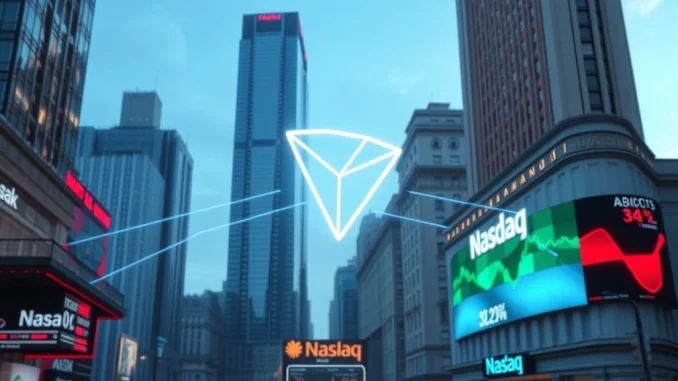
In a groundbreaking move set to redefine the future of digital assets, TRON Inc.’s recent Nasdaq listing, coupled with the establishment of a robust $210 million TRX treasury, signals a monumental leap forward for the entire blockchain industry. This isn’t just news; it’s a powerful statement about the increasing maturity and mainstream acceptance of decentralized technologies. For anyone watching the evolution of finance, the TRON Nasdaq Listing represents a critical juncture where the innovative spirit of crypto meets the stringent demands of traditional markets. But what does this truly mean for TRON, its native token TRX, and the broader landscape of digital finance?
The Strategic Significance of TRON Nasdaq Listing
On July 24, 2025, the cryptocurrency world witnessed a pivotal moment as TRON Inc. (formerly SRM Entertainment) officially marked its presence on Nasdaq. This wasn’t an overnight development but the culmination of a strategic restructuring initiated in July 2023, meticulously aligning the company with Nasdaq’s rigorous regulatory framework. This monumental step positions TRON not just as another blockchain project, but as a crucial bridge connecting the vibrant, decentralized crypto ecosystems with established, institutional financial markets.
- Enhanced Credibility: A Nasdaq listing inherently bestows a level of trust and legitimacy that is often elusive in the nascent crypto space. It signals adherence to strict financial reporting standards and corporate governance.
- Broader Investor Appeal: For traditional investors who might be hesitant to directly engage with volatile cryptocurrencies, TRON Inc. offers a compliant and familiar investment vehicle, significantly expanding its potential investor base.
- Setting a Precedent: TRON’s successful navigation of this process could pave the way for other blockchain projects aspiring to merge with conventional capital markets, accelerating the industry’s maturation.
What Does the $210M TRX Treasury Mean for Stability and Growth?
Beyond the high-profile listing, TRON’s announcement of a substantial TRX Treasury of $210 million is equally impactful. This isn’t merely a reserve; it’s a multi-purpose strategic asset designed to fortify the TRON ecosystem and ensure its long-term viability. Denominated in TRX, this treasury is a testament to TRON’s commitment to self-sustainability and resilience.
The treasury serves several critical functions:
- Liquidity Provision: It provides essential liquidity for developer grants, fostering innovation and attracting top talent to build on the TRON network.
- Price Volatility Mitigation: By strategically managing TRX holdings, the treasury can help mitigate extreme price fluctuations, contributing to greater market stability for investors.
- Funding Strategic Initiatives: This includes potential acquisitions, strategic partnerships, and investments in cutting-edge technologies that can further enhance the TRON ecosystem.
- Community Engagement: The treasury can be utilized to incentivize community participation through staking rewards and other engagement programs, strengthening the decentralized governance model.
Analysts suggest that this proactive approach to treasury management creates a robust, self-sustaining ecosystem capable of adapting to various market conditions, ultimately bolstering TRON’s long-term prospects.
Pioneering Blockchain-Traditional Finance Integration
The dual announcement of the Nasdaq listing and the TRX treasury underscores a significant trend: the accelerating Blockchain-Traditional Finance Integration. This isn’t just about cryptocurrencies gaining legitimacy; it’s about reshaping the very infrastructure of global finance.
TRON’s move is a powerful example of how blockchain projects can:
- Reduce Barriers to Entry: By adhering to stringent financial reporting standards, TRON makes it easier for traditional institutions to understand, trust, and invest in blockchain innovation without navigating complex crypto-native processes.
- Unlock Capital Inflows: Compliance with regulated markets opens the floodgates for institutional capital, which has historically been hesitant to enter the less-regulated crypto space. This influx of capital can fuel further development and adoption across the industry.
- Set Industry Standards: TRON is effectively pioneering a model for how decentralized technology can coexist and thrive within traditional financial frameworks, potentially influencing other projects to follow suit.
This strategic alignment represents a crucial step towards a future where decentralized finance (DeFi) and traditional finance (TradFi) are not separate silos but integrated components of a more efficient and inclusive global financial system.
The Surge in Institutional Crypto Adoption
One of the most profound implications of TRON’s strategic shift is its potential to significantly boost Institutional Crypto Adoption. For years, institutions have eyed the crypto market with a mix of curiosity and caution. Concerns over regulation, volatility, and lack of familiar investment vehicles have been major deterrents. TRON’s Nasdaq listing directly addresses these concerns.
COINOTAG highlights that TRON’s appeal to institutional investors has surged, positioning it as a key player at the evolving intersection of regulated markets and decentralized finance. By operating within a recognized regulatory framework, TRON reduces the perceived risk for large-scale investors, making it a more attractive proposition than many purely decentralized entities. This could lead to a domino effect, encouraging more institutions to explore and invest in other compliant blockchain projects.
Fueling TRON Ecosystem Growth: What’s Next for TRX?
The rebranding and treasury strategy have significant implications for TRX, TRON’s native cryptocurrency, and the broader TRON Ecosystem Growth. Increased institutional and retail interest, combined with the treasury-driven market stability, could lead to elevated demand for TRX and enhanced robustness of the entire ecosystem.
While direct price correlations always remain subject to market dynamics, the strategic interventions and dedicated funding for dApp, DeFi, and NFT innovations position TRX to thrive in an increasingly competitive landscape. The treasury’s ability to fund developer grants and incentivize community engagement directly contributes to the creation of more utility and value within the TRON network, fostering a virtuous cycle of growth and adoption.
Navigating the Road Ahead: Challenges and Opportunities
Despite these monumental strides, TRON faces inherent challenges at the intersection of decentralized governance and centralized regulation. Balancing Nasdaq’s stringent compliance requirements with TRON’s core ethos of decentralization will require careful and continuous governance. Additionally, the inherent volatility of crypto markets, though mitigated by the treasury, still poses risks for traditional investors unfamiliar with such dynamics.
However, TRON’s enhanced public profile and significant financial resources position it uniquely to attract top talent, drive innovation, and potentially influence the broader blockchain ecosystem positively. This bold step towards mainstream blockchain adoption sets a powerful precedent, fostering institutional trust and ecosystem growth.
In conclusion, TRON Inc.’s Nasdaq listing and the strategic $210 million TRX treasury represent a transformative period for the company and the blockchain industry as a whole. By leveraging Nasdaq’s established infrastructure, TRON is pioneering a viable model for integrating decentralized technology with traditional finance, opening doors for unprecedented institutional trust and accelerating ecosystem growth. This milestone underscores TRON’s ambition to redefine the future of finance through strategic compliance and relentless innovation.
Frequently Asked Questions (FAQs)
Q1: What is the significance of TRON Inc. listing on Nasdaq?
The TRON Inc. Nasdaq listing is significant because it positions TRON as a compliant investment vehicle within traditional financial markets. This enhances TRON’s credibility, attracts traditional investors who might otherwise avoid direct crypto exposure, and sets a precedent for other blockchain projects seeking mainstream integration and institutional crypto adoption.
Q2: How does the $210 million TRX treasury benefit the TRON ecosystem?
The $210 million TRX treasury serves multiple purposes: it provides liquidity for developer grants, helps mitigate TRX price volatility, supports strategic acquisitions, and incentivizes community engagement through staking rewards. This strengthens TRON’s long-term viability by creating a self-sustaining ecosystem capable of adapting to market fluctuations and fueling TRON ecosystem growth.
Q3: How does this move impact Blockchain-Traditional Finance Integration?
TRON’s Nasdaq listing and treasury strategy significantly advance Blockchain-Traditional Finance Integration by demonstrating how decentralized technology can adhere to stringent financial reporting standards. This reduces barriers for traditional investors, potentially unlocking substantial capital inflows and accelerating the maturation of the crypto industry while maintaining decentralized principles.
Q4: Will the Nasdaq listing affect the price of TRX?
While direct price correlations are always subject to market uncertainty, increased institutional and retail interest stemming from the Nasdaq listing, coupled with treasury-driven market stability, could elevate TRX’s demand and ecosystem robustness. The strategic funding for dApp, DeFi, and NFT innovations also positions TRX to thrive, though market volatility remains a factor.
Q5: What challenges does TRON face with this integration?
TRON faces challenges in balancing Nasdaq’s centralized regulatory compliance requirements with its core ethos of decentralized governance. Additionally, the inherent volatility of crypto markets poses risks for traditional investors who may be unfamiliar with such dynamics, requiring careful management and communication.