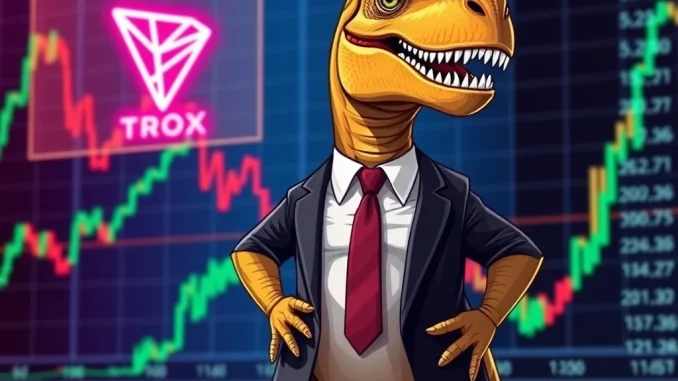
The world of digital assets is constantly evolving, and a recent development has sent ripples of excitement and discussion across the crypto community: T-Rex, a notable player in the financial sector, has officially filed for a 2x leveraged Tron (TRX) Exchange Traded Fund (ETF). This groundbreaking move, first highlighted by Bloomberg ETF analyst Eric Balchunas on X, marks a significant step for both the Tron ecosystem and the broader landscape of crypto investment products.
Understanding the `Leveraged ETF` Landscape: What Does 2x Mean?
For those new to the intricacies of financial instruments, a leveraged ETF is designed to deliver returns that are a multiple of the underlying asset’s daily performance. In this case, a 2x leveraged Tron ETF would aim to provide twice the daily return of Tron (TRX).
Here’s a quick breakdown of what that entails:
Magnified Returns: If Tron’s price increases by 1% in a day, a 2x leveraged Tron ETF would theoretically aim to return 2% for that day, before fees and expenses.
Magnified Losses: Conversely, if Tron’s price drops by 1%, the leveraged ETF would aim to lose 2% of its value. This amplified effect is why leveraged products are considered higher risk.
Daily Reset: Leveraged ETFs typically reset their leverage daily. This means their performance over longer periods (weeks, months, or years) can significantly deviate from simply multiplying the underlying asset’s long-term return due to compounding effects.
These products are often favored by experienced traders looking to capitalize on short-term market movements, but they come with inherent complexities and elevated risks.
`T-Rex` Ventures into `TRX` Territory: Who Are They?
The name ‘T-Rex’ might conjure images of dinosaurs, but in the financial world, it signifies a firm making a bold foray into new territory. While specific details about ‘T-Rex’ in this context are emerging, their filing for a leveraged Tron ETF indicates a strategic interest in expanding the accessibility of digital assets through regulated financial products.
Why is T-Rex’s involvement significant for TRX?
Institutional Validation: A filing from a recognized entity like T-Rex lends a degree of institutional credibility to Tron, signaling that mainstream financial players are increasingly viewing crypto assets as viable investment vehicles.
Market Maturity: The introduction of more complex financial products like leveraged ETFs suggests a maturing market. It indicates that the crypto ecosystem is evolving beyond simple spot trading to offer diverse investment strategies.
Regulatory Navigation: T-Rex’s willingness to navigate the regulatory landscape for a leveraged crypto product highlights a growing effort to bridge the gap between traditional finance and decentralized assets.
The `Tron ETF` and Its Market Implications: A New Era for `TRX`?
The prospect of a Tron ETF, particularly a leveraged one, could have several far-reaching implications for TRX and the broader crypto market. Tron, spearheaded by Justin Sun, has established itself as a significant blockchain platform, focusing on decentralized applications (dApps), smart contracts, and a robust ecosystem for content creators and entertainment.
Here’s how a Tron ETF could impact the market:
Increased Accessibility: An ETF makes it easier for traditional investors to gain exposure to TRX without directly buying and holding the cryptocurrency. This could attract a new wave of capital from institutional investors, wealth managers, and retail investors who prefer regulated investment vehicles over direct crypto purchases.
Enhanced Liquidity: As more capital flows into the ETF, it could indirectly increase the liquidity of TRX on exchanges, potentially leading to more stable price discovery.
Mainstream Adoption: The availability of a Tron ETF on traditional exchanges could further legitimize TRX in the eyes of the mainstream financial community, fostering greater trust and potentially accelerating its adoption.
However, it’s crucial to remember that regulatory approval is not guaranteed. The SEC and other financial regulators have historically been cautious about approving crypto ETFs, especially those with leverage, citing concerns about market manipulation, volatility, and investor protection.
Boosting `Crypto Investment` Accessibility: A Broader Trend
The filing for a leveraged Tron ETF is part of a larger trend towards making crypto investment more accessible through traditional financial products. We’ve seen the approval of Bitcoin spot ETFs in the US, and there’s ongoing discussion around Ethereum ETFs. These developments collectively indicate a shift in how financial institutions and regulators view digital assets.
For many investors, ETFs offer:
Simplicity: No need to manage private keys, understand blockchain wallets, or navigate complex crypto exchanges.
Familiarity: Trading an ETF is similar to trading stocks, a familiar process for many traditional investors.
Regulatory Oversight: ETFs operate within regulated frameworks, offering a perceived layer of security and investor protection.
While this move by T-Rex focuses on a leveraged product, it underscores the persistent demand for diverse avenues for crypto exposure. It highlights the growing conviction that digital assets, including Tron, are here to stay and will increasingly integrate with traditional finance.
What’s Next for the Tron ETF?
The journey from filing to approval for a Tron ETF is often a lengthy and rigorous one. Regulators will scrutinize every aspect of the proposed ETF, from its underlying asset management to its risk disclosures and market surveillance mechanisms. The outcome is far from certain, but the filing itself sends a powerful signal.
If approved, a 2x leveraged Tron ETF could open new doors for sophisticated investors to express their views on TRX’s price movements. It would also further solidify Tron’s position as a prominent blockchain in the eyes of institutional finance. Regardless of the approval timeline, this filing is a testament to the relentless innovation and growing acceptance within the broader crypto investment landscape.
The move by T-Rex for a 2x leveraged Tron ETF is more than just a news headline; it’s a marker of how far the crypto market has come and a glimpse into its potential future. As the industry continues to mature, we can expect to see more creative and complex financial products emerge, bridging the gap between traditional finance and the decentralized world.
Frequently Asked Questions (FAQs)
Q1: What is a 2x leveraged Tron ETF?
A 2x leveraged Tron ETF is an Exchange Traded Fund designed to provide daily returns that are approximately two times the daily performance of Tron (TRX). If TRX goes up 1% in a day, the ETF aims to go up 2% (before fees); if TRX goes down 1%, the ETF aims to go down 2%.
Q2: Who is T-Rex, and why is their filing for a leveraged Tron ETF significant?
T-Rex is a financial entity that has submitted a filing for this specific ETF. Their involvement is significant because it represents a traditional financial player seeking to offer a complex crypto-related product, indicating growing institutional interest and a move towards greater integration of crypto assets into mainstream finance.
Q3: What are the main risks associated with a leveraged ETF like the proposed Tron ETF?
The main risks include amplified losses (if the underlying asset moves against your position, losses are doubled), the effect of daily rebalancing (which can lead to significant deviation from expected returns over longer periods, especially in volatile markets), and the potential for rapid decay in value during extended periods of sideways trading or high volatility.
Q4: How does a Tron ETF benefit crypto investment accessibility?
A Tron ETF simplifies crypto investment for traditional investors by allowing them to gain exposure to TRX through a familiar, regulated financial product traded on stock exchanges, without the need to directly manage cryptocurrencies, wallets, or navigate complex crypto exchanges.
Q5: What is the likelihood of this 2x leveraged Tron ETF being approved?
The approval of any crypto ETF, especially a leveraged one, depends heavily on regulatory bodies like the SEC. While the landscape for crypto ETFs is evolving (e.g., Bitcoin spot ETF approvals), leveraged products face higher scrutiny due to their inherent risks. The outcome is uncertain and subject to a rigorous review process.
Q6: What is TRX, and what is its primary use case?
TRX is the native cryptocurrency of the Tron blockchain. Tron is a decentralized platform focused on dApps, smart contracts, and a robust ecosystem for content creators and entertainment. TRX is used for transactions, paying fees, and participating in governance within the Tron network.