The world of finance is constantly evolving, and the line between traditional banking and decentralized blockchain technology is blurring faster than ever. For those watching the crypto space, the news of major financial players like Goldman Sachs and BNY Mellon embracing blockchain is a clear signal of mainstream adoption. They’ve just launched a groundbreaking solution: Tokenized Money Market Funds with real-time settlements, a move set to reshape institutional investment.
Unveiling Tokenized Money Market Funds: What’s the Big Deal?
Money market funds (MMFs) are a cornerstone of institutional finance, offering low-risk liquidity. Traditionally, transactions involving these funds can take one to three business days to settle. This delay, while seemingly minor, impacts efficiency and capital utilization. Enter tokenization – the process of representing real-world assets as digital tokens on a blockchain.
Goldman Sachs and BNY Mellon’s new initiative introduces fractional shares of MMFs accessible via a decentralized ledger system. This means sophisticated investors can now manage these shares in real time, dramatically enhancing liquidity and transparency. The solution utilizes Goldman’s private blockchain infrastructure, known as the Digital Asset Platform (GS DAP), and BNY Mellon’s robust custody capabilities. This allows for 24/7 trading and near-instant settlements, a significant leap forward from the traditional model.
Key benefits of this innovative approach include:
- Enhanced Liquidity: Fractional ownership and real-time access free up capital faster.
- Increased Transparency: Blockchain provides an immutable and auditable record of ownership.
- Improved Efficiency: Near-instant settlements eliminate multi-day delays.
- 24/7 Access: Trading is no longer confined to traditional business hours.
The system mirrors existing fund structures, ensuring compliance with regulatory frameworks while offering the flexibility of digital assets. Initial participants, including Dreyfus (a BNY subsidiary), Federated Hermes, Fidelity Investments, and Goldman Sachs Asset Management, are already issuing tokenized versions of their MMFs, with BNY Mellon maintaining ownership records on the blockchain.
The Transformative Power of Blockchain Settlements
At the heart of this innovation lies the power of Blockchain Settlements. Traditional settlement processes involve multiple intermediaries, manual reconciliation, and significant delays. Blockchain streamlines this by providing a single, shared ledger that updates instantly, ensuring all parties have access to the same, verified information simultaneously.
While the initiative does not introduce new tokens in the speculative sense, it digitizes the access and settlement mechanisms for existing fund shares. This minimizes regulatory hurdles while powerfully demonstrating blockchain’s potential to streamline asset servicing. Ethereum remains central to this tokenization infrastructure, underpinning the secure and efficient transfer of ownership records.
The move also aligns with broader industry trends, particularly following the U.S. adoption of the GENIUS Act, which provided much-needed regulatory clarity for stablecoins and, by extension, other forms of digital assets. This legislative development has encouraged traditional institutions to experiment with digital assets, paving the way for solutions like these to gain traction.
The Strategic Alliance: Goldman Sachs BNY Mellon Leading the Charge
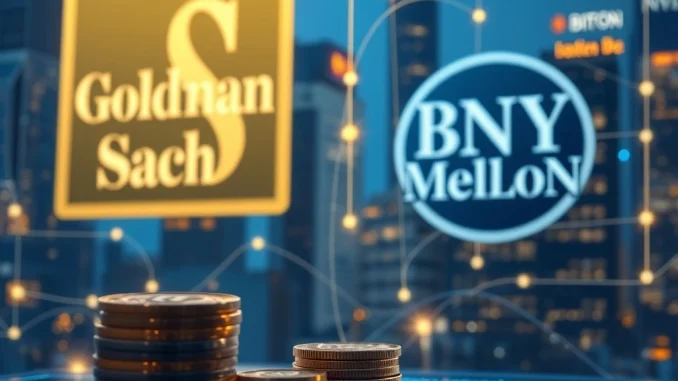
The collaboration between Goldman Sachs BNY Mellon represents a formidable alliance. Goldman Sachs brings its digital asset expertise and proprietary blockchain platform (GS DAP) to the table, while BNY Mellon contributes its unparalleled leadership in custody services and its extensive LiquidityDirect platform. This partnership is strategically positioned to capture a growing share of the immense $7 trillion fund market.
Laide Majiyagbe, BNY Mellon’s Head of Liquidity, Funding, and Collateral, emphasized this initiative as a “first step in the transition toward a digital, real-time financial architecture,” highlighting its scalability and security. George Zarya, Goldman Sachs’ Global Head of Digital Assets, underscored blockchain’s utility, particularly in collateral management, foreseeing enhanced transferability of tokens as collateral in the future. Caroline Butler, BNY Mellon’s Global Head of Liquidity, expressed pride in pioneering this initiative, which has the potential to reshape global asset management through blockchain-based fund settlement.
This combined strength allows them to tackle long-standing inefficiencies in asset liquidity, providing institutional clients with more flexible and responsive investment tools.
Institutional Digital Assets: Paving the Way for Future Finance
This groundbreaking launch signals a significant leap for Institutional Digital Assets. It demonstrates that major financial players are not just observing the digital asset space but actively integrating it into their core operations. The focus here is on leveraging blockchain for its utility in improving existing financial processes, rather than on speculative trading.
The success of this model for money market funds could very well influence its adoption across other asset classes. Imagine a future where bonds, real estate, or even private equity are tokenized, allowing for similar gains in liquidity and efficiency. This initiative reinforces Ethereum’s role as a robust and reliable platform for institutional asset settlement, proving its enterprise-grade capabilities.
Achieving Real-Time Settlements: Challenges and the Road Ahead
While the promise of Real-Time Settlements is immense, challenges remain. Interoperability between different blockchain networks and traditional financial systems is a key hurdle that requires ongoing development. Furthermore, market education is crucial to ensure broad understanding and adoption among institutional clients who are accustomed to traditional workflows.
Despite these challenges, analysts widely believe that this model’s success could pave the way for broader tokenization across the financial industry. The ability to use tokenized assets for collateral management, as highlighted by Goldman Sachs, opens up new avenues for capital efficiency and risk management. This partnership is a clear indicator of the financial industry’s accelerating shift towards a more digitized, efficient, and interconnected future.
In conclusion, Goldman Sachs and BNY Mellon’s introduction of tokenized money market funds with blockchain real-time settlements is a pivotal moment for institutional finance. It marks a decisive step towards integrating advanced digital ledger technology into traditional financial products, promising enhanced liquidity, transparency, and efficiency. This collaboration not only addresses current market inefficiencies but also lays a robust foundation for the future of institutional digital assets, demonstrating the transformative potential of blockchain beyond cryptocurrencies.
Frequently Asked Questions (FAQs)
Q1: What are Tokenized Money Market Funds?
Tokenized Money Market Funds are traditional money market funds whose shares are represented as digital tokens on a blockchain. This allows for fractional ownership, real-time access, and near-instant settlements, enhancing liquidity and transparency compared to conventional MMFs.
Q2: How do Blockchain Settlements differ from traditional settlements?
Traditional settlements typically involve multiple intermediaries and can take one to three business days to finalize. Blockchain settlements, on the other hand, use a decentralized ledger to record transactions instantly and immutably, enabling near real-time transfers and reducing delays and manual reconciliation.
Q3: What role does Ethereum play in this initiative?
Ethereum serves as the underlying blockchain infrastructure for the tokenization and settlement mechanisms. While the initiative doesn’t introduce new cryptocurrencies, it leverages Ethereum’s robust and secure network to facilitate the digital representation and transfer of money market fund shares.
Q4: What are the main benefits for institutional investors?
Institutional investors benefit from enhanced liquidity, 24/7 access to their funds, improved transparency through immutable blockchain records, and significantly faster settlement times (near-instant) compared to the traditional multi-day process.
Q5: Will this initiative affect other asset classes?
Analysts believe that the success of tokenized money market funds could serve as a blueprint for the tokenization of other asset classes, such as bonds, real estate, and private equity. This could lead to broader adoption of institutional digital assets and further revolutionize financial markets.
Q6: What is the significance of the Goldman Sachs BNY Mellon partnership?
This partnership combines Goldman Sachs’ expertise in digital assets and blockchain technology with BNY Mellon’s extensive experience in custody services and asset management. It represents a powerful collaboration between two financial giants, signaling a major step towards mainstream adoption of blockchain in institutional finance and positioning them to capture a significant share of the digital asset market.